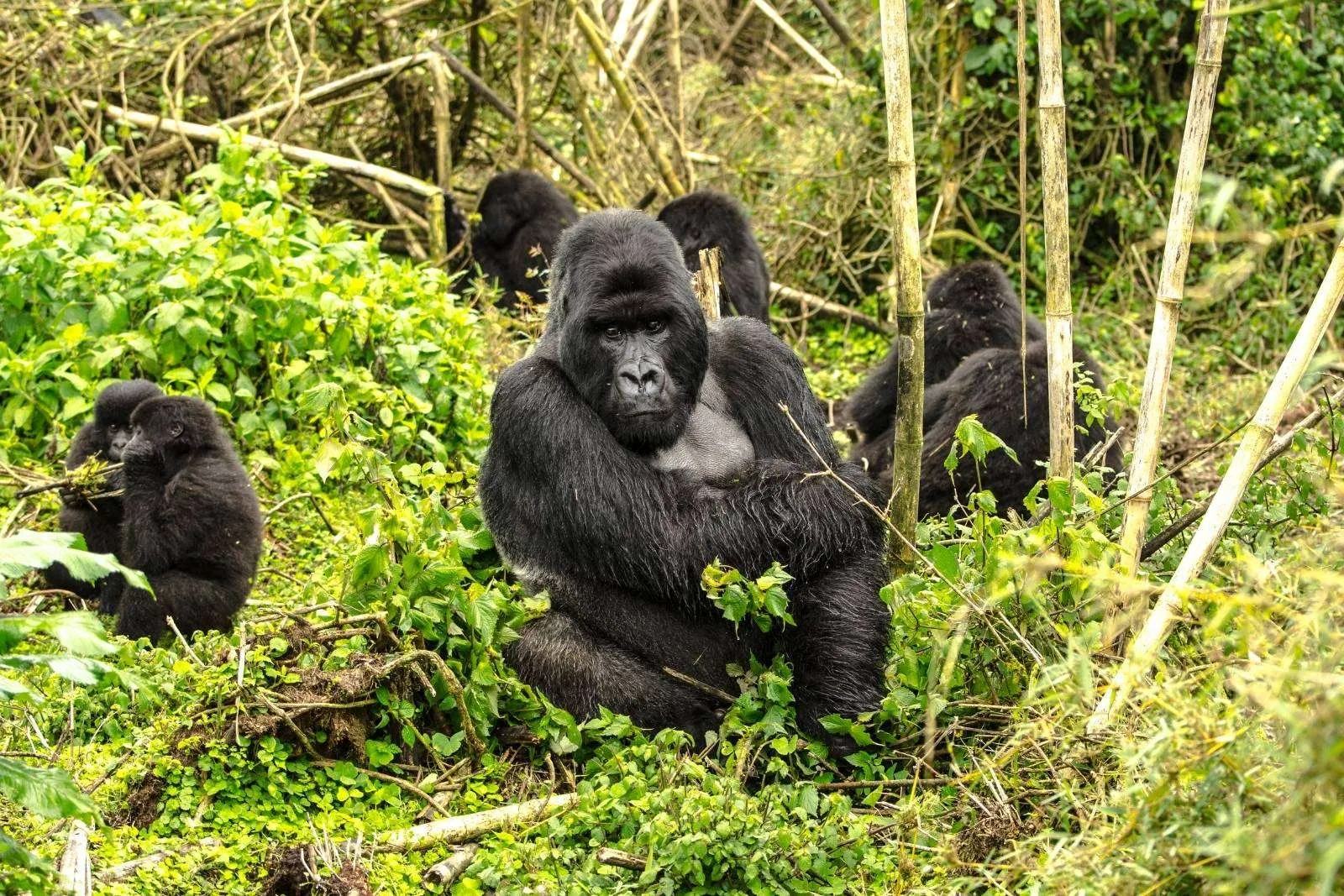
Gorillas of Bwindi
Close Encounters: Trekking With the Gentle Giants of Bwindi
There’s a moment in the misty rainforest of Bwindi that stops time.
It happens when the crashing of undergrowth falls silent. When your guide whispers, “They’re here.” And suddenly, through the emerald tangle of leaves, you see them—a pair of deep, intelligent eyes staring back at you from behind a curtain of vines.
This isn’t a zoo. There are no barriers, no glass, no separation between you and one of our closest living relatives. You’re a visitor in their living room, and they’re allowing you to stay.
The Impenetrable Forest
Bwindi Impenetrable National Park lives up to its name. Tucked in the southwestern corner of Uganda, this ancient rainforest has been growing for over 25,000 years. It’s a Jurassic-looking landscape of tangled vines, giant ferns, and trees that pierce the persistent mist.
But Bwindi’s real treasure isn’t its botanical wonders. It’s home to roughly half of the world’s remaining mountain gorillas—just over 400 individuals, scattered across 19 habituated families.
The Trek
The morning starts early. You assemble at the park headquarters, nervous energy bouncing between the eight strangers who will become your trekking companions. After a briefing from the Uganda Wildlife Authority rangers, you’re assigned to a gorilla family based on your fitness level and, admittedly, a bit of luck.
Some treks last 30 minutes. Others stretch into six hours of scrambling up muddy slopes, sliding down ravines, and pushing through vegetation that seems determined to keep its secrets.
Our group was assigned to the Mubare family, the first group habituated for tourism in Bwindi back in 1993. We were told the trek would be “moderate.” This turned out to be optimistic.
Two hours in, my lungs burned at 2,500 meters. My boots weighed triple their original mass, coated in sticky red mud. The porters—local men who navigate these slopes like mountain goats—practically carried me up the final ascent.
And then, silence.
The Hour
You get exactly one hour with them. It sounds short. It feels like an eternity.
The silverback emerged first. His name was Ruhondeza, though he passed away in 2012. On this day, he was very much alive and very much in charge. He sat with the dignity of an elder statesman, casually stripping bark from a branch while assessing our group with sideways glances. His silver saddle marked him as the patriarch, the decision-maker, the protector.
Then came the others. A juvenile somersaulted down the slope, crashing into his mother who swatted him absently. Two females groomed each other with fastidious care, their long fingers working through black fur with surgical precision. An adolescent male watched us with undisguised curiosity, inching closer until a ranger gently signaled him back.
At one point, a youngster no more than three years old decided our group was more interesting than his lunch. He climbed onto a low-hanging vine, swung gently, and stared directly into my lens. For a breathless minute, we were two young primates, separated by 8 million years of evolution, sharing a moment of pure mutual curiosity.
Why This Matters
Mountain gorillas have made an extraordinary comeback. In the 1980s, scientists feared they’d be extinct by the year 2000. Poaching, habitat loss, and civil unrest had pushed their numbers below 300. Today, thanks to decades of conservation work and community engagement, the population hovers around 1,000.
Gorilla tourism is the engine driving this recovery. Permits are expensive—$700 in Uganda—but that money flows directly back into conservation and local communities. A single gorilla family can generate over $1 million annually in permit revenue alone, creating powerful economic incentives to keep these animals alive and protected.
The Batwa pygmies, displaced from Bwindi when it became a national park, now work as porters, trackers, and cultural performers. Villages near the park have built schools and clinics with tourism revenue. Poachers have become park rangers.
This is conservation that works.
Leaving the Forest
The hour dissolved like morning mist. When the ranger signaled our time was up, I felt a physical ache at leaving. The gorillas paid no attention to our departure—they had more pressing matters, like a particularly tasty patch of wild celery.
The trek down was slippery and silent. Nobody spoke much. What could we say?
Back at the lodge that evening, I scrubbed mud from my boots and stared at my photographs. They were inadequate. No image could capture the weight of that silverback’s gaze, the absurd tenderness of watching a 400-pound male nibble leaves next to his sleeping infant, the profound recognition that passes between species when the last barrier drops away.
The gorillas of Bwindi don’t need us. They’ve survived for millennia in this misty fortress, through wars and environmental upheaval and the relentless expansion of our own species. But they tolerate us. And if we’re wise enough to remain worthy of that tolerance, they might just survive another 25,000 years.