Short answer: Rubaga Cathedral, officially St. Mary’s Cathedral, stands on Rubaga Hill in western Kampala and is the seat of the Catholic Archbishop of Kampala. Construction began in 1914 and the brick church was consecrated in 1925. It is open to visitors outside services, but we found no published hours or fees.
Last updated: 29 October 2026. Confirm visiting times with the cathedral office before you go.
Rubaga Cathedral is the mother church of Catholic Uganda. It sits on the hill where the first missionaries settled, close to the heart of Buganda’s history. This guide explains its history, what you can see around it and how to include it in a Kampala pilgrimage.
History of Rubaga Cathedral
The White Fathers arrived at Rubaga in 1879, and in 1889 Kabaka Mwanga II gave the hill to the mission. After the Uganda Martyrs were killed in 1885 to 1887, the first bishop, Henry Streicher, proposed in 1901 a cathedral that would show Uganda as the land of the martyrs.
Building began in 1914 and took 11 years, funded in part by donations from Catholic congregations abroad. The cathedral was consecrated in 1925, so it marked its 100th anniversary in 2025. Accounts differ on the month, so we give only the year.
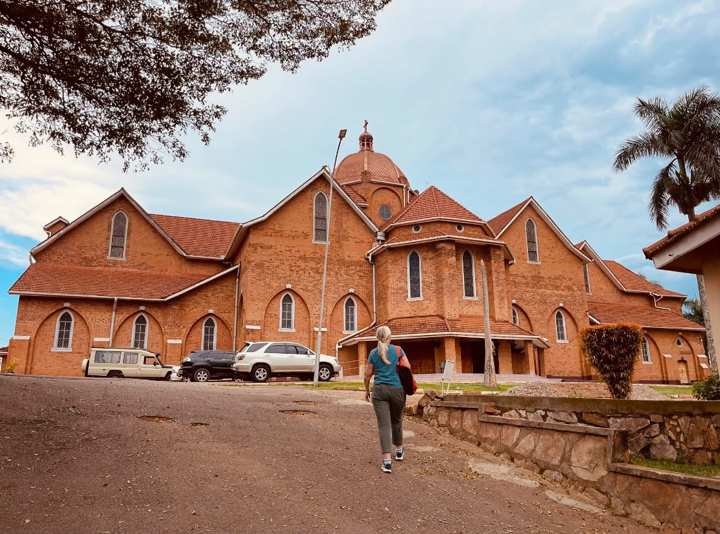
Rubaga Cathedral key facts
| Detail | Fact |
|---|---|
| Official name | St. Mary’s Cathedral, Rubaga |
| Location | Rubaga Hill, Lubaga Division, western Kampala, about 3 km from the centre |
| Construction | Began 1914 |
| Consecrated | 1925 |
| Material | Brick |
| Role | Seat of the Catholic Archbishop of Kampala |
| Renovation | 1993, ahead of the visit of Pope John Paul II |
What to see on Rubaga Hill
The cathedral is described as Romanesque in style, with stained-glass windows showing saints. Sunday Mass draws large crowds, and visitors of any faith come to see the architecture outside service times.
The wider mission complex includes Lubaga Hospital, a 300-bed community hospital run by the archdiocese, and the Lubaga campus of Uganda Martyrs University. Cardinal Emmanuel Kiwanuka Nsubuga, the first Ugandan cardinal (named in 1976), and Bishop Joseph Kiwanuka are buried at the Rubaga mission. Ask the cathedral office which graves can be visited.
How to visit Rubaga Cathedral
- Confirm hours. We did not find published opening hours or fees.
- Avoid service times unless you plan to attend Mass.
- Dress modestly and keep your voice low inside.
- Ask before photographing worshippers.
See our Uganda dress code guide for what to wear.
Combine Rubaga with other Kampala sites
Rubaga sits close to Namirembe Cathedral, the Anglican counterpart, and both fit into one day of Kampala churches and cathedrals. For the martyrs’ story, add the Munyonyo Martyrs Shrine and Namugongo. Cathedral visits can be added to our 5-day multi-faith pilgrimage on request. See all trips under religious tourism in Uganda.
Rubaga Cathedral FAQs
Is Rubaga Cathedral open to visitors?
Yes. People of any faith visit outside service times to see the architecture. We found no published hours or fees, so confirm with the cathedral office first.
When was Rubaga Cathedral built?
Construction began in 1914 and the cathedral was consecrated in 1925. It was built of brick, partly with donations from Catholic congregations abroad.
Who is buried at Rubaga?
Cardinal Emmanuel Kiwanuka Nsubuga and Bishop Joseph Kiwanuka are buried at the Rubaga mission. Ask the cathedral office which graves visitors can see.
Why is Rubaga Cathedral important?
It is the seat of the Archbishop of Kampala. The cathedral was planned after the martyrdoms of 1885 to 1887 as a church that shows Uganda as the land of the martyrs.
Can I visit Rubaga Cathedral on a guided tour?
Yes, we can add it to a Kampala faith tour. Request a free quote.
Plan This Trip With Afraeka Adventures
Turn this guide into a real itinerary. Our local team plans your dates, transport and guides around your group.
About the author: Victoria Kayaga
Victoria Kayaga is a Ugandan-born safari expert and the founder of Afraeka Adventures, with over 7 years of experience in the East African tourism industry. She specializes in gorilla trekking, wildlife safaris and multi-country itineraries across Uganda, Rwanda, Kenya and Tanzania.