Last updated: 29 September 2026. Rates and availability are set by UWA and subject to change — confirm before booking.
Short answer: A 6 day gorilla and golden monkey safari combines two gorilla treks — one at Bwindi Impenetrable National Park and one at Mgahinga Gorilla National Park — with a golden monkey trek in Mgahinga’s bamboo zone. The route runs from Kampala to Bwindi, transfers to Mgahinga, runs the golden monkey trek and the second gorilla trek on consecutive days, then returns to Kampala. Two permits per trekker are required for the gorilla treks, plus a golden monkey permit. It is the format for travellers who want to trek gorillas twice in two different parks, and it is the only multi-primate route that includes a trek accessible to children aged 12 and over.
Most gorilla itineraries involve a single trek. The traveller flies or drives to Bwindi or Mgahinga, treks once, and leaves. The 6 day gorilla and golden monkey safari is built around a different idea — that two gorilla treks, in two different parks with two different habituated families, deliver something a single trek cannot. Bwindi’s family is one of several groups spread across four trekking sectors, and Nyakagezi at Mgahinga is the only habituated family in Uganda’s smallest national park. The two experiences feel genuinely different, and the golden monkey trek in between adds a third primate species to the trip.
This guide covers what a 6 day gorilla and golden monkey safari actually involves — the day-by-day route, how the Bwindi and Mgahinga treks differ, how the golden monkey trek fits alongside the gorilla treks, the transfers between the two parks, and who the format suits. It is a companion to our guides on the two-day gorilla trekking format and on golden monkey trekking at Mgahinga. Permit categories and current rates for all primate treks sit on the gorilla permits Uganda page. The regulatory framework for Uganda’s protected areas is published by the Uganda Wildlife Authority.
6 day gorilla and golden monkey safari — key facts
- Route: Kampala → Bwindi → Mgahinga → Kampala
- Gorilla treks: Two — one at Bwindi, one at Mgahinga
- Golden monkey trek: One — at Mgahinga
- Distance from Kampala: 8–9 hours each way to the Bwindi and Mgahinga area
- Bwindi to Mgahinga: 1–2 hours depending on the Bwindi sector
- Minimum age: 15 for gorilla trekking; 12 for golden monkey trekking
- Best season: Dry months (Dec–Feb, June–Sept) for easier trails and firmer roads
- Best for: Travellers wanting a second gorilla trek, families with children aged 12–14, and primate-focused trips
What is a 6 day gorilla and golden monkey safari?
A 6 day gorilla and golden monkey safari is a six-day road itinerary that combines two gorilla treks with a golden monkey trek in Uganda’s extreme south-west. The two gorilla treks take place in two different parks — Bwindi Impenetrable National Park and Mgahinga Gorilla National Park — and the golden monkey trek runs in Mgahinga’s bamboo zone.
Three things define the format:
- Two separate gorilla permit bookings. Bwindi and Mgahinga operate separate permit allocations. Each trekker needs one Bwindi permit and one Mgahinga permit, booked individually and both paid in full at booking. The two permits are non-transferable between parks.
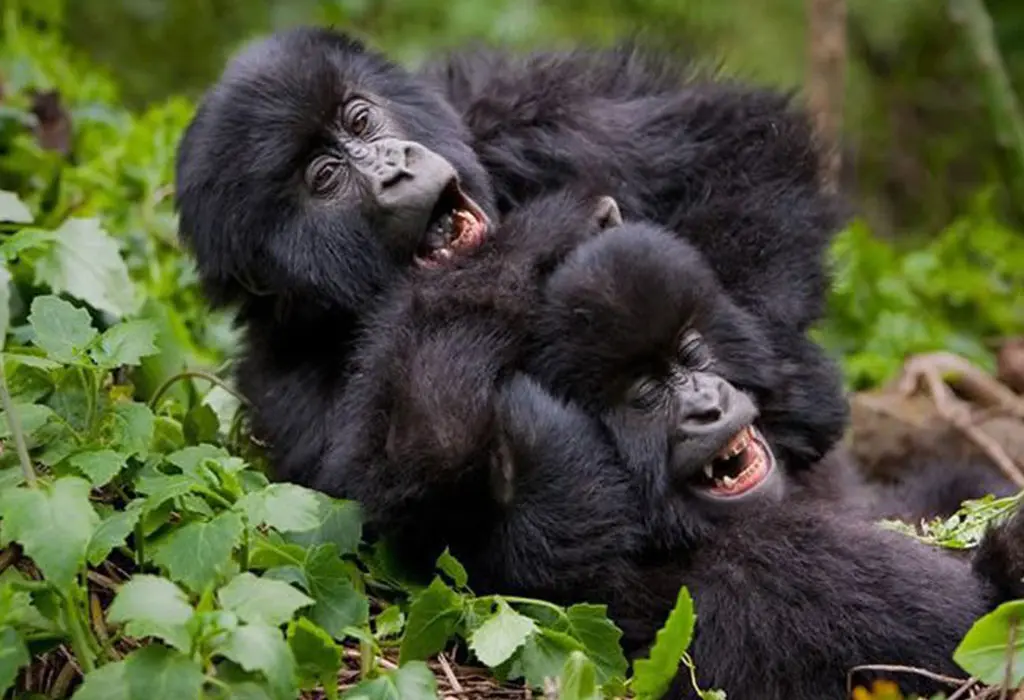
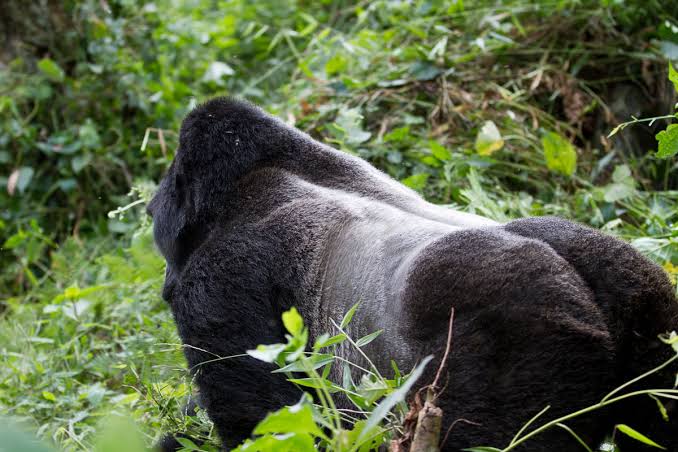
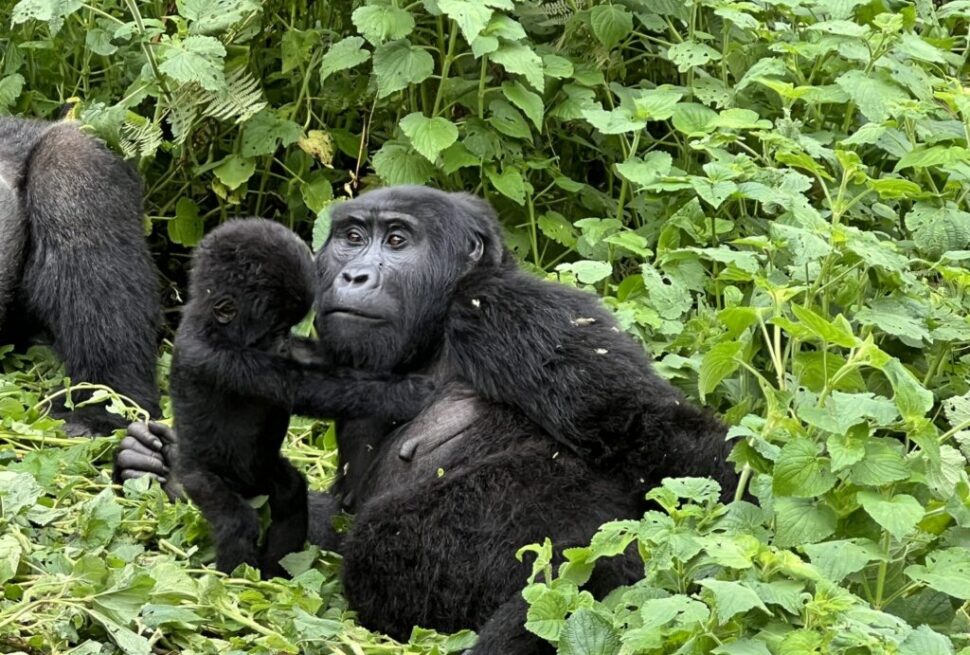
- Two different habituated families. Bwindi has multiple habituated families across four trekking sectors, and the family you are assigned depends on which sector you book. Mgahinga has one habituated family — Nyakagezi — and every Mgahinga trek is with that group. The two treks deliver genuinely different encounters.
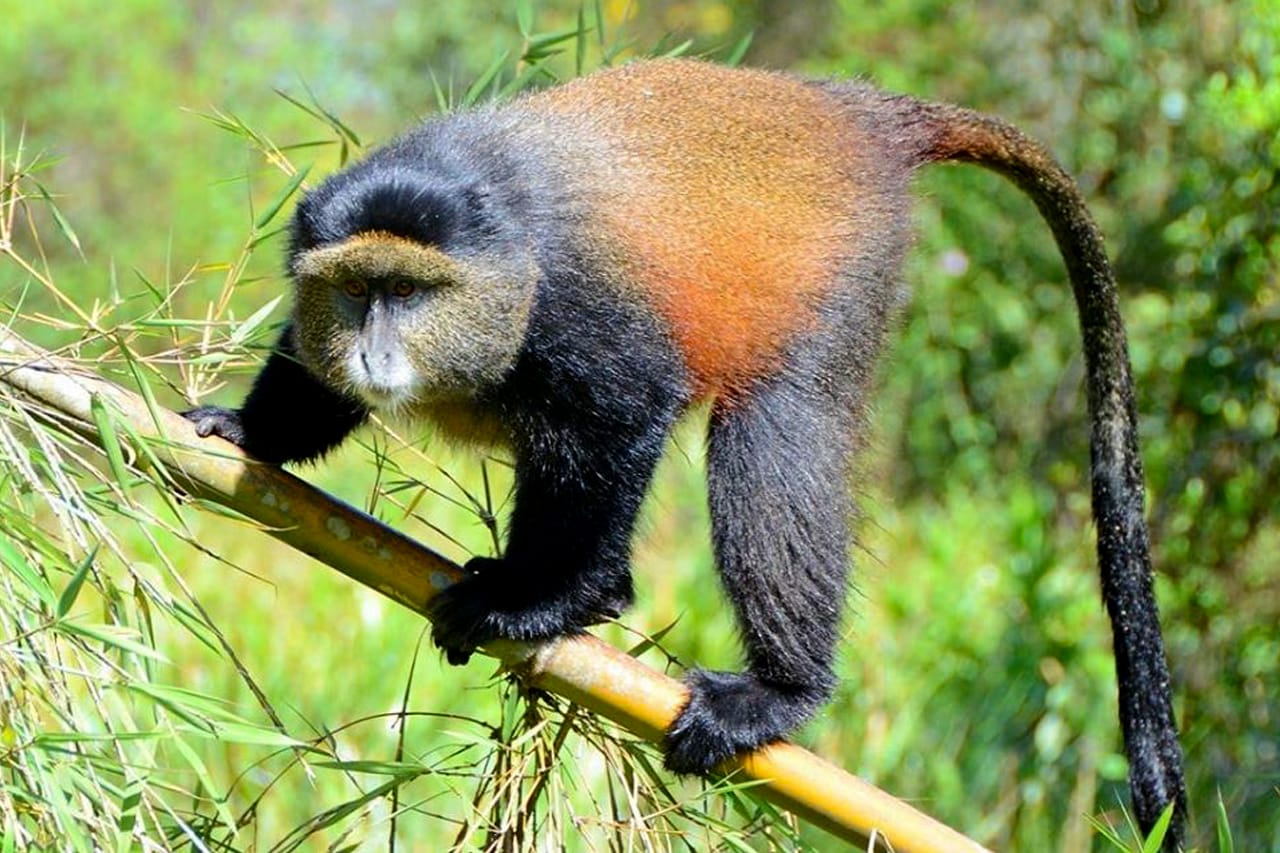
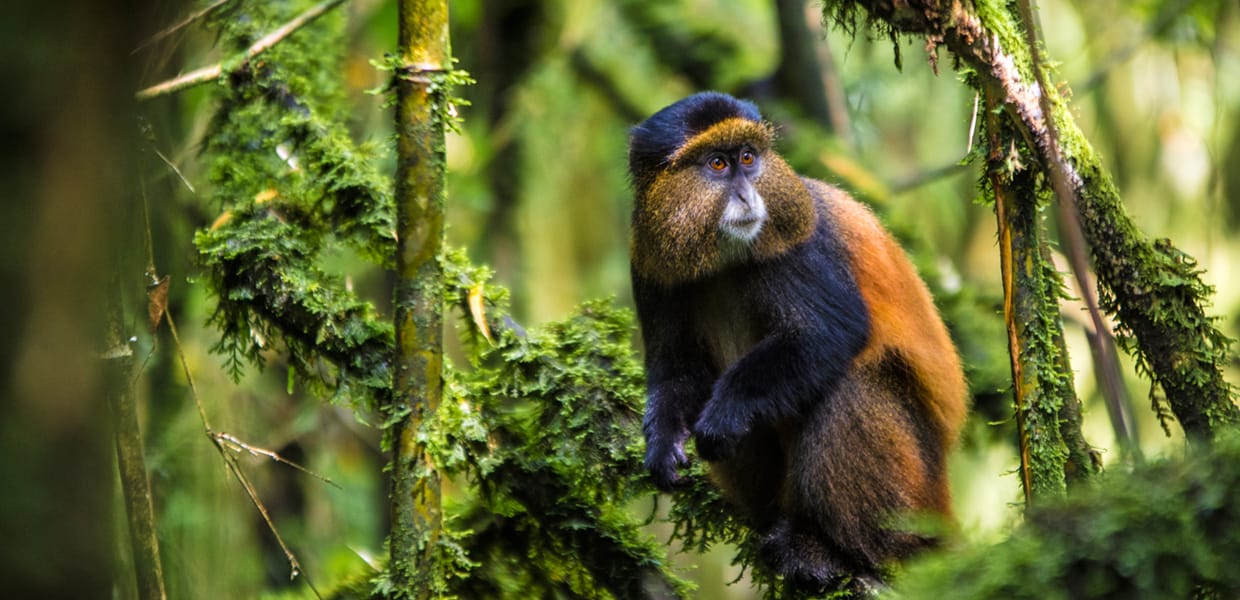
- A golden monkey trek in between. Golden monkeys are a separate species from gorillas — smaller, faster, and arboreal. They live in Mgahinga’s bamboo zone, which sits at lower altitude than the gorilla trails. The golden monkey minimum age is 12, lower than the 15 for gorillas, which makes the trek accessible to families with younger teenagers.
The practical consequence is that the format delivers three primate species across six days — mountain gorillas twice and golden monkeys once. For travellers whose priority is primates rather than savannah wildlife, it is the most concentrated primate itinerary in Uganda that still fits a single week. The wider primate activity set is on the Uganda destinations page.
Afraeka tip: If you are booking a 6 day gorilla and golden monkey safari, book the Bwindi permit first, then the Mgahinga permit, then the golden monkey permit. Bwindi has the largest permit pool but also the highest demand, and it anchors the first half of the trip. Mgahinga’s single-family structure makes its permit pool much smaller, and its permit should be booked immediately after Bwindi. The golden monkey permit is the most flexible of the three and can be booked once the two gorilla treks are confirmed.
What does the day-by-day route look like?
The six-day route runs from Kampala south-west to Bwindi, transfers to Mgahinga, runs the golden monkey and second gorilla treks on consecutive days, then returns to Kampala. The driving happens on days one and six, and the middle four days are the primate experiences.
The 6-day route, day by day
- Day 1 — Kampala to Bwindi. Depart at 6:00–7:00am. Drive south-west via Mbarara and Kabale (8–9 hours), with a lunch stop and a short photo break at the equator. Arrive at your Bwindi lodge in the late afternoon or early evening. Dinner and an early night.
- Day 2 — First gorilla trek at Bwindi. Pre-dawn departure for the trailhead. Briefing, forest walk, one hour with the gorilla family, walk back. Return to the lodge by early afternoon. Rest for the remainder of the day.
- Day 3 — Bwindi to Mgahinga. Depart after breakfast. Drive to Mgahinga (1–2 hours depending on the Bwindi sector). Arrive at a Mgahinga or Kisoro lodge by lunchtime. Afternoon Batwa cultural experience or a short walk in the Mgahinga foothills. Evening at the lodge.
- Day 4 — Golden monkey trek at Mgahinga. Morning golden monkey trek in the bamboo zone (2–4 hours). Afternoon free, or a volcano hike for travellers with energy remaining. Evening at the lodge.
- Day 5 — Second gorilla trek at Mgahinga. Pre-dawn briefing for the Nyakagezi gorilla family. Forest walk, one hour with the family, walk back. Afternoon transfer to Kisoro or Lake Bunyonyi for rest.
- Day 6 — Return to Kampala. Depart after breakfast. Drive north-east via Kabale and Mbarara (8–9 hours), with a lunch stop. Arrive back in Kampala or Entebbe by late afternoon or early evening.
Two structural notes on this route. First, the golden monkey trek on day four and the second gorilla trek on day five run back to back. Both depart early, but the golden monkey trek is shorter and gentler, which makes it a natural lead-in to the second gorilla trek. Second, the return drive on day six is a full day — eight to nine hours. Do not book anything with a fixed start time in Kampala or Entebbe that evening.
The wider timing of a gorilla trekking day is covered in our guide on how long a gorilla trek takes, and the sector-by-sector terrain differences are covered on the Uganda gorilla trekking hub.
How do the two gorilla treks differ?
The two gorilla treks differ in park, family, terrain and permit allocation. Bwindi’s trek is in one of four sectors with one of multiple habituated families. Mgahinga’s trek is with Nyakagezi, the single habituated family in a much smaller park. Both deliver the same one hour with the gorillas under the same UWA rules, but the experiences around that hour are genuinely different.
| Factor | Bwindi | Mgahinga |
|---|---|---|
| Park size | Large (321 km²) | Small (33.7 km²) |
| Sectors | Four — Buhoma, Ruhija, Rushaga, Nkuringo | Single trailhead |
| Habituated families | Multiple across sectors | One — Nyakagezi |
| Terrain | Variable by sector; steep in Ruhija and Nkuringo | Volcanic slopes; higher average altitude |
| Permit pool | Larger — multiple families per day | Smaller — one family |
| Character | Established, wide choice, busier trailheads | Quieter, more mountainous, less infrastructure |
| Minimum age | 15 | 15 |
Both parks apply the same UWA rules — one-hour viewing window, seven-metre distance, no flash, health exclusion.
Two things follow from this comparison. First, Bwindi offers more choice — the sector and family you book determine your terrain, your lodge options and the surrounding activities. Buhoma is the gentlest sector and the easiest introduction to gorilla trekking, and the sector-level detail sits on our Buhoma sector gorilla trekking guide. Second, Mgahinga’s single-family structure makes it a distinct experience — the trailhead is smaller, the trekking groups are usually quieter, and the volcano landscape is unlike anything in Bwindi.
Travellers considering this trip alongside a single-trek version should also read our guide on the 4 day Bwindi gorilla trekking safari by road, which covers the minimum road-based gorilla format. Adding a second trek at Mgahinga is what makes the six-day version worthwhile. The Mgahinga family is covered in detail on the Nyakagezi gorilla family guide.
How does the golden monkey trek work?
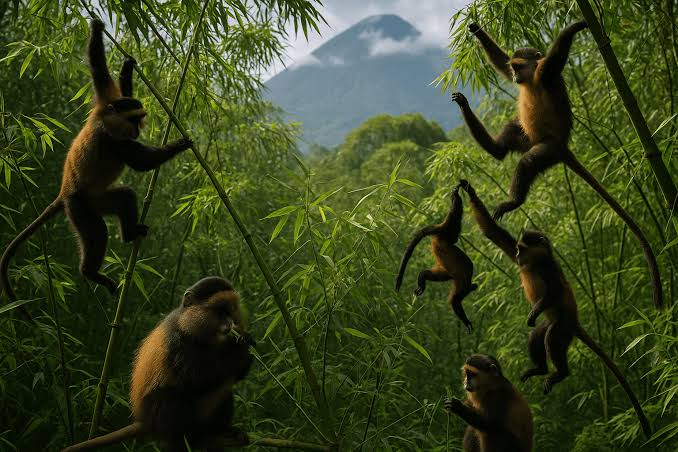
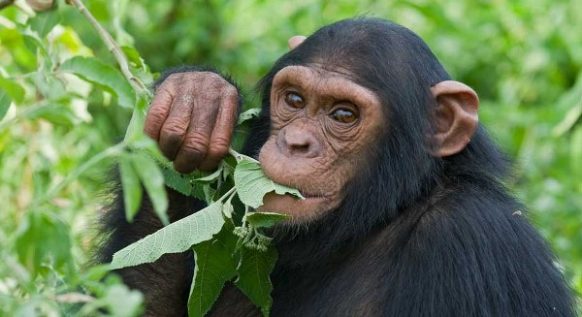
The golden monkey trek runs in Mgahinga’s bamboo zone, on the lower slopes of the Virunga Volcanoes. It is a shorter, gentler trek than a gorilla trek — usually two to four hours total — and the viewing is often at close range because golden monkeys are highly active in the bamboo and frequently at eye level. The minimum age is 12, which is lower than the 15 required for gorilla trekking.
Three practical points about the golden monkey trek:
- The terrain is gentler than a gorilla trek. The bamboo zone sits below the gorilla trail, and the walking is on lower-altitude forest paths. Travellers who are not regular hikers manage it comfortably.
- The viewing is dynamic. Golden monkey troops number between 30 and 80 individuals, and during the hour the troop moves through the bamboo. The ranger repositions the group as it moves, and the viewing hour often feels busier than a gorilla trek.
- Families can join. The minimum age of 12 makes the golden monkey trek the only proper primate trek in Uganda accessible to children aged 12 to 14. Families with younger teenagers often use this trek as their primary primate experience.
The golden monkey trek pairs naturally with the Mgahinga gorilla trek because both start from the same trailhead and both run in the early morning. Doing the golden monkey trek on day four and the gorilla trek on day five gives each day its own focus. The detailed booking mechanics for the golden monkey permit sit on our golden monkey trekking permit booking guide.
What activities fit into the six days?
The activities that fit into a 6 day gorilla and golden monkey safari are concentrated around the three primate treks, plus cultural and landscape activities on the transfer and rest days. The format does not include savannah game viewing, so the activities are primate-focused, cultural and scenic.
| Activity | Location | Day |
|---|---|---|
| First gorilla trek | Bwindi | 2 |
| Batwa cultural experience | Bwindi or Mgahinga | 2 or 3 |
| Bwindi waterfall trail | Buhoma sector | 2 or 3 |
| Golden monkey trek | Mgahinga bamboo zone | 4 |
| Volcano hike (Mt Gahinga or Mt Muhavura) | Mgahinga | 4 |
| Second gorilla trek | Mgahinga — Nyakagezi family | 5 |
| Lake Bunyonyi stop | Between Kabale and the return route | 5 or 6 |
Activities are arranged through the lodge or UWA rangers. Some require advance booking.
Two activities deserve a specific note. The volcano hikes in Mgahinga — Mt Gahinga, Mt Muhavura and Mt Sabyinyo — are genuine half-day to full-day walks on volcanic terrain. They are worth doing on day four afternoon if the family is fit, or on day five if a rest day is not needed. The detailed hike options sit on our adventure hiking page. The Batwa cultural experience is the other activity worth prioritising — it is a visit with the Batwa community that lived in the Bwindi and Mgahinga forests before the parks were gazetted, and it adds context to the primate experience.
The Lake Bunyonyi stop is optional but a genuine rest opportunity on the return leg. It adds one to two hours to the drive and can be built into day five or the morning of day six.
When is the best time for the trip?
The best time for a 6 day gorilla and golden monkey safari is the drier months — December to February and June to September. The trails at both Bwindi and Mgahinga are firmer, the murram road sections on the drive are more predictable, and all three treks are more comfortable. The wet months of April, May and November are workable but slower.
Three practical points on timing:
- Dry season is best for all three treks. Bwindi and Mgahinga trails are firmer, and the golden monkey trek in Mgahinga’s bamboo zone is easier to walk. The drive to and from the parks is also more predictable.
- Wet season is quieter and more affordable. Lodges and permits are more available in April, May and November, and the parks are less crowded. The trade-off is muddier trails and a slower drive.
- Permits tighten in peak season. Bwindi gorilla permits sell out months ahead for the June–September and December–February windows. Mgahinga’s single-family structure means its permit pool is even tighter. Book all three permits six to twelve months ahead for peak-season dates.
The wider country season picture sits with the Uganda Tourism Board. The six-day format is genuinely year-round, and the trade-offs between seasons are about comfort and cost rather than whether the trip works.
Who is the format best for?
The 6 day gorilla and golden monkey safari is best for travellers who want to trek gorillas more than once, families with children aged 12 to 14 who cannot do gorillas but can do golden monkeys, and primate-focused travellers who want maximum primate time in Uganda’s south-west.
Book the format if you are…
- Wanting a second gorilla trek with a different family in a different park
- Travelling with children aged 12 to 14 — the golden monkey trek is the only primate trek they can do
- Wanting the widest primate coverage in a single Uganda trip
- Willing to do three early-morning treks in five days
- Comfortable with a long first and last day of driving
- Interested in the Virunga volcano landscape at Mgahinga
Consider a different format if you are…
- On a first Uganda trip and want to see both primates and savannah — the 6 day Murchison, Kibale, Queen Elizabeth route is broader
- Wanting a single gorilla trek — the 4-day Bwindi road format is the minimum viable version
- Travelling with children under 12 — they cannot do either gorilla or golden monkey treks
- Wanting a slower pace — the format has three early-morning treks in five days
- Wanting gorilla trekking plus a lake — the Bwindi and Lake Bunyonyi combination is more relaxed
The format is the most primate-dense six-day itinerary in Uganda. It is not the most relaxed and it does not include savannah game viewing, but for travellers whose priority is primates in the wild, it delivers the strongest possible coverage in a single week.
How do you book a 6 day gorilla and golden monkey safari?
You book a 6 day gorilla and golden monkey safari by confirming the three primate permits first — two gorilla permits and one golden monkey permit — then matching the lodges to the permit sectors, and arranging the vehicle and driver-guide for the full route. The Bwindi permit is the fixed anchor.
What to arrange before the trip
- Gorilla permit at Bwindi — sector and date, paid in full at booking
- Second gorilla permit at Mgahinga — Nyakagezi family, paid in full at booking
- Golden monkey permit at Mgahinga — paid in full at booking
- Bwindi lodge matched to the permit sector
- Mgahinga or Kisoro lodge for nights three, four and five
- Vehicle and driver-guide for the full six-day route
- Batwa cultural experience and volcano hike arranged through the lodge
- Any mobility or fitness notes shared with the operator in advance
Two things are worth confirming when you book. First, whether the Mgahinga permit is available on your specific date — because Nyakagezi is the only habituated family in Mgahinga, the daily permit pool is small and the family occasionally ranges across the border into Rwanda or the DRC. Second, whether the golden monkey trek has an afternoon departure option, which gives flexibility if the morning is fully booked.
The full range of Uganda primate itineraries is on the trips page linked below. For travellers wanting a broader first Uganda trip, our guide on the 6 day Murchison, Kibale and Queen Elizabeth route covers the savannah-and-primate combination.
Common mistakes with the 6 day gorilla and golden monkey safari
Most of what goes wrong with a 6 day gorilla and golden monkey safari comes down to a small set of avoidable mistakes, and all of them can be prevented with one careful planning conversation.
- Booking the Mgahinga permit late. Nyakagezi is the only habituated family at Mgahinga, and its permit pool is the smallest of any Ugandan gorilla trek. Book it immediately after the Bwindi permit.
- Assuming one Bwindi permit covers both treks. Bwindi and Mgahinga permits are separate documents with separate allocations. Booking one does not reserve the other.
- Not checking Mgahinga availability in advance. Because Nyakagezi crosses international borders periodically, the park occasionally cannot run gorilla treks on specific dates. Confirm at the time of booking.
- Scheduling three early-morning treks back to back. Day two (Bwindi gorilla), day four (golden monkey) and day five (Mgahinga gorilla) are all early starts. The day three transfer is the recovery day.
- Choosing a distant Bwindi sector. Rushaga and Nkuringo are the closest sectors to Mgahinga — roughly one hour. Buhoma is further, at around two hours. Confirm the sector matches the transfer times.
- Booking a same-day flight home on day six. The return drive is eight to nine hours. Build in a buffer night in Entebbe or Kampala before any international departure.
- Travelling with children under 12. Neither the gorilla trek (15) nor the golden monkey trek (12) is accessible to younger children. Families with children under 12 need a different itinerary.
- Underestimating the driving. The route involves two long driving days at either end and a transfer in the middle. A private vehicle and driver-guide is the correct format.
Can one permit cover two people?
No. One permit covers one person for one trek, and this applies to every permit on the 6 day gorilla and golden monkey safari — the Bwindi gorilla permit, the Mgahinga gorilla permit, and the golden monkey permit. A couple doing the trip needs six permits in total: two Bwindi gorilla permits, two Mgahinga gorilla permits, and two golden monkey permits. Each permit is tied to a named individual, and there is no way to share one or transfer it to another person. Current permit categories and rates sit on the gorilla permits Uganda page.
Each permit type uses a separate allocation. The Bwindi gorilla permit pool, the Mgahinga gorilla permit pool, and the golden monkey permit pool operate independently. The daily caps apply separately to each pool, and Mgahinga’s single-family structure makes its gorilla permit pool the smallest of the three. A party of eight fills a full day’s allocation at any of the three sites.
Once the permits are confirmed, the specific gorilla family or golden monkey troop you follow is allocated on the morning of each trek. You will know your sector or site in advance because it is on the permit; you will learn your specific family or troop at the briefing alongside everyone else. The one-hour viewing window, seven-metre distance rule, no-flash rule and health exclusion apply to every trekker. The regulatory framework is set by the Uganda Wildlife Authority.
Afraeka field note: A couple in their late forties once booked a 6 day gorilla and golden monkey safari after trekking gorillas in Bwindi three years earlier and wanting a return trip that felt different. Their Bwindi trek on day two was in Rushaga, and their Mgahinga trek on day five was with Nyakagezi. What they told us afterwards was that the two gorilla treks had felt genuinely different — not just in terrain, but in atmosphere. Bwindi’s trek had been busier at the trailhead and the approach had been longer; Mgahinga’s had been quieter, with fewer groups operating, and the volcano backdrop had changed the whole feel of the day. The golden monkey trek in between had been the surprise — they had not expected to enjoy it as much as they did, and the troop had stayed at eye level for most of the hour. That is the case for the six-day format. It delivers three primate encounters in five days, and each one feels distinct from the others.
A question that comes up occasionally on TripAdvisor’s Uganda forum and on r/Uganda is some version of: “Is it worth doing a second gorilla trek in a different park?” The honest answer depends on what you want from the trip. If a single trek has satisfied your interest, the second trek is not necessary. If you want the widest primate coverage in a single Uganda trip, the second trek at Mgahinga is worth the extra permit — the family is different, the park is different, and the experience is genuinely distinct. Adding the golden monkey trek makes it a three-primate trip, which is the strongest six-day primate itinerary Uganda offers.
Frequently asked questions
Is 6 days enough for two gorilla treks and golden monkeys?
Yes — six days fits two gorilla treks, one golden monkey trek, and the transfers between Kampala, Bwindi and Mgahinga. The treks run on days two, four and five, with day three for the transfer and day six for the return drive. It is a compressed but workable format.
Do I need a separate permit for Mgahinga?
Yes. Bwindi and Mgahinga operate separate gorilla permit allocations, and a Bwindi permit cannot be used at Mgahinga or vice versa. Each trekker needs one Bwindi permit and one Mgahinga permit for the two gorilla treks, plus a golden monkey permit for the bamboo zone trek.
Can children do the golden monkey trek?
Yes — the minimum age for golden monkey trekking at Mgahinga is 12, which is lower than the 15 required for gorilla trekking. It is the only proper primate trek in Uganda accessible to children aged 12 to 14.
How difficult is the golden monkey trek compared with a gorilla trek?
The golden monkey trek is shorter and gentler. It runs two to four hours total, walks at lower altitude in the bamboo zone, and the terrain is less demanding than the gorilla trails. Travellers who are not regular hikers manage it comfortably.
Which Bwindi sector is closest to Mgahinga?
Rushaga and Nkuringo are the closest, roughly one hour from Mgahinga. Buhoma is further, at around two hours. If you have a choice of Bwindi sectors, Rushaga or Nkuringo shorten the transfer to Mgahinga.
How far in advance should I book all three permits?
Six to twelve months ahead for peak-season dates (June to September and December to February). The Mgahinga gorilla permit pool is the smallest of the three, so book it immediately after the Bwindi permit. The golden monkey permit is the most flexible and can be confirmed later.
Can the two gorilla treks be done on consecutive days?
Yes, but it is more comfortable with a day between them. The format here places the golden monkey trek on day four between the two gorilla treks — this gives you a recovery day and matches the trekking schedule to the park locations.
Does the trip include any savannah game viewing?
No. The 6 day gorilla and golden monkey safari is entirely primate-focused in Uganda’s far south-west. Travellers wanting savannah game viewing should consider the 6 day Murchison, Kibale and Queen Elizabeth route, which combines big game and primates across the northern and western circuits.
What should I pack for the trip?
Waterproof hiking boots with deep tread, gaiters, long trousers and sleeves, gardening gloves, a light waterproof shell, a warm layer for the morning briefings, a small daypack and a camera with a strap. Hire a porter for both gorilla treks. Full kit details are covered in our guide on what to pack for gorilla trekking.
Planning a two-gorilla-trek safari?
Send us your dates, party size and whether you want the second gorilla trek at Mgahinga or a second Bwindi sector, and we will check permit availability at both parks, recommend the Bwindi sector that best fits the transfer to Mgahinga, and outline how the golden monkey trek fits alongside the gorilla treks. If a single-trek format or a broader multi-park trip would suit you better, we will say so. No price figures until we know your route, because the permits are only one line of the total.
About the author: Victoria Kayaga is a Ugandan-born safari expert and founder of Afraeka Adventures, with 15+ years in East African tourism. Based in Kampala, she has planned gorilla and golden monkey itineraries across Bwindi’s four sectors and Mgahinga for years, and she advises travellers on combining multiple primate treks into a single coherent trip. More about Victoria.
Keep planning
- 7-day Uganda and Rwanda primate safari
- 16-day Rwanda and Uganda gorilla trekking and big five safari
- 5-day Bwindi and Lake Mburo safari
- All Afraeka trips