Last updated: 25 September 2026. Rates and availability are set by UWA and subject to change — confirm before booking.
Short answer: A Uganda gorilla trekking safari takes you into one of two national parks — Bwindi Impenetrable National Park or Mgahinga Gorilla National Park — for a one-hour encounter with a habituated mountain gorilla family. Bwindi has four trekking sectors and the majority of Uganda’s habituated families; Mgahinga has a single habituated family and a quieter, more mountainous character. Both parks deliver the same core experience, and both operate under Uganda Wildlife Authority rules. The trekking day begins before dawn and runs four to nine hours, most of it on foot.
Uganda is one of only three countries in the world where mountain gorillas can be trekked, and it is the one with the widest range of options. A Uganda gorilla trekking safari can be as short as three days from Kampala or Entebbe, or as long as a full East African itinerary that combines gorillas with chimpanzees, savannah wildlife, and the lakes and volcanoes of the south-west. What every version has in common is the same one-hour encounter with a habituated family, under the same UWA rules, in one of two parks.
This page is the starting point for planning a Uganda gorilla trekking safari — what the trek involves, how Bwindi and Mgahinga differ, which park and sector suit different travellers, and how the trekking day is structured from the pre-dawn briefing through to the certificate at the trailhead. It sits above the sector-specific guides and the permit booking pages, and it is designed for travellers who are deciding whether to book, which park, and how to structure the trip. Permit fees and booking categories are kept current on the gorilla permits Uganda page, and the wider picture is covered on the Uganda gorilla trekking hub. The regulatory framework that governs every trek is published by the Uganda Wildlife Authority.
Uganda gorilla trekking safari — key facts
- Parks: Bwindi Impenetrable National Park and Mgahinga Gorilla National Park
- Species: Mountain gorilla — one of only three countries where they can be trekked
- Viewing time: 1 hour with the family, strictly enforced
- Minimum distance: 7 metres from the gorillas
- Group size: Maximum 8 visitors per habituated family per day
- Minimum age: 15 years
- Trekking day: 4–9 hours, most of it on foot at altitude
- Best time to visit: Year-round, with drier months (June–Sept, Dec–Feb) easier on the trails
What is a Uganda gorilla trekking safari?
A Uganda gorilla trekking safari is a trip built around a one-hour encounter with a habituated mountain gorilla family in Bwindi Impenetrable National Park or Mgahinga Gorilla National Park. The trek itself is a single day: a pre-dawn briefing, a forest walk of one to several hours, one hour with the family, and the walk back to the trailhead. A safari wraps that day in transport, lodge accommodation and often one or two other Ugandan parks or activities.
Three things distinguish a Uganda gorilla trekking safari from a safari elsewhere in Africa:
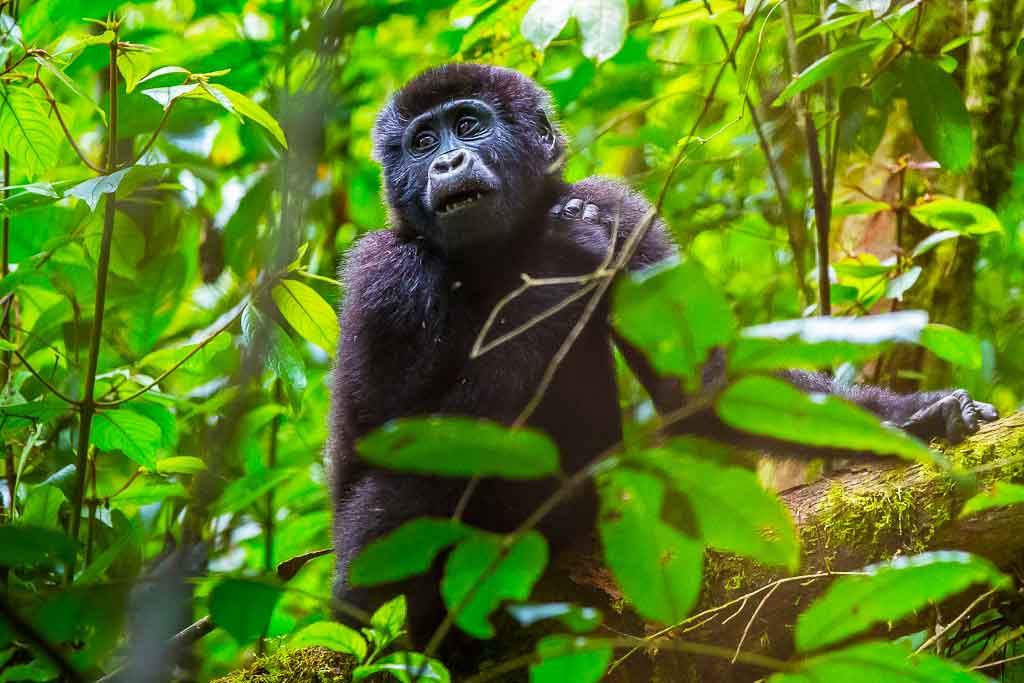
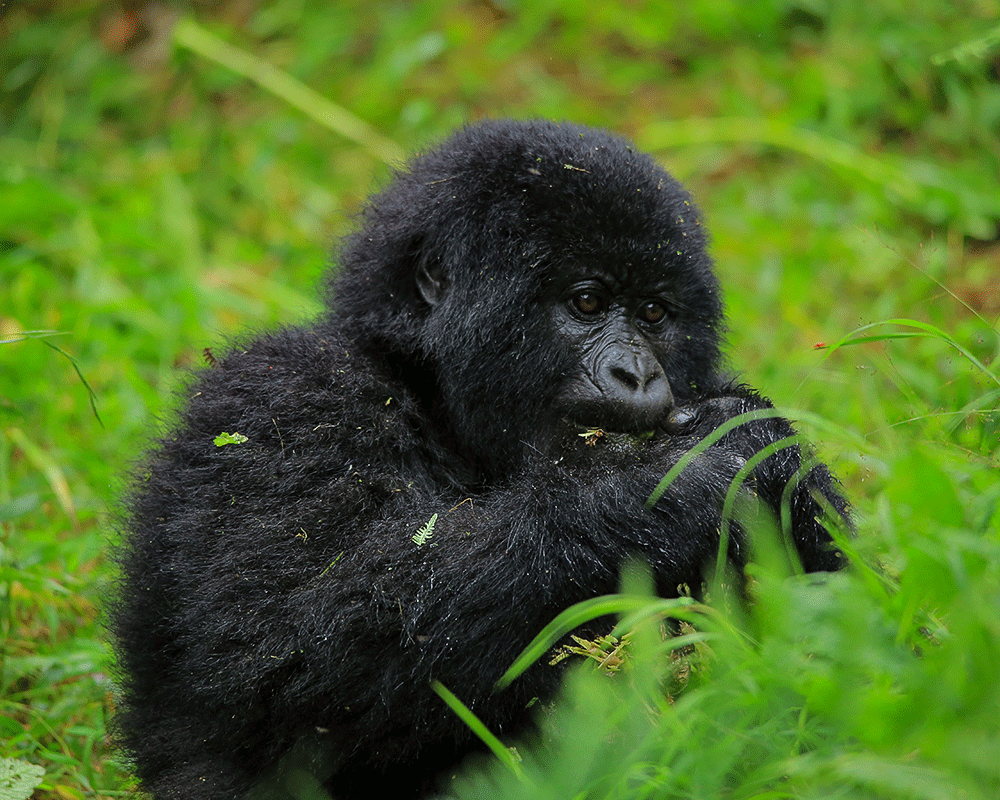
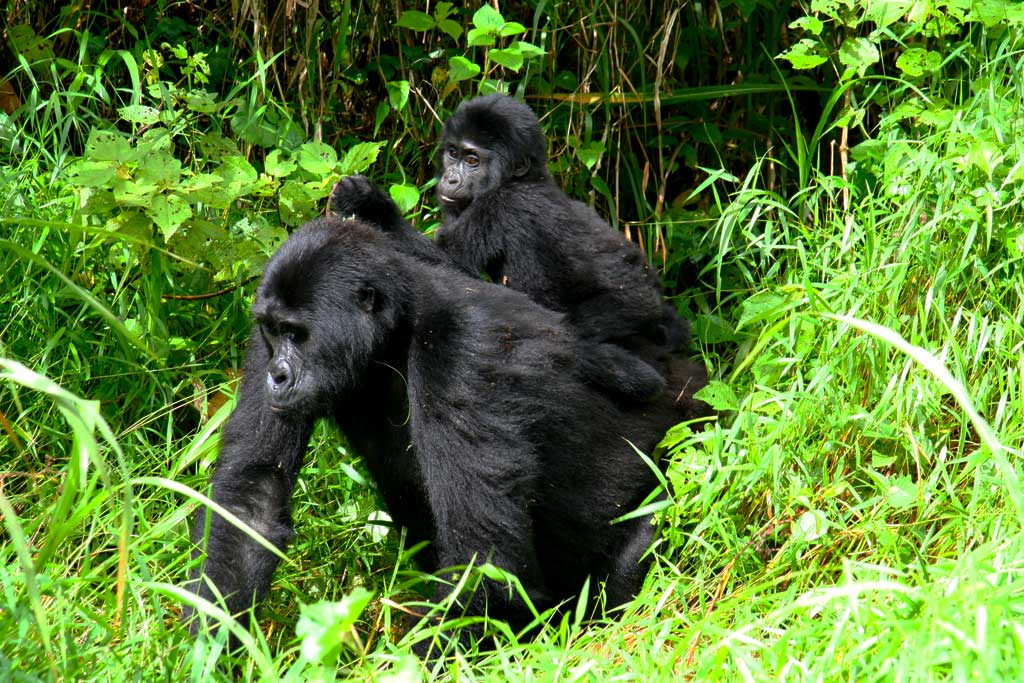
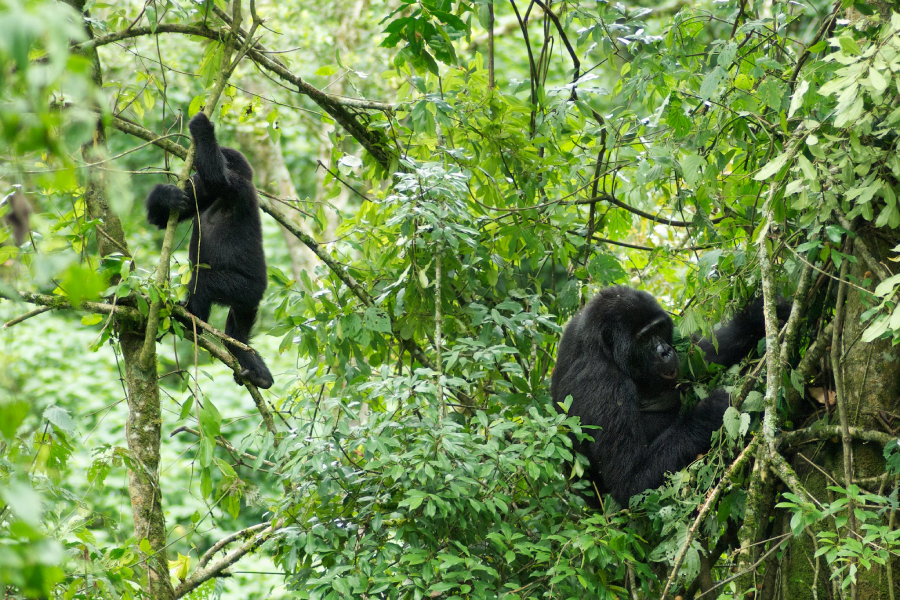
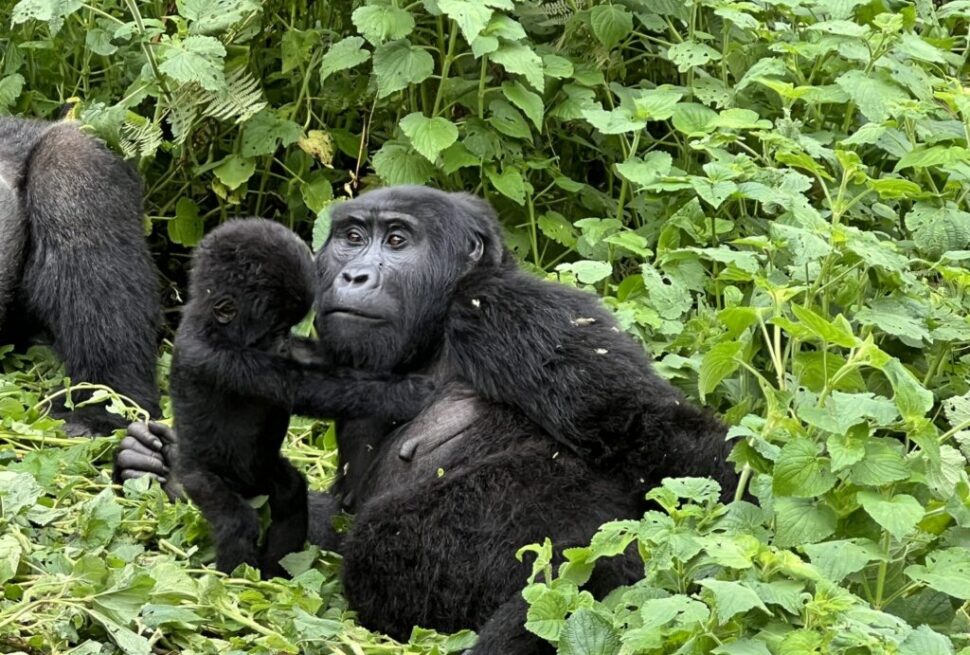
- The gorillas are habituated but wild. The families you visit have been slowly accustomed to human presence over years, but they are not captive and not fed. You are visiting a wild group in its home range, and the family behaves as it would without you there.
- The encounter is fixed at one hour. UWA caps the viewing at 60 minutes, on the basis that the gorillas’ welfare comes first. The rule applies to every trekker, every park, every day.
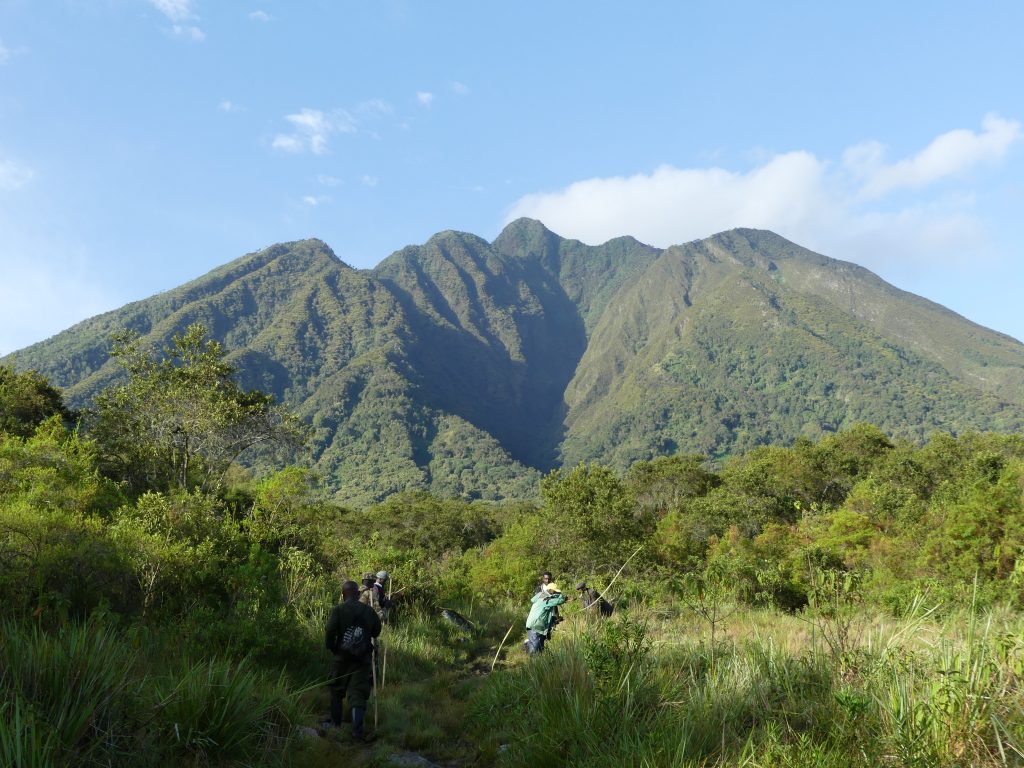
- The trekking day is a walk in the forest at altitude. Bwindi’s trailheads sit between roughly 1,500 and 2,600 metres depending on sector, and Mgahinga’s sits around 2,200 metres and rises. A reasonable level of fitness is needed, and the descent is often harder than the climb.
The rest of the safari — transport, lodges, other parks — is built around the trek. Typical Uganda itineraries range from a compact three-day trip that is essentially the trek plus travel, up to two-week routes that combine gorillas with chimpanzee trekking in Kibale, savannah game drives in Queen Elizabeth or Murchison Falls, and sometimes a Rwanda extension to Volcanoes National Park. The safari format you choose depends on time and budget, not on the gorilla trek itself, which is the same experience in every version.
Afraeka tip: For a Uganda gorilla trekking safari, the two decisions that matter most are the park (Bwindi or Mgahinga) and the sector within it. Both determine the terrain, the permit availability and the lodge choice. Book these two things together rather than separately — mismatches between sector and lodge are the most common planning error we see.
Bwindi or Mgahinga — which park for your gorilla trekking safari?
Bwindi is the right park for most travellers, because it has more habituated families, more sectors, more lodges and better permit availability. Mgahinga is the right park for travellers who want a quieter, more mountainous experience, who are combining a trek with volcano hiking or golden monkeys, or who are coming through Kisoro or the Rwanda border. The two parks are roughly an hour apart by road, and combining them on a single Uganda gorilla trekking safari is a genuine option.
| Factor | Bwindi | Mgahinga |
|---|---|---|
| Habituated families | Multiple across four sectors | One |
| Sectors | Buhoma, Ruhija, Rushaga, Nkuringo | Single trailhead |
| Terrain | Variable by sector | Volcanic slopes; higher average altitude |
| Lodge range | Widest in the region | Limited |
| Permit availability | Better — more families means more daily permits | Tighter — single family means fewer permits |
| Character | Established, well-documented, wide choice | Quieter, more mountainous, less infrastructure |
Trekking character and availability change over time. Conditions reflect typical patterns, not a guarantee for any specific date.
Within Bwindi, the four sectors differ in terrain and demand. Buhoma is the gentlest and the most requested — good for first-time trekkers and travellers who want the widest lodge choice. Rushaga is the most flexible, with the largest concentration of habituated families, which makes it the best sector for groups and short-notice bookings. Ruhija is the highland forest sector, cooler and more demanding, and one of Africa’s premier forest birding sites. Nkuringo is the most physically demanding sector, with a ridge-to-valley geography that makes the return climb the hardest part of any Bwindi trek. Each sector has its own guide on the blog, and they are cross-referenced on the Uganda gorilla trekking hub.
For travellers doing a Uganda gorilla trekking safari who want more than one trek, combining Bwindi and Mgahinga is the natural choice. Bwindi and Mgahinga are roughly an hour apart by road, and Mgahinga pairs easily with a Bwindi sector for a two-trek itinerary. The Uganda destinations page maps how the two parks connect with the rest of the country, and the Rwanda destinations page covers the cross-border option via Cyanika.
What happens on a Uganda gorilla trekking safari day?
On a Uganda gorilla trekking safari day, the sequence is fixed: pre-dawn departure from your lodge, briefing and registration at the trailhead, a forest walk of one to several hours, one hour with the gorilla family, the walk back to the trailhead, and a certificate and debrief. The total day runs four to nine hours, most of it on foot. The core of the day — the one hour with the gorillas — is the same in every sector and every park.
The trekking day, step by step
- Pre-dawn departure. Leave the lodge before daylight to reach the trailhead for the briefing. Departure is usually around 5:00 to 6:00am depending on distance from the trailhead.
- Briefing and registration. Register with your passport and permit details, meet your ranger guide, and receive the day’s operational briefing. Group allocation is confirmed here.
- Walk in to the family. Rangers have gone ahead at first light to locate the family. The walk can take under an hour or several hours depending on where the family nested.
- One hour with the gorillas. A strict maximum of 60 minutes in the family’s presence. Cameras, no flash, seven-metre minimum distance.
- Walk back to the trailhead. The return is usually faster but wet clay and steep ground can slow it considerably.
- Certificate and debrief. UWA issues a trekking certificate. Your ranger guide shares background on the family you visited.
- Return to the lodge. Usually by early to mid-afternoon. Most travellers rest for the remainder of the day.
The single most important fact about the trekking day is that the one hour with the gorillas is unaffected by everything around it. Rain, mud, distance walked, group size, sector — none of these change the one hour or the rules that govern it. What changes is how much effort it takes to get there and back. That is the part first-time trekkers most often underestimate.
What does a Uganda gorilla trekking safari include?
A Uganda gorilla trekking safari includes the gorilla trekking permit for each trekker, transport to and from the trailhead, accommodation at a lodge in or near the trekking sector, meals on trekking days, and the guiding and support services for the trekking day itself. What is usually not included: international flights, Uganda visa fees, travel insurance, personal gear, alcoholic drinks, tips, and any optional activities added to the itinerary.
What a typical Uganda gorilla trekking safari includes
- Gorilla trekking permit for each trekker (arranged separately, paid in full at booking)
- Ground transport to and from the trailhead
- Accommodation at a lodge near the trekking sector
- Meals and drinking water on trekking days
- Ranger guides and trekking support (porters can be added)
- Park entry fees where applicable
- Vehicle, driver-guide and fuel for the road sections
- Airport transfers at the start and end of the itinerary
What is not included on most Uganda gorilla trekking safari itineraries: international flights, visa and yellow fever certificate costs, travel insurance (including medical evacuation cover — see our terms and conditions page for the details that apply), personal trekking gear, tips for guides, porters and lodge staff, and any optional activities booked separately. The permit itself is the largest single cost line and is paid in full at the time of booking — a trip deposit alone does not secure a permit. Full current permit categories and rates sit on the gorilla permits Uganda page.
What else can you combine with a Uganda gorilla trekking safari?
A Uganda gorilla trekking safari combines naturally with three broad categories of activity: other primate experiences, savannah wildlife, and the landscapes and communities of the south-west. Most travellers build in at least one of these, because the gorilla trek itself is a single day and Uganda offers much more than the trek alone.
| Addition | Where | Why it works with the trek |
|---|---|---|
| Chimpanzee trekking | Kibale Forest, Kyambura Gorge, Budongo | Second primate experience; Kibale combines naturally with the western circuit |
| Golden monkey trekking | Mgahinga Gorilla National Park | Short trek from the same base as Mgahinga gorilla trekking |
| Savannah game drives | Queen Elizabeth, Murchison Falls, Lake Mburo | Big game and boat safaris; Queen Elizabeth pairs with Buhoma via Ishasha |
| Lake Bunyonyi | South-west, near Kabale | Canoeing, island hopping and lakeside lodges for post-trek downtime |
| Volcano hiking | Mgahinga | Virunga volcano trails; full-day or multi-day options |
| Batwa cultural experience | Bwindi and Mgahinga | Community visit with the Batwa, who lived in these forests before the parks were gazetted |
| Rwanda extension | Volcanoes National Park | Second gorilla trek in a different country via Cyanika border crossing |
Additions are booked as part of the wider itinerary. Availability varies by season and location.
For a Uganda gorilla trekking safari with a full primate focus, Kibale Forest is the natural partner to Bwindi — chimpanzee trekking is a separate permit, a separate day, and a genuinely different forest experience. Our primate tracking experiences page covers the options, and the 7-day Uganda and Rwanda primate safari shows how a two-country version is structured. For travellers who want savannah alongside gorillas, the 5-day Bwindi and Lake Mburo safari combines the trek with a southern savannah stop, and the 16-day Rwanda and Uganda gorilla trekking and big five safari is the extended version.
The Uganda Tourism Board maintains country-level information on the parks and activities, and the International Gorilla Conservation Programme documents the conservation context behind the permits that fund the parks’ protection work.
How do you plan a Uganda gorilla trekking safari?
You plan a Uganda gorilla trekking safari by deciding the park and sector first, booking the permits early, then building the wider itinerary around those fixed dates. The trek is the anchor; transport, lodges and additional activities fit around it. The order matters because permits sell out in peak season, and once the permit date is set, the rest of the trip can be planned with certainty.
Planning sequence for a Uganda gorilla trekking safari
- Choose the park and sector. Bwindi for the widest choice; Mgahinga for a quieter, more mountainous trek. Within Bwindi, Buhoma for first-time trekkers, Rushaga for groups and short-notice bookings, Ruhija for birding and highland forest, Nkuringo for a demanding trek.
- Set the trekking date. Peak season runs June to September and December to February and fills first. Low season in April, May and November is more forgiving and easier to book at short notice.
- Book the permits early. Three to six months ahead for peak season, six to twelve months for groups of four or more. The full UWA permit fee is payable at booking.
- Choose the lodge. Match the lodge to the sector. Proximity to the trailhead matters more than the wider view, because the trekking day starts before dawn.
- Build the wider itinerary. Add transport, other parks, primate experiences or a Rwanda extension depending on the length of the trip.
- Confirm the logistics. Airport transfers, park entry fees, porters, and any specific needs — mobility, fitness, dietary — are confirmed with your operator before travel.
- Travel with the documentation ready. Passport details, permit confirmation, insurance and yellow fever certificate for the Uganda entry requirements.
The reason we recommend booking the permit before the lodge is that they run on entirely separate systems, and a mismatch means a lodge that does not suit your sector. The permit gives you the sector and the date; the lodge needs to fit that, not the other way around. Availability mechanics are covered on our guide to gorilla permit availability, and the low-season tariff structure is on the permits page. If you are considering two treks, our guide on gorilla trekking two days in a row covers the logistics.
Common mistakes when planning a Uganda gorilla trekking safari
Most of what goes wrong with a Uganda gorilla trekking safari comes down to a small set of avoidable mistakes, and all of them can be prevented with one careful planning conversation before booking.
- Booking the lodge before the permit. Lodges and permits run on separate systems. Match the lodge to the sector after the permit is confirmed.
- Choosing Nkuringo for a first trek. It is the most demanding sector in Bwindi. Buhoma is the gentler choice for first-time trekkers.
- Leaving the permit too late in peak season. June to September and December to February fill first, and groups of four or more need their permits months ahead.
- Assuming the trek is a walk. It is a forest hike at altitude, and the descent is harder than the climb for most trekkers.
- Skipping the porter. A porter carries your daypack and steadies you on the descent. It is the most consistently recommended decision on any trek.
- Wearing new boots. Blisters are the most preventable problem on the trek. Break boots in for a month before travel.
- Not booking a buffer night. Long-haul flights plus altitude plus a pre-dawn start is a poor combination. Arriving a day early is worth the cost.
- Not telling the operator about mobility or fitness needs. These shape the sector choice, the group placement and the support arrangements. The earlier the operator knows, the better the day.
Can one permit cover two people?
No. One permit covers one person for one trek, and this applies to every Uganda gorilla trekking safari. A party of four needs four permits in the same sector on the same date. Each permit is tied to a named individual, and there is no way to share one or to transfer it to another person. Details on how permits work, including current requirements, are kept current on the gorilla permits Uganda page.
The eight-visitor daily cap per habituated gorilla group applies equally, and it is the reason permit availability depends on group size and sector. Rushaga has more habituated families than any other Bwindi sector, which means more daily permits and better odds for groups and short-notice bookings. Nkuringo and Ruhija have fewer families, so their allocations close earlier. Mgahinga has a single habituated family, so its daily permit pool is the smallest of any sector in the two parks.
Once you have your permits, the gorilla group you actually visit is allocated according to the trekking sector, with final group allocation managed by UWA on the morning of the trek. You will know your sector in advance because it is on your permit; you will learn your family at the briefing alongside everyone else. If you are planning a Uganda gorilla trekking safari with a specific family in mind, the family-level guides on the blog cover what each habituated group is like — from the founding generation at Habinyanja and Mubare in Buhoma, through the Rushaga lineage families like Nshongi, Kahungye, Mishaya, Bweza, Busingye and Kutu, to Ruhija’s Bitukura and Oruzogo, and Mgahinga’s single habituated family, Nyakagezi.
Afraeka field note: Travellers often ask whether the Uganda gorilla trekking safari is really about the trek or about the surrounding trip. The honest answer is that it depends on the traveller. We have organised three-day itineraries that were essentially travel plus the trek, and two-week itineraries that were built around the trek and filled the rest with chimpanzees, savannah, lakes and cultural visits. The trek itself is identical in both cases — same one hour, same rules, same experience. What changes is everything around it. That is why the trip plan matters more than the trek plan on a Uganda gorilla trekking safari: the trek will be excellent in any format, and the question is what you want the rest of the trip to be.
A question that comes up regularly on TripAdvisor’s Uganda forum and on r/Uganda is some version of: “Is a Uganda gorilla trekking safari worth it compared to Rwanda?” The honest answer is that both countries deliver the same one-hour encounter with a habituated mountain gorilla family under the same regional rules. Uganda offers the wider range of options — more habituated families, more trekking sectors, lower permit fees, and the ability to combine gorillas with chimpanzees, savannah game drives, and a much broader set of activities within a single country. Rwanda offers a shorter, more compact trip and easier logistics from Kigali. For travellers who want the broader Ugandan experience, the Uganda gorilla trekking safari is the more varied choice. For travellers who want the shortest possible trip to the gorillas, Rwanda is the more direct one. Both are excellent, and the choice depends on how much time you have and what else you want to see.
Frequently asked questions about a Uganda gorilla trekking safari
What is a Uganda gorilla trekking safari?
A Uganda gorilla trekking safari is a trip built around a one-hour encounter with a habituated mountain gorilla family in Bwindi Impenetrable National Park or Mgahinga Gorilla National Park. The trek itself is a single day; a safari wraps that day in transport, lodge accommodation and often one or two other Ugandan parks or activities.
Which park is best for a Uganda gorilla trekking safari — Bwindi or Mgahinga?
Bwindi is the right park for most travellers, because it has more habituated families across four sectors, more lodges and better permit availability. Mgahinga is the right park for travellers who want a quieter, more mountainous experience, who are combining a trek with volcano hiking or golden monkeys, or who are coming through Kisoro or the Rwanda border.
How long does the trekking day take?
Plan for four to nine hours, most of it on foot. The walk in to the family can take under an hour or several hours depending on where the family nested the night before. The viewing is a strict one hour. The walk back to the trailhead is usually faster, though wet-season clay can slow the descent.
How far in advance should I book a Uganda gorilla trekking safari?
Three to six months ahead for peak-season dates (June to September and December to February), and six to twelve months ahead for groups of four or more. Low-season dates in April, May and November are more forgiving and easier to book at short notice. Permits are non-refundable once issued, and the full UWA permit fee is payable at booking.
What is included in a Uganda gorilla trekking safari?
Typically included: the gorilla trekking permit, ground transport to and from the trailhead, lodge accommodation, meals on trekking days, ranger guides and trekking support. Usually not included: international flights, visa fees, travel insurance, personal gear, drinks, tips and optional activities. The permit is the largest single cost line.
Can you combine Bwindi and Mgahinga on one safari?
Yes, and it is one of the strongest two-park combinations in Uganda. Bwindi and Mgahinga are roughly an hour apart by road, and a two-trek itinerary covering one sector of each park is a natural choice for travellers who want more than one gorilla encounter. Each trek requires its own permit, and the two parks have separate allocations.
Is a Uganda gorilla trekking safari physically demanding?
It is a moderate forest hike at altitude. Bwindi’s trailheads sit between roughly 1,500 and 2,600 metres depending on sector, and Mgahinga’s sits around 2,200 metres and rises. The descent is harder on knees and hips than the climb. Reasonable cardiovascular fitness and recent walking on hills or uneven ground are recommended. Porters and — where relevant — the sedan chair service can support a range of fitness levels.
What should I pack for a Uganda gorilla trekking safari?
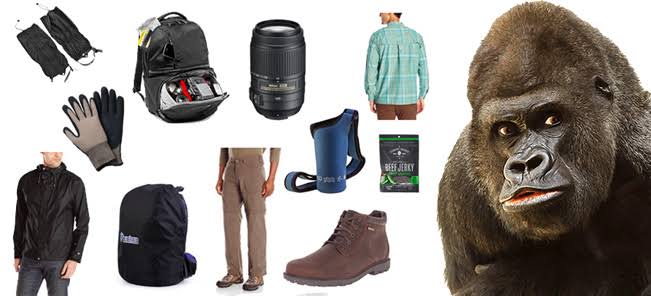
Waterproof hiking boots broken in before travel, gaiters, long trousers and sleeves, gardening gloves, a light waterproof shell, a warm layer for the morning briefing, a small daypack, plenty of water and a camera with a strap. Hire a porter to carry the daypack on the trail. Full kit details are covered in our guide on what to pack for gorilla trekking.
Can you do a Uganda gorilla trekking safari with limited mobility?
Often yes, with planning. The sedan chair service — a litter carried by a team of porters — makes the walking sections of a Bwindi trek accessible for trekkers who cannot complete the forest trail on foot. Sector choice (Buhoma is the most accessible) and advance arrangement are essential. Tell your operator about mobility needs at the enquiry stage.
Plan your Uganda gorilla trekking safari
Send us your dates, party size and the kind of trip you are imagining — a compact three-day trek, a full primate-focused route, or a longer East African itinerary. We will confirm permit availability for Bwindi and Mgahinga, recommend the park and sector that fit your dates, and outline the whole trip with everything included and no price figures until we know your route. Every Uganda gorilla trekking safari begins with the permit, and everything else follows.
About the author: Victoria Kayaga is a Ugandan-born safari expert and founder of Afraeka Adventures, with 15+ years in East African tourism. Based in Kampala, she has planned Uganda gorilla trekking safaris across Bwindi’s four sectors and Mgahinga for years, and she handles permit bookings, lodge matching and multi-park itineraries for travellers from across the world. More about Victoria.
Keep planning