Last updated: 25 September 2026. Rates and availability are set by UWA and subject to change — confirm before booking.
Short answer: Kibale chimpanzee permit availability follows the same pattern as gorilla permits — the best slots in peak season sell out months ahead, while low-season dates often open up with a few weeks’ notice. Standard trekking permits are limited per habituated community per day, and habituation permits are even more restricted. Peak season (June to September and December to February) is the tightest window; April, May and November are the most forgiving. Groups of four or more should book six to twelve months ahead for peak dates.
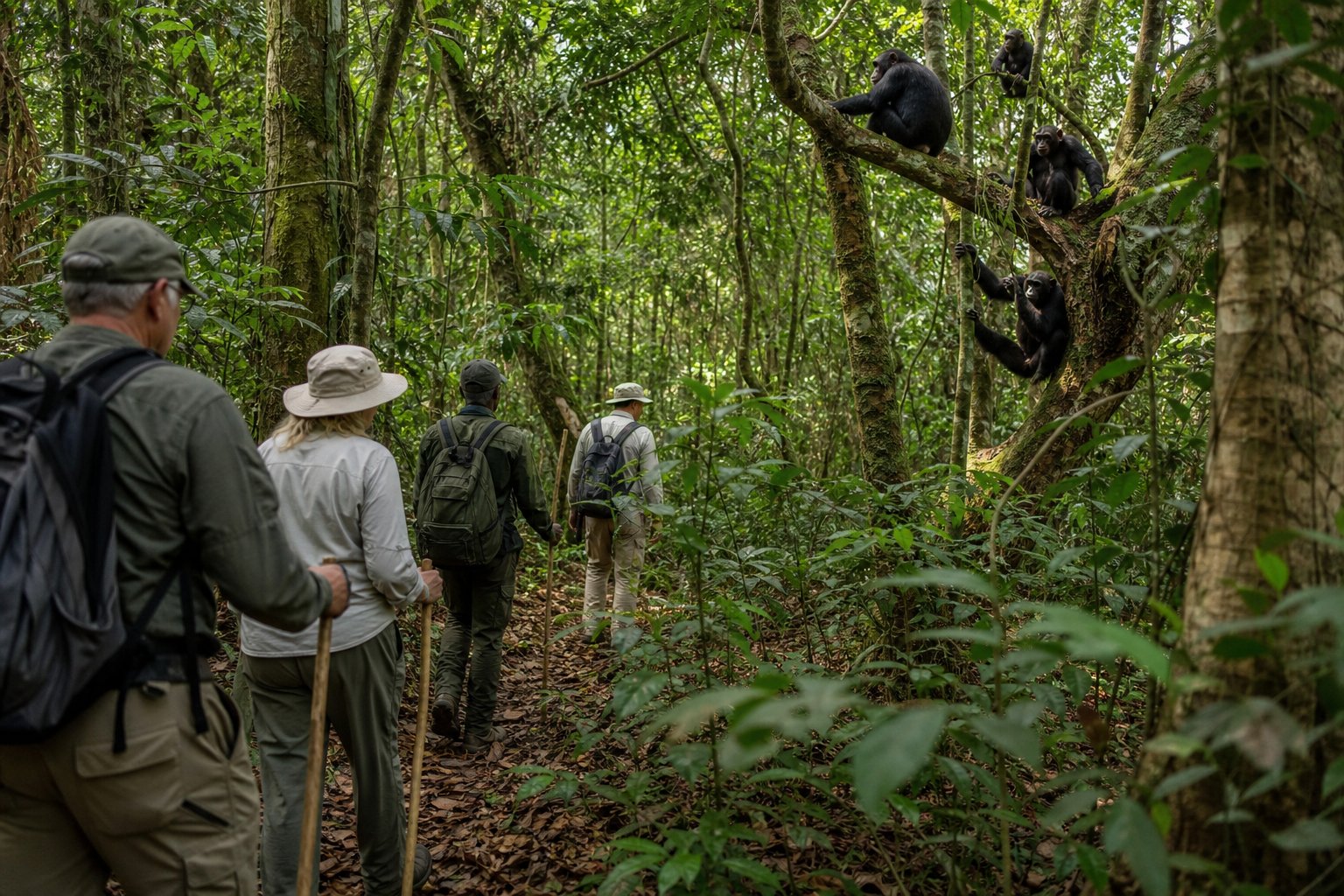
Kibale Forest National Park has the highest concentration of primates in East Africa, and the chimpanzee trekking programme there is one of the most established in the world. The tracking teams know the habituated communities individually, the trails are maintained, and the experience itself is exceptionally consistent. What is not consistent is Kibale chimpanzee permit availability — the simple question of whether a permit exists on the date you want, at the time you need it, for the size of party you are bringing.
This guide is about that question specifically. Not the trek itself, not the fees, not the alternatives. It is about how permits are released, how they sell out, and how to plan around the constraints so you end up with the dates you want rather than the dates that happen to be left. Fee categories and current rates are kept current on the gorilla permits Uganda page, and the wider primate context in Uganda sits on the primate tracking experiences page. The regulatory framework that governs chimpanzee trekking is published by the Uganda Wildlife Authority.
Kibale chimpanzee permit availability — key facts
- Issued by: Uganda Wildlife Authority (UWA)
- Permit types: Standard chimpanzee trekking and full-day habituation
- Group size cap: Up to 8 trekkers per habituated community per standard trek
- Habituation cap: A handful of trekkers per day (much smaller)
- Tightest season: June–September and December–February
- Most forgiving season: April, May, November
- Recommended lead time: 3–6 months (peak); 6–12 months (groups of 4+)
- Payment: Full fee at booking — a deposit alone does not hold a permit
What determines how many Kibale chimpanzee permits are available?
Kibale chimpanzee permit availability is determined by the same logic as gorilla permits — a fixed daily cap per habituated community, multiplied by the number of communities that are actively being trekked. UWA issues permits per community per day, and the cap exists to protect the chimpanzees from over-exposure. The result is a limited supply that does not expand with demand.
Three structural facts shape Kibale chimpanzee permit availability:
- Each habituated community can take a limited number of trekkers per day. Standard trekking permits are capped at a small group size per community, similar to the eight-trekker cap that applies to gorilla families. This is a hard ceiling — it does not flex on popular dates.
- Habituation permits are a fraction of standard trekking permits. The full-day habituation experience is limited to a handful of trekkers per day, which is why habituation slots disappear faster than standard trekking slots. If you specifically want the habituation experience, book earlier than you would for standard trekking.
- Morning slots fill first. Most trekkers want the morning departure, which coincides with the chimpanzees’ most active period. The second departure of the day — late morning or early afternoon — is often available when the morning is sold out, and the experience is still excellent.
The practical consequence is that Kibale chimpanzee permit availability behaves less like a general ticket and more like a seat allocation on a specific date and time. There is no way to “get in” without a permit, no standby list that reliably converts, and no way to share a permit between travellers. If the date and departure you want are gone, the options are to shift the date, accept the other departure, or look at a different chimp-trekking location.
Afraeka tip: If your dates are fixed and the morning slot is gone, the afternoon departure is almost always the right answer — it is less requested, still delivers an excellent chimpanzee viewing window, and opens up dates that look closed on the morning-only search. Ask your operator to check both departures before accepting that a date is unavailable.
When does Kibale chimpanzee permit availability peak?
Kibale chimpanzee permit availability tightens most in the peak safari seasons — June to September and December to February. Those are the dry months in Uganda, they coincide with the northern hemisphere school holidays and the festive season, and they are the periods when the largest number of travellers attempt to book. Permits for the most-requested morning departures in peak season can sell out three to six months ahead.
The pattern across the year looks like this:
| Period | Availability | Notes |
|---|---|---|
| January–February | Tight | Peak dry season; high demand from northern hemisphere travellers |
| March | Moderate | Shoulder month; mixed weather; reasonable availability |
| April–May | Best | Long rains; lowest demand; most flexible booking window |
| June–September | Tightest | Peak dry season and northern summer holidays |
| October | Moderate | Shoulder month; conditions vary but availability is workable |
| November | Best | Short rains; low demand; short-notice bookings possible |
| December–February | Tight | Festive season and peak dry season combined |
Availability reflects typical patterns. Actual availability changes daily and depends on group size, departure time and how far ahead you book.
Two practical consequences follow. First, if you are planning a peak-season Kibale trek, plan the booking as early as you plan the trip. The chimp trek is often a secondary activity to a gorilla trek, and it is easy to leave until later in the planning process — but the availability window is tighter than most travellers expect. Second, if your dates are flexible, the shoulder and low seasons offer a much wider booking window. Kibale chimpanzee permit availability is genuinely good in April, May and November, and those months also carry better lodge availability and lower demand at the neighbouring parks.
How far in advance should you book?
For standard chimpanzee trekking at Kibale, book three to six months ahead for peak-season dates and six to twelve months ahead for groups of four or more. For the full-day habituation experience, add another three months to those windows — habituation permits are limited to a much smaller number of slots per day and are often booked before the standard trekking slots on the same dates.
Recommended booking lead times for Kibale chimpanzee permits
- Solo traveller or couple, low season: 4–8 weeks
- Solo traveller or couple, peak season: 3–6 months
- Group of 4, low season: 2–3 months
- Group of 4, peak season: 6–9 months
- Group of 6+, peak season: 9–12 months
- Habituation experience, any season: 6–12 months
- Fixed-date requests (school holidays, festive season): 12+ months
The reason groups need longer lead times is structural rather than commercial. A party of six requires six permits on the same date in the same community, which is a much narrower match than a solo traveller’s single permit. Kibale chimpanzee permit availability for a group of six in peak season is genuinely difficult to secure at short notice, and operators regularly find that the only way to fit a large party is to split across two days or shift the date.
Two additional considerations worth building into the plan. First, the full fee is payable at the time of booking — a trip deposit alone does not hold a chimpanzee permit, exactly as with gorilla permits. Second, permits are non-refundable and non-transferable once issued. This is worth knowing if your trip dates are not yet final — booking early for flexibility has a real cost if plans change.
Does group size affect Kibale chimpanzee permit availability?
Yes, significantly. Kibale chimpanzee permit availability is much tighter for larger groups, because the daily cap applies per community rather than per booking. A party of two can often be accommodated on dates that are closed to a party of six, because the sector’s allocation may have a single leftover permit but no run of six.
Three practical patterns:
- Parties of 1–2 are the most flexible. Couples and solo travellers can slot into dates that larger parties cannot, and they can often book with several weeks’ notice even in shoulder season.
- Parties of 3–4 are workable with planning. These are common group sizes and are manageable if booked two to four months ahead in peak season and a few weeks ahead in low season.
- Parties of 5+ need early booking. Six is often the point at which a party crosses from “fits into remaining allocation” to “requires a group allocation of its own.” For groups this size, treat the booking like a fixed-departure group tour and commit early.
If you are travelling as a large party and the target date is tight, splitting into two smaller groups across two consecutive days is often the fastest way to secure permits. This does mean the party treks separately, but each group still gets the same one-hour viewing window and the same experience. A split across a morning and afternoon departure on the same day is another option — same trailhead, different departure times.
Family groups with young travellers need to remember the minimum age for chimpanzee trekking is 15, the same as gorilla trekking. This affects group composition for families, and the practical consequence is that children under 15 do not count toward the party size because they cannot trek. Our gorilla trekking minimum age guide covers the rule and the alternatives for younger children in more detail.
What happens if your dates are already sold out?
If your target dates show no Kibale chimpanzee permit availability, you have four practical moves, and they should be taken in this order before accepting that the date is gone.
What to try when your Kibale dates are unavailable
- Check the afternoon departure. Morning slots fill first, but the second departure of the day is less requested and often available when the morning is sold out. Same community, same viewing rules, different timing.
- Check other habituated communities. Kibale has more than one habituated chimpanzee community. A date that is closed for one community is sometimes open for another, because each community has its own permit allocation.
- Shift your date by one or two days. Chimpanzee permit availability changes daily as bookings cancel or are released. A date that was full last week can be open today.
- Split the party or accept a different season. Larger groups sometimes need to split across two dates. If the entire peak season is closed for your party size, shifting to shoulder season or low season opens up availability considerably.
The one thing that rarely works is waiting. Unlike the gorilla system, Kibale chimpanzee permits are not held on a short release cycle in the same way — a permit that is booked tends to remain booked, and cancellations are less frequent than in gorilla trekking because chimp permits are cheaper and travellers are more willing to hold onto them. If your target date is genuinely full, the honest answer is often that the date is gone and the right move is to shift.
How does habituation availability differ from standard trekking?
Habituation permits are scarcer than standard trekking permits at Kibale. The habituation experience runs for a full day with a very small group — usually a handful of trekkers — which means the daily permit pool is dramatically smaller than for standard trekking. Availability for the full-day format is the tightest of any chimpanzee permit in Uganda, and it books out earlier than standard trekking permits on the same dates.
Two practical consequences:
- Book habituation permits six to twelve months ahead for peak season. Even low-season habituation slots fill faster than standard trekking slots, and the right approach is to treat habituation like a fixed-departure booking rather than a flexible one.
- Confirm the permit type explicitly when booking. Standard trekking and habituation are separate permit categories. Some operators do not offer habituation as standard and it needs to be requested specifically. Our guide on the chimpanzee habituation experience covers what the full-day format involves in more detail.
For travellers who want the chimpanzee experience but do not specifically need the full-day habituation format, standard trekking availability is much wider. The morning departure in low season can often be booked with a few weeks’ notice, and the afternoon departure even later. The habituation trade-off is real: a much smaller number of permits for a much richer experience.
Common mistakes with Kibale chimpanzee permit planning
Most of what goes wrong with Kibale chimpanzee permit availability comes down to a small set of avoidable mistakes, and all of them can be prevented with one careful planning conversation.
- Leaving the chimp trek until after the gorilla trek is booked. Kibale is often a secondary activity, and travellers frequently book the gorilla permit first and only think about chimps later. Availability does not wait.
- Assuming the morning departure is the only option. The afternoon slot is less requested and often available when the morning is not. Check both before deciding a date is gone.
- Booking as a group without checking availability first. Groups of 4 or more need to check availability before committing to a date. A party of six across two days is sometimes the only workable option in peak season.
- Confusing standard trekking and habituation permits. They are separate products with separate availability windows. Confirm which one you are booking.
- Paying a deposit and assuming the permit is held. The full fee must be paid at booking. A deposit alone does not secure a chimpanzee permit.
- Not checking other communities. Kibale has more than one habituated community. A date that is closed for one is sometimes open for another.
- Planning for peak season with a short booking window. June to September and December to February close earliest. If your dates are fixed in peak season, book early.
- Forgetting the minimum age. Trekkers must be 15 or older, which affects group composition for families with younger children.
Can one permit cover two people?
No. One permit covers one person for one trek, and this applies to Kibale chimpanzee permits the same as to any other. A party of four needs four permits on the same date and departure. Each permit is tied to a named individual, and there is no way to share one or transfer it to another person. Current permit categories and rates sit on the gorilla permits Uganda page.
The daily cap applies per habituated community, not per booking. This is why Kibale chimpanzee permit availability behaves differently for a solo traveller than for a group — the group has to fit within the same allocation as individual bookings, and the room available is a function of how many individual permits have already been taken.
Once you have your permits, the specific community you follow is allocated by the trackers on the day, and the ranger will confirm which one is being trekked. The community shapes the feel of the day but not the rules of the trek — the one-hour viewing window, the seven-metre distance, the no-flash rule and the health exclusion apply regardless. The wider primate landscape across Uganda is mapped on the Uganda destinations page, and the conservation context for the region’s chimpanzees sits with the International Gorilla Conservation Programme.
Afraeka field note: A family of five once contacted us about a Kibale trek for a peak-season date in August, having already booked gorilla permits for the following week. They assumed the chimp permits would be easy because they were a secondary activity, and had not checked Kibale chimpanzee permit availability at all before building the itinerary. By the time they asked, the morning departure was fully booked for their date. We found them two morning permits in a different community on the same date and three afternoon permits on the following day — enough to fit the whole family across two days, but only because they were flexible on departure time and willing to trek on consecutive mornings. The family took the split, and told us afterwards that the two-day version had been easier than a single large booking would have been. The lesson they passed on: check chimp availability at the same time as the gorilla permits, not after.
A question that comes up regularly on TripAdvisor’s Uganda forum and on r/Uganda is some version of: “Do Kibale chimp permits sell out like gorilla permits?” The honest answer is that they sell out differently. Gorilla permits are scarcer overall because there are fewer habituated families, but Kibale chimpanzee permit availability is tighter per-community because the daily cap is smaller for chimps and the habituation experience is very restricted. Travellers often assume the chimp trek is the easy one to book because it is cheaper and shorter than a gorilla trek — in peak season, it is often the harder one to secure, especially for groups.
Frequently asked questions
How far in advance should I book a Kibale chimpanzee permit?
Three to six months ahead for peak-season dates (June to September and December to February), and six to twelve months ahead for groups of four or more. Habituation permits should be booked six to twelve months ahead in any season. Low-season dates in April, May and November are more forgiving and can often be booked with a few weeks’ notice.
When is Kibale chimpanzee permit availability tightest?
June to September and December to February, which are Uganda’s peak dry seasons and coincide with school holidays in the northern hemisphere. The morning departure on popular dates can sell out three to six months ahead in these periods. The most forgiving months are April, May and November.
Do Kibale chimp permits sell out like gorilla permits?
They sell out differently. Gorilla permits are scarcer overall because there are fewer habituated families. Kibale chimpanzee permit availability is tighter per community because the daily cap is smaller for chimps, and the habituation experience is very restricted. In peak season, chimp permits for a fixed date can be harder to secure than gorilla permits.
Can I book a Kibale chimp permit at short notice?
Sometimes, especially in low season and for solo travellers or couples. Peak season and larger groups need much longer lead times. The afternoon departure is less requested than the morning and often has availability when the morning is sold out. Ask your operator to check both departures before accepting that a date is unavailable.
What happens if my preferred date is sold out?
Four things to try, in order: check the afternoon departure; check other habituated communities; shift your date by one or two days; and consider splitting the party across two dates. If your target date is genuinely full across all communities and departures, the honest answer is usually that the date is gone and shifting is the right move.
Does group size affect availability?
Yes, significantly. Parties of one to two are the most flexible and can slot into single remaining permits. Parties of three to four are workable with planning. Parties of five or more need to book early — six is often the point at which a party requires its own group allocation rather than fitting into remaining individual permits.
How does habituation availability differ from standard trekking?
Habituation permits are much scarcer. The habituation experience runs for a full day with a very small group, so the daily permit pool is dramatically smaller than for standard trekking. Habituation slots are the tightest of any chimpanzee permit in Uganda, and they book out earlier than standard trekking permits on the same dates.
Does the minimum age affect availability for families?
Yes. Trekkers must be 15 or older, so children under 15 do not count toward the party size and cannot trek. This affects group composition for families and means that a family of six with one under-15 child effectively needs five permits, not six — but the under-15 traveller needs a separate activity planned for them.
Can I combine a Kibale chimp permit with a gorilla permit?
Yes, and it is a common combination. The usual structure is a few days in Kibale followed by a drive south-west to Bwindi or Mgahinga. The drive takes most of a day, so the combination is best over an eight- to ten-day itinerary with a rest day between the two primate experiences. Book both permits together so availability can be managed as a single plan rather than two separate ones.
Need to check availability for your dates?
Send us your dates, party size and departure preference, and we will check Kibale chimpanzee permit availability across the habituated communities and both departures, then confirm what is genuinely open. If your first-choice date is gone, we will tell you honestly and suggest the strongest alternative. No price figures until we know your route, because the permits are only one line of the total.
About the author: Victoria Kayaga is a Ugandan-born safari expert and founder of Afraeka Adventures, with 15+ years in East African tourism. Based in Kampala, she has planned primate-focused itineraries across Kibale, Bwindi and Mgahinga for years, and she tracks chimpanzee permit availability patterns through the year for clients. More about Victoria.
Keep planning