Last updated: 26 September 2026. Rates and availability are set by UWA and subject to change — confirm before booking.
Short answer: Golden monkey trekking Mgahinga is a short, gentle primate trek in Uganda’s far south-west, in the bamboo zone of Mgahinga Gorilla National Park. The trek runs two to four hours, involves an easy walk on the lower volcano slopes, and gives an hour with a habituated golden monkey troop at close range. The minimum age is 12 — lower than gorilla or chimpanzee trekking — which makes it the most family-accessible primate trek in Uganda. Permits are separate from gorilla permits, and the trek pairs naturally with a Nyakagezi gorilla trek or a Virunga volcano hike on the same trip.
Uganda has four primate trekking experiences that most travellers know about: gorillas, chimpanzees, golden monkeys, and the Ngamba Island sanctuary visit. Gorillas and chimpanzees get the attention. Golden monkeys — a small, striking, bamboo-dwelling primate found only in the Albertine Rift — quietly deliver one of the most enjoyable and least demanding treks in the country.
The species is endangered. Its entire global range is a narrow band across the Virunga massif in Uganda, Rwanda and the Democratic Republic of Congo. In Uganda, golden monkey trekking Mgahinga is the only option — Mgahinga Gorilla National Park is the sole park where the trek operates, and the habituated troops there are the only ones accessible to visitors. This guide covers what the trek involves, how it differs from gorilla and chimpanzee trekking, and how it fits into a south-western Uganda itinerary alongside gorillas and the Virunga volcanoes. Permit categories and current rates sit on the gorilla permits Uganda page, and the wider primate picture is on the primate tracking experiences page. The regulatory framework for primate trekking in Uganda is published by the Uganda Wildlife Authority.
Golden monkey trekking Mgahinga — key facts
- Where: Mgahinga Gorilla National Park, far south-west Uganda
- Species: Golden monkey (Cercopithecus kandti) — endangered, Albertine Rift endemic
- Habitat: Bamboo zone on the lower volcano slopes
- Trek duration: 2–4 hours including the walk and the viewing hour
- Viewing window: 1 hour with the troop
- Minimum age: 12 years — lower than gorilla or chimpanzee trekking
- Terrain: Gentle compared with gorilla trekking; lower altitude than the gorilla trail
- Pairs well with: Nyakagezi gorilla trekking, Virunga volcano hiking, Lake Bunyonyi
What is golden monkey trekking Mgahinga?
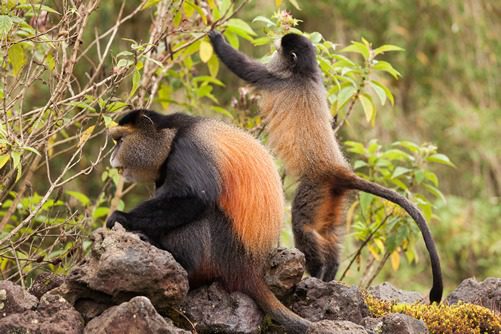
Golden monkey trekking Mgahinga is a guided walk into the bamboo zone of Mgahinga Gorilla National Park, following a habituated troop of golden monkeys for a one-hour viewing window. The trek runs on the lower slopes of the Virunga Volcanoes, below the bamboo line where the gorilla trek operates, and it is a fundamentally gentler experience than either gorilla or chimpanzee trekking — shorter, lower, and easier underfoot.
Three things define the experience:
- The species is unique to the Albertine Rift. Golden monkeys are found only in the Virunga massif and a small number of forests in the wider region. Mgahinga is the only park in Uganda where trekking operates, and the habituated troops there are the only ones accessible to visitors. Trekking golden monkeys is therefore something you can only do in a handful of places on earth.
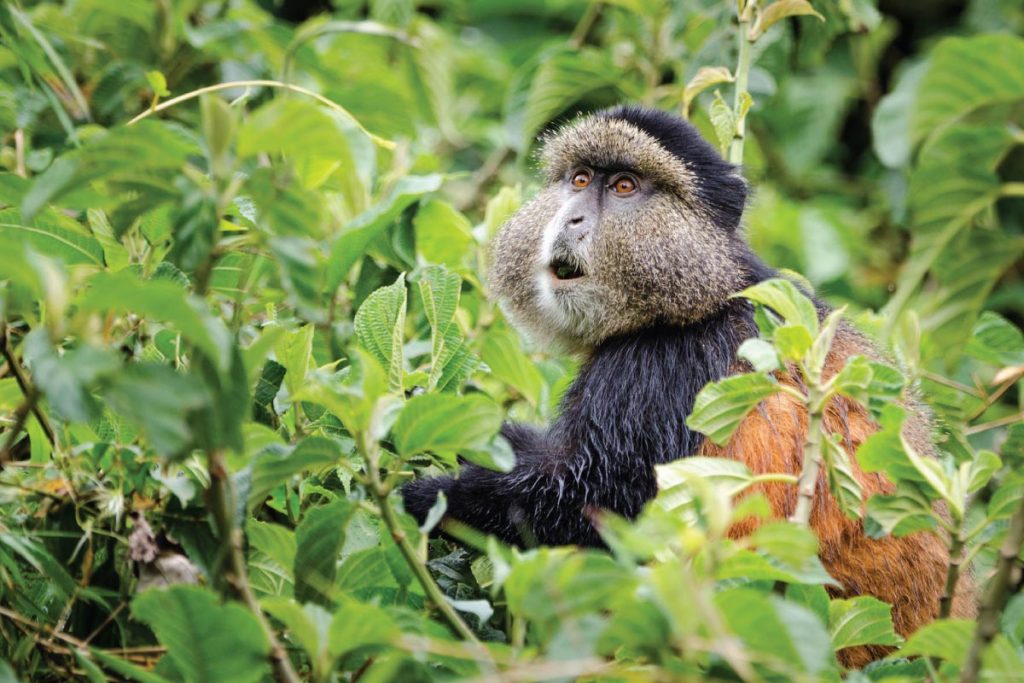
- The habitat is bamboo. Unlike gorillas, which move through mixed forest at higher altitude, golden monkeys spend most of their time in the bamboo zone. They are active, arboreal, and often at eye level in the bamboo canopy — which means the viewing is close, dynamic, and frequent.
- The trek is short and accessible. The total trek runs two to four hours including the walk and the viewing hour, the terrain is gentle, and the minimum age is 12. This is the most family-accessible primate trek in Uganda, and one of the few that welcomes younger teenagers.
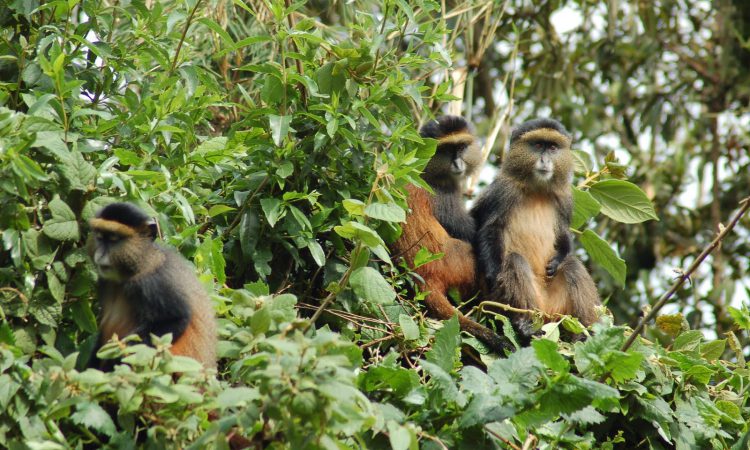
The troop size varies — habituated golden monkey groups typically number between 30 and 80 individuals, which is far larger than a gorilla family. During the viewing hour, the troop is often spread across several bamboo clusters, feeding, moving and interacting at close range. Rangers manage the group’s position to keep the monkeys undisturbed while giving trekkers clear views.
Afraeka tip: Golden monkey trekking is often booked as an add-on to a Nyakagezi gorilla trek, and it works best as the day before or after the gorilla trek. Doing it the day before a gorilla trek is the smarter order — it is a gentle introduction to the forest and the altitude, and it settles any nerves about the harder trek the following day. Many travellers who book the golden monkey trek as an afterthought end up calling it the surprise favourite of their Uganda trip.
What is a golden monkey, and why is it endangered?
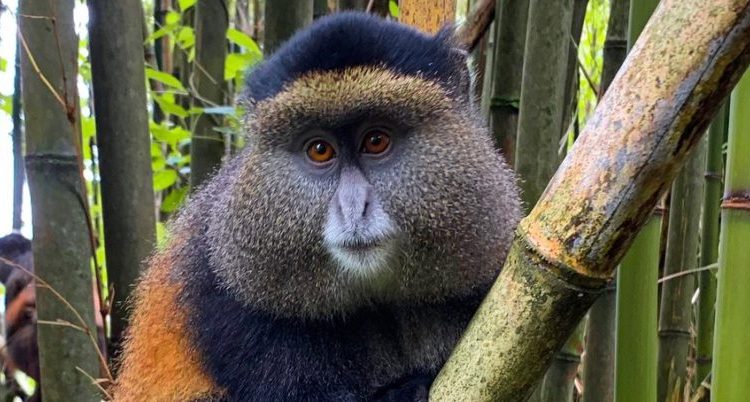
The golden monkey is a small, striking primate found only in the Albertine Rift — the mountainous region that runs through Uganda, Rwanda, the Democratic Republic of Congo, and neighbouring countries. It is a subspecies of the blue monkey group, distinguished by its golden-orange back and shoulders and its pale, expressive face. Adults weigh four to six kilograms, which makes them roughly a tenth of the size of an adult mountain gorilla.
Three points about the species:
- It is listed as endangered. The population is fragmented and small, and the species is threatened by habitat loss, degradation of the bamboo zone, and its naturally restricted range. The Virunga massif is the stronghold, and Mgahinga’s habituated troops are one of the more studied populations in the region.
- It depends on bamboo. Golden monkeys feed heavily on bamboo shoots and leaves, and their range is tied to the bamboo zone on the volcano slopes. In Mgahinga, this puts them on the lower slopes and in the saddle between the volcanoes — below the gorilla trekking altitude, and on easier terrain.
- It lives in large troops. Unlike the small family groups of gorillas, golden monkeys live in troops of 30 to 80 individuals. The viewing hour is therefore often a wide view of many animals at once, rather than a single family group.
The habituated troops at Mgahinga have been the subject of ongoing conservation work for years. Permits fund the monitoring and research that keeps the habituated troops under observation, and the trekking programme is part of the broader management of the Virunga massif alongside gorilla trekking and the surrounding national parks.
What happens during the golden monkey trekking day?
A golden monkey trekking day is shorter and gentler than a gorilla or chimpanzee trekking day. It runs two to four hours from trailhead to trailhead, with most of that time spent walking into the bamboo zone and back. The viewing window is a strict one hour, in line with every other UWA primate trekking experience.
The golden monkey trekking day, step by step
- Morning briefing at the Mgahinga trailhead. Arrive around 7:30am. The ranger guide confirms the group, the rules, and the day’s plan. Because groups are usually smaller and the trek is shorter, the briefing is efficient.
- Walk into the bamboo zone. The trek follows the lower volcano slopes into the bamboo. Walking time is typically 30 minutes to 1.5 hours, depending on where the troop has moved overnight.
- Contact with the troop. The ranger confirms the group is in view and positions the trekkers at a suitable distance. The one-hour viewing window begins.
- One hour with the golden monkeys. A strict cap, enforced the same as at every Uganda primate site. The troop often moves through the bamboo during the hour, and the rangers reposition the group to follow. No flash photography, quiet behaviour.
- Walk back to the trailhead. Usually faster than the walk in. The descent is gentle and often includes sightings of other forest species — turacos, sunbirds and other primates.
- Certificate and return. UWA issues the trekking certificate at the trailhead. The drive back to your lodge is short, and most trekkers are back by mid-morning.
The brevity of the golden monkey trek is one of its advantages. Travellers can complete it by mid-morning and still have most of the day free for other activities — a Lake Bunyonyi excursion, a drive to Kisoro, or simply a slower afternoon at the lodge. It also pairs well with a longer activity on the same day, unlike gorilla trekking which consumes the whole day.
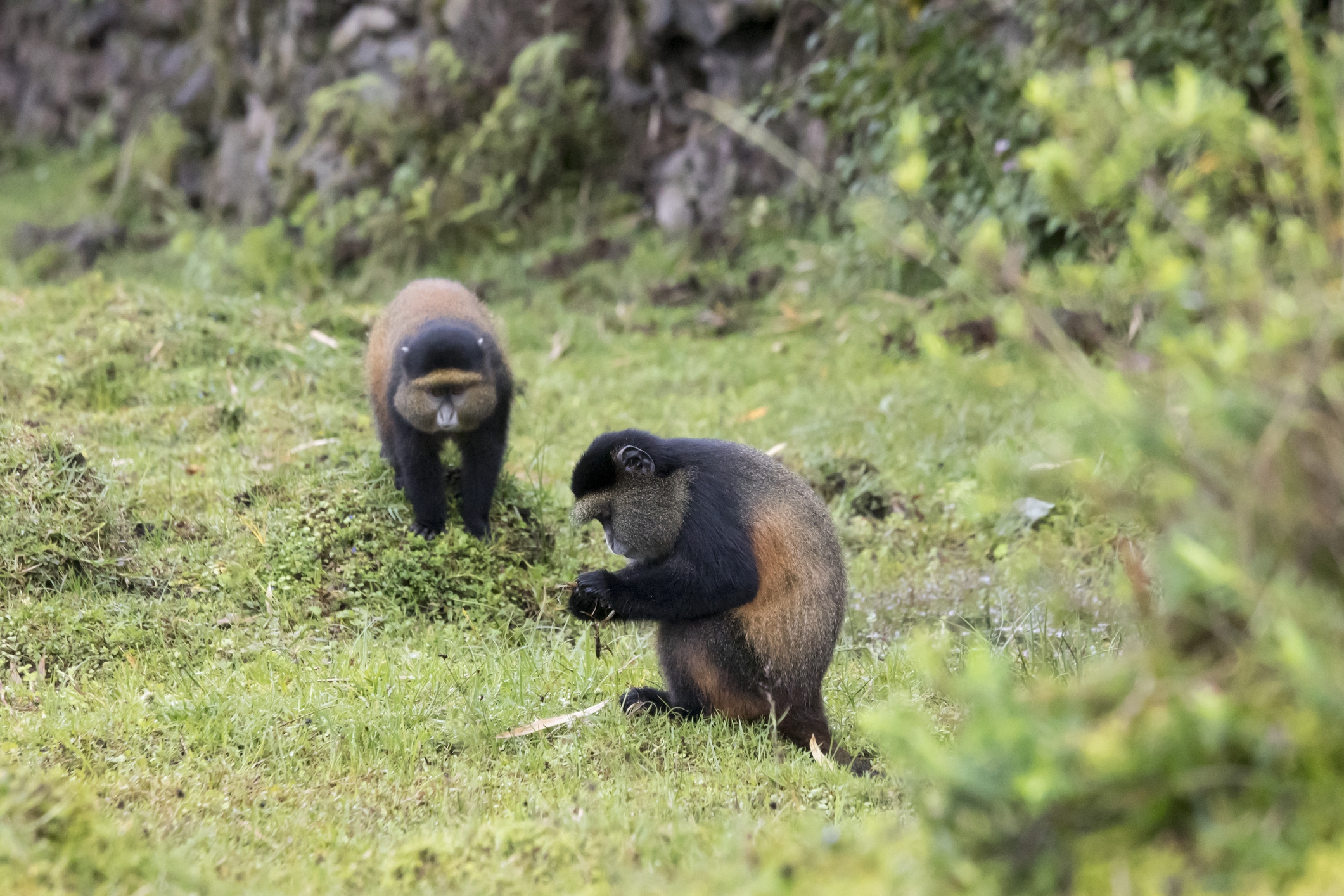
The viewing experience during the hour is genuinely different from gorilla trekking. Golden monkeys are small, fast, and arboreal. The troop is often spread across several bamboo clusters at once, and the rangers rotate the group to keep everyone in view. Some trekkers find this busier and more dynamic than a gorilla viewing; others prefer the close, quiet, stationary viewing of a gorilla family. Both are excellent — they are just different.
How does golden monkey trekking compare with gorilla and chimpanzee trekking?
Golden monkey trekking sits at the gentlest end of Uganda’s primate trekking landscape. It is shorter, at lower altitude, and more accessible than either gorilla or chimpanzee trekking. It is also the only one of the three that operates year-round for families with children under 15, because of its lower minimum age.
| Factor | Golden monkey | Gorilla | Chimpanzee |
|---|---|---|---|
| Where | Mgahinga only | Bwindi, Mgahinga | Kibale, Budongo, Kyambura, Kalinzu |
| Trek duration | 2–4 hours | 4–9 hours | 2–4 hours |
| Terrain | Gentle; lower volcano slopes | Steep; high altitude (1,500–2,600m) | Variable; generally gentle |
| Altitude | Lower than gorilla trekking | 1,500–2,600m | 1,100–1,600m |
| Minimum age | 12 | 15 | 15 |
| Viewing window | 1 hour | 1 hour | 1 hour |
| Group size | Larger troops (30–80) | Small family (up to 30) | Community (variable) |
| Best for | Families, easy trek, Mgahinga pairings | The headline primate experience | Second primate experience |
Rules for all three are the same — one-hour viewing window, distance rules, no flash, health exclusion. What differs is terrain, altitude, and the age threshold.
Two conclusions from this table. First, golden monkeys are the only primate trek in Uganda that a family with children aged 12 to 14 can do together — the minimum age is lower than the other two. Second, golden monkey trekking is the least physically demanding of the three, which makes it a good fit for travellers with knee, hip or general fitness concerns who still want a primate experience. The species itself is also distinctive — smaller, faster, and more numerous than a gorilla family, which makes the viewing hour feel lively rather than intimate.
Is golden monkey trekking suitable for families?
Yes — golden monkey trekking is the most family-friendly primate trek in Uganda. The minimum age is 12, the trek is short and gentle, the altitude is lower than the gorilla trek, and the viewing hour is often dynamic enough to keep younger trekkers engaged throughout. Families with teenagers who are too young for the gorilla trek (under 15) frequently book this instead, and the response is consistently positive.
Three practical points for families:
- The minimum age is 12. This is the key difference from gorilla and chimpanzee trekking, where the minimum age is 15. Families with children aged 12, 13 or 14 can do golden monkey trekking together; the same children cannot trek gorillas or wild chimps for another year or three.
- The terrain is easy. Lower altitude, gentler slopes, shorter duration. Families with older travellers or less-fit members can do this trek without the fitness concern that a gorilla trek requires.
- The viewing is engaging. Golden monkeys move constantly, and the troop size means there is almost always something happening. Younger trekkers tend to stay interested throughout the hour, unlike the more stationary gorilla viewing.
Because families cannot do the gorilla trek together when there is a child under 15 in the group, golden monkey trekking often becomes the family’s primary primate experience. For those families, it is a genuinely excellent one — the species is beautiful, the bamboo habitat is distinctive, and the trek itself is rewarding for trekkers of all ages. Our guide on the gorilla trekking minimum age covers the family alternatives in more detail.
How does it pair with gorilla trekking at Mgahinga?
Golden monkey trekking Mgahinga pairs naturally with the gorilla trek at the same park. Mgahinga has one habituated gorilla family — Nyakagezi — and the golden monkey troops share the same volcano massif. Travellers who trek one often trek the other on an adjacent day, and the pairing is one of the strongest two-primate combinations in Uganda.
Three practical points about pairing the two treks:
- Same trailhead, different trails. The golden monkey trek follows the lower slopes into the bamboo; the gorilla trek follows the trail to Nyakagezi’s current location. Both start at the Mgahinga trailhead, but the terrain and the experience are different enough that they do not feel repetitive.
- Do the golden monkey trek first. It is the easier of the two, and doing it the day before the gorilla trek provides a gentle acclimatisation to the altitude and the forest. Travellers who do the gorilla trek first often find the golden monkey trek anticlimactic; travellers who do the golden monkey trek first tend to enjoy both.
- Book permits for both in advance. Nyakagezi gorilla permits are tightly allocated — Mgahinga has only one habituated family — and the golden monkey permit is subject to its own limits. Booking both together ensures they align on consecutive days.
The wider primate picture in Uganda, including how the golden monkey trek compares with other primate experiences, sits on the primate tracking experiences page. The Mgahinga gorilla family is covered in our guide on Nyakagezi gorilla family. For travellers combining a Mgahinga golden monkey trek with a gorilla trek at Bwindi, the drive between the two parks is roughly an hour, which makes the combination logistically straightforward.
When is the best time for golden monkey trekking at Mgahinga?
Golden monkey trekking runs year-round at Mgahinga. The best conditions are in the drier months — December to February and June to September — when the bamboo zone is easier to walk through, the trails are firmer, and the monkeys are more visible in the bamboo canopy. The wet months bring muddier trails and denser vegetation, but the trek still runs and the viewing remains good.
Three practical points on timing:
- Dry season is easier and more comfortable. Trails are firmer, walking is faster, and photography is generally better. If your dates are flexible, the dry months are the safer choice.
- Morning treks are standard. Golden monkey treks depart in the morning, usually around 7:30 to 8:00am. The monkeys are most active in the cooler morning hours, and the trek fits neatly with an afternoon drive or a Lake Bunyonyi excursion.
- Permit availability is generally good. Because the trek is shorter and less competitive than the gorilla permit, golden monkey permits are usually easier to secure at shorter notice. For peak-season dates and families with specific age compositions, booking a few weeks ahead is still recommended.
Because Mgahinga sits at the western edge of the Virunga massif, the weather pattern follows the wider south-western Uganda pattern rather than the central Uganda pattern. Afternoon showers are common in the wet months, which is one more reason the morning trek is the standard format.
How do you book golden monkey trekking Mgahinga?
You book golden monkey trekking Mgahinga through a registered operator or directly with UWA, the same way as for other Uganda primate experiences. The permit is for a specific date and departure, and the full permit fee is payable at booking — a deposit alone does not hold the permit. Permits are non-refundable and non-transferable once issued. Current permit categories and rates are kept up to date on the gorilla permits Uganda page.
What to arrange before your golden monkey trek
- Golden monkey trekking permit for your date and departure
- Gorilla permit if you are pairing with a Nyakagezi trek (book both together)
- Transport to the Mgahinga trailhead — usually from a lodge in the Kisoro area
- Packed breakfast if leaving your lodge before dawn
- Boots, gaiters, long sleeves, gloves — the standard forest kit
- Camera with strap, flash off, spare battery
- Binoculars if you carry them — Mgahinga is excellent for birds
- Any mobility or fitness notes shared with the operator in advance
Two things are worth confirming when booking. First, that your permit is for golden monkey trekking — not for the gorilla trek, which uses a separate permit and a separate trailhead briefing. Second, whether the departure is the standard morning slot or an afternoon departure, which operates occasionally in peak season. Most operators schedule the morning trek as standard.
Because Mgahinga is roughly an hour from the Bwindi sectors and about 30 to 45 minutes from Kisoro town, the golden monkey trek fits easily into a south-western Uganda itinerary. It pairs naturally with a Bwindi gorilla trek, a Nyakagezi gorilla trek, or a Virunga volcano hike. Our Uganda destinations page maps how the parks connect, and the Uganda Tourism Board maintains national context on the parks and activities.
Common mistakes with golden monkey trekking Mgahinga
Most of what goes wrong with a golden monkey trek comes down to a small set of avoidable mistakes, and all of them can be prevented with one careful planning conversation.
- Assuming the gorilla permit covers the golden monkey trek. They are separate permits. A gorilla permit does not include golden monkey trekking, and booking one does not reserve the other.
- Forgetting the trek is a two to four hour commitment, not a whole day. Travellers often under-plan the rest of the day. There is plenty of time for other activities after the trek, and it is worth filling the afternoon.
- Skipping the trek because it is “not gorillas.” Golden monkey trekking is not a consolation prize. It is a distinct, excellent experience, and travellers who do it after a gorilla trek often rate it as one of their favourites.
- Booking it after the gorilla trek instead of before. Doing the golden monkey trek first builds acclimatisation and confidence for the gorilla trek. Doing it after often feels anticlimactic.
- Bringing children under 12. The minimum age is 12 for golden monkeys, and the rule is enforced at booking and at the briefing. Children under 12 cannot trek.
- Wearing shorts or short sleeves. The bamboo zone has nettles and thorns. Long trousers and long sleeves are the correct choice regardless of the temperature.
- Not booking permits in advance for peak season. Golden monkey permits are easier to secure than gorilla permits, but they are still limited. Book two to four weeks ahead, and earlier for peak-season dates.
- Underestimating the bamboo trek. The terrain is gentler than a gorilla trek, but it is still a forest walk on uneven ground. Proper boots with grip are essential.
Can one permit cover two people?
No. One permit covers one person for one trek, and this applies to golden monkey trekking Mgahinga the same as to any other Uganda primate experience. A family of four needs four permits for the same date and departure, and each permit is tied to a named individual. There is no way to share a permit or transfer it to another person. Current permit categories and rates sit on the gorilla permits Uganda page.
Because golden monkey treks operate on a per-permit basis with larger troop sizes, the daily cap is more generous than the gorilla permit pool. This is one of the reasons the trek is easier to book at short notice than a Nyakagezi gorilla permit. For families with children aged 12 to 14, this makes golden monkey trekking the most accessible primate experience in Uganda — and one that can genuinely be booked with less lead time than the gorilla permit requires.
Once you have your permits, the specific troop you follow is confirmed at the briefing on the morning of the trek. The ranger will explain the day’s plan, and the trackers will have been out since dawn checking the troop’s position. The one-hour viewing window, distance rules, no-flash rule and health exclusion apply to golden monkey trekking the same as to every other UWA primate site. The wider country map is on the Uganda destinations page, and the regulatory framework is set by the Uganda Wildlife Authority.
Afraeka field note: A family of five once booked a Uganda trip with three teenagers, and asked whether the golden monkey trek was worth doing given that the youngest child — 13 — could not do the gorilla trek. We booked them onto golden monkey trekking Mgahinga for the day before the parents did the Nyakagezi gorilla trek, and the whole family went together. What they told us afterwards was that the golden monkey trek had been the highlight of the trip for the youngest child and, surprisingly, for the parents too. The troop had been spread through the bamboo at eye level, and the ranger had positioned the family so that they were surrounded by monkeys feeding at close range for most of the hour. The youngest child had spent the whole hour counting individuals. The parents said the golden monkey hour had been the more active and more engaging experience, and the gorilla trek had been the more solemn and more profound one. Both, they said, had been worth doing — but the golden monkey trek had been the surprise.
A question that comes up occasionally on TripAdvisor’s Uganda forum and on r/Uganda is some version of: “Is golden monkey trekking worth doing if I am already going to trek gorillas?” The honest answer is yes, especially at Mgahinga, where the two treks share the same trailhead and the same volcano massif. The golden monkey trek is short, gentle, and delivers a completely different viewing experience — a large, active troop at close range in the bamboo, versus the quiet, stationary intimacy of a gorilla family. Families with children aged 12 to 14 can do it together in a way they cannot do the gorilla trek. Travellers with any fitness concerns can do it without the strain of a gorilla trek. And travellers who simply enjoy primates will find it one of the more rewarding hours on the Uganda circuit. It is not a substitute for the gorilla trek — it is a genuinely different experience, and worth booking as a companion rather than an alternative.
Frequently asked questions
What is golden monkey trekking Mgahinga?
A guided trek into the bamboo zone of Mgahinga Gorilla National Park, following a habituated troop of golden monkeys for a one-hour viewing window. The trek runs two to four hours in total, involves a gentle walk on the lower volcano slopes, and is the only place in Uganda where golden monkey trekking operates.
What is the minimum age for golden monkey trekking?
12 years, set by UWA. This is lower than the minimum age for gorilla trekking (15) and wild chimpanzee trekking (15), which makes it the most family-accessible primate trek in Uganda. The rule is enforced at booking and at the briefing.
How long does the golden monkey trek take?
Two to four hours from trailhead to trailhead, including the walk in, the one-hour viewing window and the walk back. Most trekkers are back at the trailhead by mid-morning, which leaves the rest of the day open for other activities.
Is golden monkey trekking physically demanding?
No — it is the least demanding of Uganda’s primate treks. The terrain is gentle, the altitude is lower than the gorilla trek, and the total duration is shorter. Travellers with knee, hip or general fitness concerns can do it comfortably, and it is suitable for families with teenagers aged 12 and over.
Do I need a separate permit for golden monkey trekking?
Yes. The golden monkey permit is separate from the gorilla permit and the chimpanzee permit. Booking one does not include the others. Current permit categories and rates are kept up to date on the gorilla permits Uganda page.
Can I combine golden monkey trekking with gorilla trekking at Mgahinga?
Yes, and it is one of the strongest primate pairings in Uganda. Mgahinga has one habituated gorilla family (Nyakagezi) and habituated golden monkey troops. Both treks start from the same trailhead. Doing the golden monkey trek the day before the gorilla trek is the recommended order.
When is the best time for golden monkey trekking at Mgahinga?
Year-round, with the drier months of December to February and June to September being the easiest underfoot and the most comfortable. Morning treks are standard, and the monkeys are most active in the cooler morning hours.
How do I book a golden monkey trekking permit?
Book through a registered operator or directly with UWA. Golden monkey permits are generally easier to secure than gorilla permits, but still limited. Book two to four weeks ahead, and earlier for peak-season dates or if you are travelling as a family group.
Is golden monkey trekking worth doing?
Yes — especially at Mgahinga, where it pairs naturally with a Nyakagezi gorilla trek. The viewing is close, active and dynamic, the troop size is large, and the trek is short and accessible. It is not a substitute for gorilla trekking, but it is a genuinely different and rewarding experience in its own right, and the most family-friendly primate trek in Uganda.
Planning a Mgahinga trip with golden monkeys?
Send us your dates, party size and whether you are also trekking gorillas at Mgahinga, and we will check golden monkey permit availability, recommend the order of the two treks, and outline how the day fits around your wider south-western Uganda itinerary. If a different primate experience would suit you better, we will say so. No price figures until we know your route, because the permits are only one line of the total.
About the author: Victoria Kayaga is a Ugandan-born safari expert and founder of Afraeka Adventures, with 15+ years in East African tourism. Based in Kampala, she has planned primate-focused itineraries across Mgahinga, Bwindi, Kibale, Budongo and Kyambura for years, and she advises travellers on combining golden monkey and gorilla trekking at Mgahinga. More about Victoria.
Keep planning