Quick answer: The main fish species anglers target in Uganda are Nile perch (the heavyweight trophy species), tigerfish (fast, toothy and explosive), Nile tilapia (widespread and beginner-friendly), several catfish species (powerful bottom fighters), marbled lungfish (an ancient air-breathing oddity) and various barbel species. Nile perch and tigerfish are the premier sport fish, found at Murchison Falls and Lake Albert. Nile perch also dominate Lake Victoria. Tilapia is found in virtually every lake and river in the country.
- Top sport fish
- Nile perch (Lates niloticus) — up to 100 kg+
- Most exciting fighter
- Tigerfish (Hydrocynus vittatus) — 1–5 kg typical
- Most widespread
- Nile tilapia (Oreochromis niloticus)
- Strongest bottom fighter
- Vundu catfish (Heterobranchus longifilis) — up to 50 kg+
- Most unusual
- Marbled lungfish (Protopterus aethiopicus)
- Best species variety
- Murchison Falls NP and Lake Albert
Uganda’s lakes, rivers and swamps hold hundreds of fish species — Lake Victoria alone was once home to over 500 cichlid species, making it one of the most species-rich lakes on Earth. For sport anglers, only a handful of these species are regular targets, but each offers a completely different fishing experience. From the raw power of a 50 kg Nile perch in the rapids below Murchison Falls to the delicate take of a tilapia on a float-fished worm at Lake Mburo, Uganda’s waters have something for every angler. This guide introduces the species you are most likely to encounter, where to find them, and how to target them.
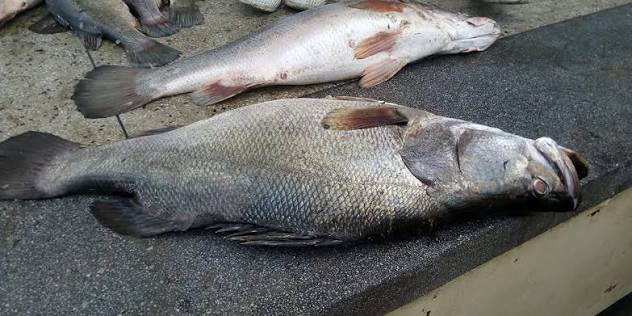
Nile perch (Lates niloticus)
The headline species and the reason most international anglers visit Uganda.
| Feature | Detail |
|---|---|
| Maximum size | Over 200 kg (world record); 100 kg+ in Uganda |
| Typical catch | 10–40 kg at Murchison Falls; 5–20 kg on Lake Victoria |
| Where | Murchison Falls (Nile), Lake Victoria, Lake Albert, Jinja |
| Methods | Lure casting, trolling, live bait |
| Tackle | Heavy spinning/baitcasting, 30–80 lb class |
| Fight style | Powerful, sustained, deep runs |
The Nile perch is one of the world’s largest freshwater fish. It is native to the Nile system and Lake Albert and was introduced into Lake Victoria in the 1950s, where it transformed the lake’s ecology and economy. In Uganda, it is the backbone of the sport-fishing industry and a major commercial food fish.
Nile perch are aggressive predators that feed on smaller fish. They hit lures hard and fight with sustained, bulldogging power — big fish in fast current (below Murchison Falls) provide some of the most challenging freshwater fishing in Africa. At Murchison Falls, all Nile perch fishing is catch and release.
Read more: Nile perch fishing in Uganda
Tigerfish (Hydrocynus vittatus)
Many experienced anglers consider the tigerfish the most exciting freshwater fish in Africa, pound for pound.
| Feature | Detail |
|---|---|
| Typical size | 1–5 kg; up to 8–10 kg possible |
| Where | Nile at Murchison Falls, Lake Albert, Nile delta |
| Methods | Spinners, small spoons, small plugs, fly fishing |
| Tackle | Medium spinning + wire trace (essential) |
| Fight style | Explosive strikes, jumping, head-shaking |
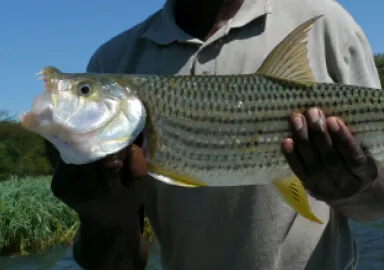
Tigerfish are characterised by their silver body with dark horizontal stripes and a fearsome set of interlocking, razor-sharp teeth. They strike fast, fight explosively and frequently leap clear of the water — making them one of the most photogenic and exciting catches in African fishing.
The wire trace is non-negotiable: tigerfish teeth cut through monofilament, fluorocarbon and even light braid in seconds. Use 20–30 lb single-strand or knottable wire, 20–30 cm long.
Tigerfish are not found in Lake Victoria. They are associated with the Nile system (Murchison Falls, the delta) and Lake Albert.
Read more: Tigerfish fishing in Uganda
Nile tilapia (Oreochromis niloticus)
| Feature | Detail |
|---|---|
| Typical size | 200 g – 1.5 kg (larger in productive waters) |
| Where | Almost everywhere: Lake Victoria, Lake Mburo, Ssese Islands, rivers, ponds |
| Methods | Bait (bread, worms, maize), small lures, flies |
| Tackle | Light spinning rod, 6–12 lb line |
| Fight style | Light but determined |
The Nile tilapia is Uganda’s most widespread fish and one of the world’s most important food fish species. For anglers, it is the go-to species for relaxed, casual fishing — ideal for beginners, children and anyone who wants a peaceful few hours by the water without the heavy tackle and logistics of big-game fishing.
Tilapia are found in virtually every lake and river in Uganda. They respond well to simple bait rigs (float and hook with bread or worms) and to small spinners and flies on light tackle. Fly fishing for tilapia with a 4–6 weight rod is excellent sport in clear water.
Tilapia are a culturally important food fish in Uganda, often served grilled whole at lakeside restaurants.
Catfish
Several catfish species inhabit Uganda’s waters. The most notable for anglers:
Vundu catfish (Heterobranchus longifilis)
| Feature | Detail |
|---|---|
| Maximum size | Over 50 kg |
| Where | Nile at Murchison Falls, Lake Albert |
| Methods | Dead/cut bait, large lures fished deep |
| Fight style | Powerful, bottom-hugging, sustained |
The vundu is a large, heavy catfish that can grow to over 50 kg. It is a powerful fighter that stays deep and uses its weight and the current to test tackle. Vundu are caught on bait (cut fish, large worms) fished near the bottom in deep pools, and occasionally on large lures. They are often caught incidentally while fishing for Nile perch.
Semutundu catfish (Bagrus docmak)
A sleek, predatory catfish that grows to 10–20 kg. More streamlined than the vundu, it takes both bait and lures. Found in the Nile and Lake Albert.
Clarias catfish
Clarias species (African sharptooth catfish) are found throughout Uganda’s freshwater habitats, including lakes, rivers, swamps and even temporary pools. They are hardy, adaptable fish that take bait readily. They are more common in Lake Mburo and smaller waters than in the big Nile perch rivers.
Electric catfish (Malapterurus electricus)
Present in the Nile but rarely targeted by anglers — for good reason. Electric catfish can deliver a shock of up to 350 volts. If you catch one accidentally, use pliers and release it carefully without touching it.
Marbled lungfish (Protopterus aethiopicus)
| Feature | Detail |
|---|---|
| Maximum size | Up to 17 kg; usually 2–8 kg |
| Where | Swamps, papyrus margins, shallow lake edges (Lake Victoria, Lake Mburo) |
| Methods | Bait (worms, cut fish) near bottom in weedy areas |
| Fight style | Strong, eel-like, twisting |
The marbled lungfish is one of Africa’s most remarkable fish. It belongs to an ancient lineage dating back hundreds of millions of years and possesses both gills and functional lungs, allowing it to breathe air. It can survive in oxygen-depleted swamps and even aestivate (a form of hibernation) buried in mud during droughts.
Lungfish are found in papyrus-fringed lake margins, swamps and sheltered bays. They are strong, muscular fighters that twist and roll when hooked. Landing one is a genuinely unique fishing experience.
Lungfish (mamba in Luganda) are culturally significant in Uganda and are a prized food fish in many communities.
Barbel (Barbus spp.)
| Feature | Detail |
|---|---|
| Typical size | 200 g – 3 kg (species dependent) |
| Where | Rivers, streams, lake margins throughout Uganda |
| Methods | Small bait, small lures, flies |
| Fight style | Spirited for their size |
Several barbel species inhabit Uganda’s rivers and lakes. They are small but spirited fish that provide fun on ultra-light tackle. Barbel are often caught incidentally while fishing for larger species at Murchison Falls or in streams near the parks. Fly anglers enjoy targeting them on light fly rods in clear water.
Which species should you target?
| If you want | Target | Best destination |
|---|---|---|
| A trophy fish | Nile perch | Murchison Falls |
| Explosive action and jumps | Tigerfish | Murchison Falls or Lake Albert |
| A relaxed session | Tilapia | Lake Mburo or Ssese Islands |
| Easy access from Kampala | Nile perch (trolling) | Lake Victoria from Entebbe |
| Adventure + variety | All species | Multi-destination 7-day fishing safari |
| Something unique | Lungfish | Lake margins, papyrus swamps |
| Fishing + rapids | Nile perch + tilapia | Jinja |
Frequently asked questions
What is the biggest fish in Uganda?
The Nile perch. Fish over 100 kg have been caught in Ugandan waters, primarily at Murchison Falls. The world record Nile perch (caught in Egypt’s Lake Nasser) exceeded 230 kg.
Can lungfish really breathe air?
Yes. Marbled lungfish have functional lungs in addition to gills. They surface to gulp air, which allows them to survive in oxygen-poor swamps where other fish would suffocate. They can even survive dry seasons buried in mud.
Which fish is best for beginners?
Tilapia. They are common everywhere, easy to catch on simple bait, and found in calm, accessible waters. Lake Mburo and the Ssese Islands are excellent beginner-friendly destinations.
Are there any dangerous fish in Uganda?
Tigerfish have extremely sharp teeth — always use pliers for handling. Electric catfish can deliver a painful shock. Neither species attacks humans, but careless handling can cause injury. The real water hazards in Uganda are hippos and crocodiles, not fish.
Is there good fly fishing in Uganda?
Yes, though it is niche. Tigerfish and tilapia are excellent fly targets. Tigerfish on a 7–9 weight rod with wire tippet is growing in popularity. Tilapia on a 4–6 weight rod in clear water is superb light-tackle sport. Nile perch on fly gear is possible but extremely demanding (10–12 weight rod, heavy sinking lines).
Want to target a specific species? Tell us what you want to catch and we will suggest the best destination and season.