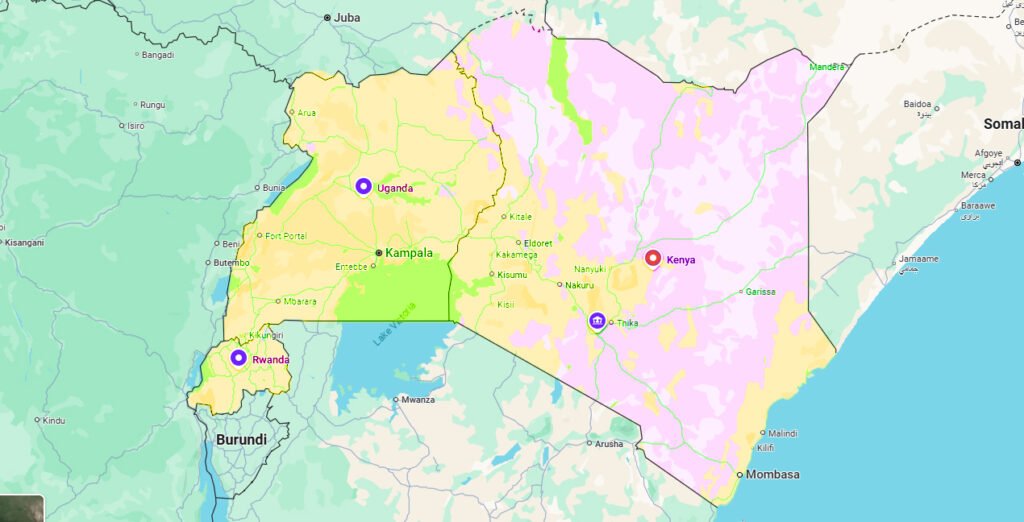

A first East Africa safari usually fails for the same reason: the itinerary tries to cover four countries in ten days. East Africa is large, the road transfers are slow, and the flights that save time are expensive. The trips that work are the ones that pick two destinations, give each enough days, and accept that the rest of the region is for a second visit.
This article sets out the four destinations a first East Africa safari realistically chooses between, how the visa arithmetic works, how many days the trip needs, and the decisions that most often go wrong. It is a planning framework rather than an itinerary, and the cost figures are split between what is fixed and confirmed and what must be quoted for your specific dates.
What a First East Africa Safari Actually Involves
East Africa safari is not one product. The four countries in the region offer different things, and the differences matter more on a first trip than on any later one, because the first itinerary sets expectations.
The central split is between wildlife viewing and primate trekking. Kenya and Tanzania hold the classic savannah parks — open plains, big cats, high wildlife density in a landscape most people picture when they hear the word safari. Uganda and Rwanda hold the mountain gorillas, and Uganda also holds chimpanzees and a wider range of habitats. Uganda is the one country with a foot in both camps.
Mountain gorillas exist in Uganda, Rwanda and the Democratic Republic of Congo only. They are not found in Kenya or Tanzania. The global population is around 1,000 individuals. Any itinerary that promises gorilla trekking in Kenya or Tanzania is wrong on the geography.
The Four Destinations at a Glance
| Country | What it does best | Gorilla trekking | Gorilla permit (per person) |
|---|---|---|---|
| Uganda | Gorillas plus chimpanzees plus savannah parks in one country | Yes — Bwindi and Mgahinga | From $800 (From $600 in April, May and November) |
| Rwanda | Gorillas, Akagera, Nyungwe; short transfers and easy logistics | Yes — Volcanoes National Park | $1,500 — no low season discount |
| Kenya | Classic savannah, Masai Mara, Amboseli; strong flight network | No | Not applicable |
| Tanzania | Serengeti and Ngorongoro; the largest contiguous wildlife areas | No — chimpanzees only, in the west | Not applicable |
Two practical points follow from that table. First, if mountain gorillas are the reason for the trip, the country choice is Uganda or Rwanda, and the $700 difference in permit price is the main financial decision. Second, if the trip is a classic savannah safari, Kenya and Tanzania are the choices, and Uganda and Rwanda become add-ons rather than the base.
Gorillas or Savannah — the Decision That Shapes Everything
Most first East Africa safari planning comes down to this question, and it is worth answering honestly rather than trying to have both.
If gorillas are the priority, budget at least four to five nights in Uganda or Rwanda. A gorilla permit buys one trekking day, and the surrounding days cover arrival, transfer to the trailhead and recovery. Uganda adds chimpanzee trekking in Kibale and savannah in Queen Elizabeth and Murchison Falls, which means a gorilla trip there can also include conventional game drives.
If savannah wildlife is the priority, Kenya or Tanzania carries the trip. Kenya offers shorter internal flights and the Masai Mara and Amboseli in a compact circuit. Tanzania offers the Serengeti and Ngorongoro Crater and generally rewards longer trips, because the distances are larger.
If the answer is both, the realistic combination is Uganda plus Kenya, or Rwanda plus Kenya. Both work because each country is served by its own international gateway and the connecting flight is short. Trying to add Tanzania to a gorilla trip usually produces a rushed itinerary rather than a richer one.
The Uganda gorilla trekking guide and the Rwanda gorilla trekking guide cover the trekking side in detail.
The Visa Arithmetic for a First Trip
Visas are the part of first-trip planning that most often surprises people, because the cost depends on which countries are combined rather than on how long the trip is.
| Visa | Where to apply | Covers | Price (per person) |
|---|---|---|---|
| Uganda e-visa | visas.immigration.go.ug | Uganda only | $50 |
| Rwanda e-visa — single entry | irembo.gov.rw | Rwanda only | $50 |
| Rwanda e-visa — multiple entry | irembo.gov.rw | Rwanda only | $70 |
| Kenya eTA | etakenya.go.ke | Kenya only | From $30 |
| East African Tourist Visa | Applied for before travel | Uganda, Kenya and Rwanda — 90 days, multi-entry. Does not cover Tanzania. | $100 |
The East African Tourist Visa is the useful one for a combined trip. At $100 it replaces three separate visas for Uganda, Kenya and Rwanda and allows multiple entries over 90 days. For a Uganda plus Kenya trip it is cheaper and simpler than two separate applications. For a Uganda plus Rwanda trip it is roughly the same cost as two separate visas, but it covers a third country if the itinerary changes.
Two limits are worth stating plainly. The East African Tourist Visa does not cover Tanzania. A trip that includes Tanzania needs a separate Tanzanian visa, and the fee and application portal should be confirmed with Tanzanian immigration before travel rather than taken from a general article. And the Uganda–Russia visa waiver announced in October 2026 covers diplomatic and service passports only — it does not apply to ordinary tourist passports and has not yet entered into force.
The visa detail for the Uganda leg is covered in more depth in the Uganda visa requirements guide.
How Many Days a First Safari Needs
The honest answer is that a first East Africa safari needs more days than most people initially allocate, because travel days consume itinerary time that is invisible on a map.
A single-country gorilla trip in Uganda: seven to nine nights. Two nights in Entebbe or Kampala for arrival and recovery, two nights near Bwindi for the trek, and two to four nights in Queen Elizabeth or Murchison Falls for savannah game drives. This is the itinerary that gives the best value in Uganda, because the long transfers are used once and the parks are grouped.
A single-country Rwanda trip: five to seven nights. Two nights in Kigali, two to three nights at Volcanoes National Park, and optionally Akagera or Nyungwe. Rwanda is compact and the transfers are short, which is why it works as a shorter trip than Uganda.
A Kenya savannah trip: seven to ten nights. Nairobi plus the Masai Mara and Amboseli is a comfortable circuit, with internal flights removing most of the road time.
A Tanzania savannah trip: eight to eleven nights. The Serengeti and Ngorongoro Crater reward a longer stay, and the distances between parks make a short trip feel thin.
A combined gorilla plus savannah trip: ten to fourteen nights. Uganda plus Kenya, or Rwanda plus Kenya, with one connecting flight.
Anything under six nights in a single country is a sampler rather than a safari. It can work, but it will involve more time in vehicles than in parks.
When to Go
Season matters, but on a first trip the country choice matters more, and the two interact. Uganda and Rwanda are equatorial and can be trekked year-round, with wetter periods affecting trail conditions rather than whether trekking happens. Kenya and Tanzania have more pronounced dry and wet seasons, and the dry months are when wildlife concentrates around water.
Two seasonal points are worth planning around. Uganda’s gorilla permit drops to $600 per person in April, May and November, which makes the low season the cheapest window for a gorilla trek. And the wildebeest movement through the Masai Mara and northern Serengeti is a seasonal event with a timing that varies year to year — treat any specific date range as an indication and confirm current expectations before booking around it.
For a first trip, the practical approach is to choose the country and the number of nights first, then choose the month. Choosing the month first usually forces the itinerary into a shape that serves the calendar rather than the trip.
What a First East Africa Safari Costs
The table separates fixed, confirmed costs from elements that must be quoted for your specific dates. Operator costs, lodge rates and park fees vary by country, season and itinerary.
| Element | Where | Price (per person) |
|---|---|---|
| Uganda gorilla permit | Bwindi Impenetrable NP and Mgahinga Gorilla NP | From $800 (From $600 in April, May and November) |
| Rwanda gorilla permit | Volcanoes National Park — no low season discount | $1,500 |
| Uganda gorilla habituation experience | Rushaga sector, Bwindi only — 4 hours | From $1,500 |
| East African Tourist Visa | Uganda + Kenya + Rwanda, 90 days multi-entry; does not cover Tanzania | $100 |
| Uganda e-visa | visas.immigration.go.ug before travel | $50 |
| Rwanda e-visa — single entry | irembo.gov.rw before travel | $50 |
| Kenya eTA | etakenya.go.ke before travel | From $30 |
| Chimpanzee trekking permit | Kibale Forest and other forests | Confirm current rate when booking |
| Kenya park and conservancy fees | Masai Mara, Amboseli and others | Confirm current rate when booking |
| Tanzania visa and park fees | Serengeti, Ngorongoro and others | Confirm current rate when booking |
| Lodges, camps and internal flights | Varies by country, season and standard | Confirm current rate when booking |
Permit and park fees are set by the relevant authorities and revised periodically — the Uganda Wildlife Authority for Uganda, the Rwanda Development Board for Rwanda and the Kenya Wildlife Service for Kenya. Verify current rates before travel (verify current requirements before travel — rules change).
Common First-Timer Mistakes
- Too many countries. Four countries in twelve days means a large share of the trip is spent at airports and on transfers.
- One night at a gorilla trailhead. Trekking starts early, and arriving the same morning is unreliable. Two nights is the practical minimum.
- Forgetting the arrival night. Long-haul flights land in the evening or after dark. The first night is for recovery, not for a game drive.
- Assuming gorillas are everywhere. Mountain gorillas are in Uganda, Rwanda and DR Congo only. Kenya and Tanzania itineraries do not include them.
- Booking the permit before the dates. Permits are date-specific and non-transferable in practice. Confirm flights and lodge availability first, then secure the permit — book in advance.
- Treating low season as a compromise. The Uganda permit discount in April, May and November is a genuine saving on a fixed cost, and trekking runs year-round.
- Underestimating altitude and fitness. Gorilla trekking involves walking at altitude through dense forest. Anyone with a heart or lung condition should discuss the trek with a doctor before committing.
Frequently Asked Questions
Where should I go on my first East Africa safari?
It depends on whether gorillas or savannah wildlife is the priority. Uganda or Rwanda for gorillas; Kenya or Tanzania for classic savannah. Uganda is the only country that offers both in one itinerary, which makes it a common first choice for travellers who want variety.
How many days do I need for a first safari?
Seven to nine nights for a single-country Uganda trip, five to seven for Rwanda, seven to ten for Kenya, eight to eleven for Tanzania, and ten to fourteen for a combined gorilla and savannah trip. Anything under six nights in one country is a sampler.
Should I do gorilla trekking or a classic safari first?
There is no rule. Gorilla trekking is a single, time-limited encounter with a one-hour limit per family, while savannah safari is a series of game drives over several days. Travellers who want the encounter that cannot be repeated elsewhere usually choose gorillas; travellers who want variety across days usually choose savannah.
Do I need a separate visa for each East African country?
Not necessarily. The East African Tourist Visa costs $100, covers Uganda, Kenya and Rwanda for 90 days with multiple entries, and replaces the three individual visas. It does not cover Tanzania, which requires a separate visa.
Is Kenya or Tanzania better for a first safari?
Kenya is more compact, with shorter internal flights and a tighter circuit between the Masai Mara and Amboseli. Tanzania has larger contiguous wildlife areas and rewards a longer trip. Neither is better in absolute terms — the choice depends on how many nights you have.
Can I combine gorilla trekking with a safari?
Yes, and the most efficient combinations are Uganda plus Kenya, or Rwanda plus Kenya. The connecting flight is short and each country has its own international gateway. Adding Tanzania to a gorilla trip usually produces a rushed itinerary.
How much does a first East Africa safari cost?
The fixed costs are known: gorilla permits from $800 in Uganda and $1,500 in Rwanda, and the East African Tourist Visa at $100. Lodge, transport, park fee and flight costs vary substantially by country, season and standard, and must be quoted for specific dates rather than estimated from a general article.
Do I need a yellow fever certificate for East Africa?
Uganda has removed the yellow fever certificate entry requirement. Requirements for Kenya, Rwanda and Tanzania differ and change periodically, and some countries require a certificate for travellers arriving from a yellow fever risk area. Confirm current rules with a travel clinic and the relevant immigration authority before travel.
How to Book
The most useful first step is to decide the priority — gorillas or savannah — and how many nights are available. Those two answers narrow the country choice to two options, and the itinerary follows from there. Afraeka Adventures is a licensed Ugandan operator based in Entebbe and Kampala, running safaris and primate trekking in Uganda, Rwanda, Kenya and Tanzania since 2018.
Contact Afraeka Adventures at info@afraekaadventures.com or use the enquiry form on our website with your dates, group size, the wildlife you most want to see and any mobility or health considerations. Useful starting points:
- Uganda gorilla trekking — permits, sectors and fitness
- Rwanda gorilla trekking — the Rwanda permit and trekking rules
- Uganda safari packages
- Rwanda safaris
- Kenya safaris
- East Africa multi-country safaris
- Uganda visa requirements
- All tour packages
- Enquiry form