Last updated: 26 September 2026. Rates and availability are set by UWA and subject to change — confirm before booking.
Short answer: Chimpanzee trekking vs gorilla trekking is not a contest — they are different experiences, and most travellers who can afford both do both. Gorilla trekking gives you one hour at close range with a habituated family in a forest, at altitude, under strict rules. Chimpanzee trekking gives you one hour with a more active, louder, less predictable community, sometimes at distance in the trees, on easier terrain, for a fraction of the permit cost. Gorilla trekking is the more physically demanding, more expensive and more reliably memorable experience. Chimpanzee trekking is easier, cheaper, and more variable.
If you are planning a Uganda primate trip and can only pick one, you need to know how they differ in practice, not in marketing. Both are called “trekking,” both involve a one-hour viewing window, both are governed by the same UWA rules — and yet they feel almost nothing alike. Understanding those differences is what makes the choice obvious for most travellers.
This guide compares them directly. Terrain, reliability, cost, duration, physical demand, photography, families, and what each is genuinely best at. It is written for travellers who are deciding between the two, or working out whether to do both. It sits alongside the existing gorilla content on the Uganda gorilla trekking hub, the wider primate picture on the primate tracking experiences page, and the permit categories on the gorilla permits Uganda page. The regulatory framework that governs both experiences is published by the Uganda Wildlife Authority.
Chimpanzee trekking vs gorilla trekking — key facts
- Viewing window: 1 hour for both
- Minimum distance: 7 metres for gorillas; similar guidance for chimps
- Permit cost: Gorilla permits are much more expensive; chimp permits are substantially cheaper
- Reliability: Gorilla sightings are near-guaranteed; chimp sightings usually above 90% at Kibale and Budongo
- Terrain: Gorilla trekking is steeper and higher; chimp trekking is generally easier
- Group size: Max 8 for gorillas; similar for chimps; habituation experience is much smaller
- Minimum age: 15 for both
- Best combined: 8–12 day Uganda itineraries cover both
What’s the difference between chimpanzee trekking and gorilla trekking?
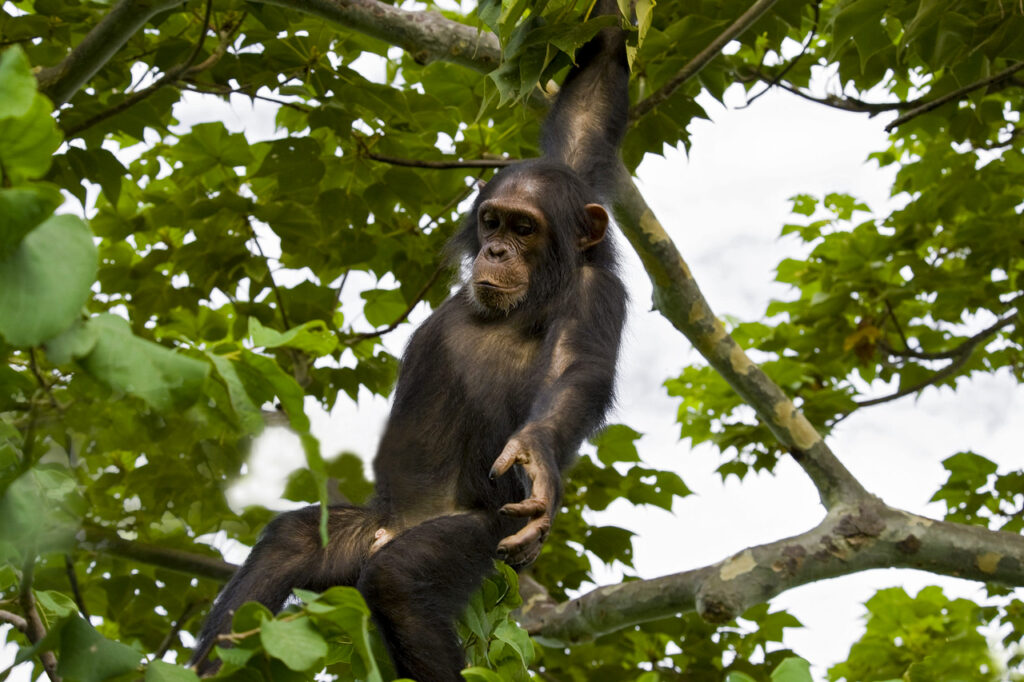
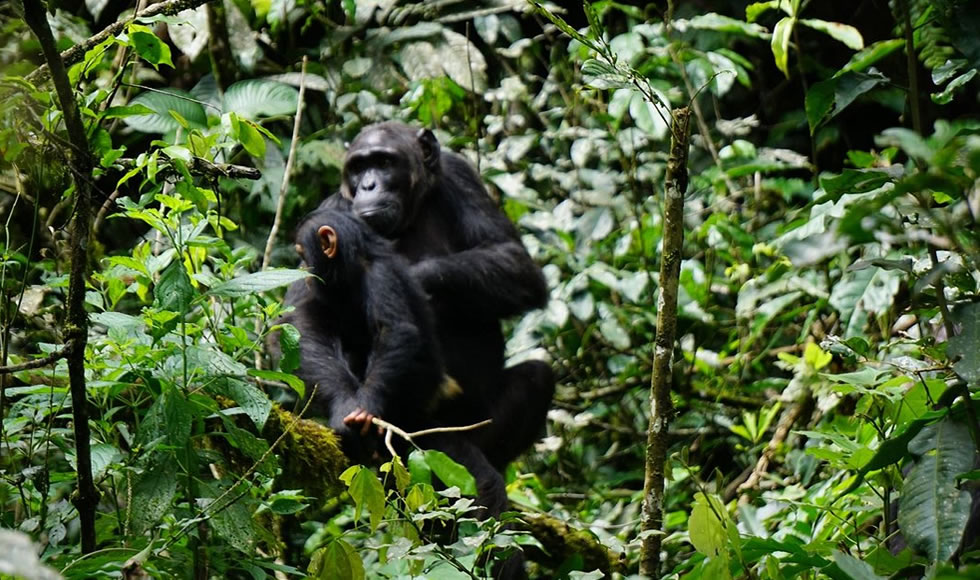
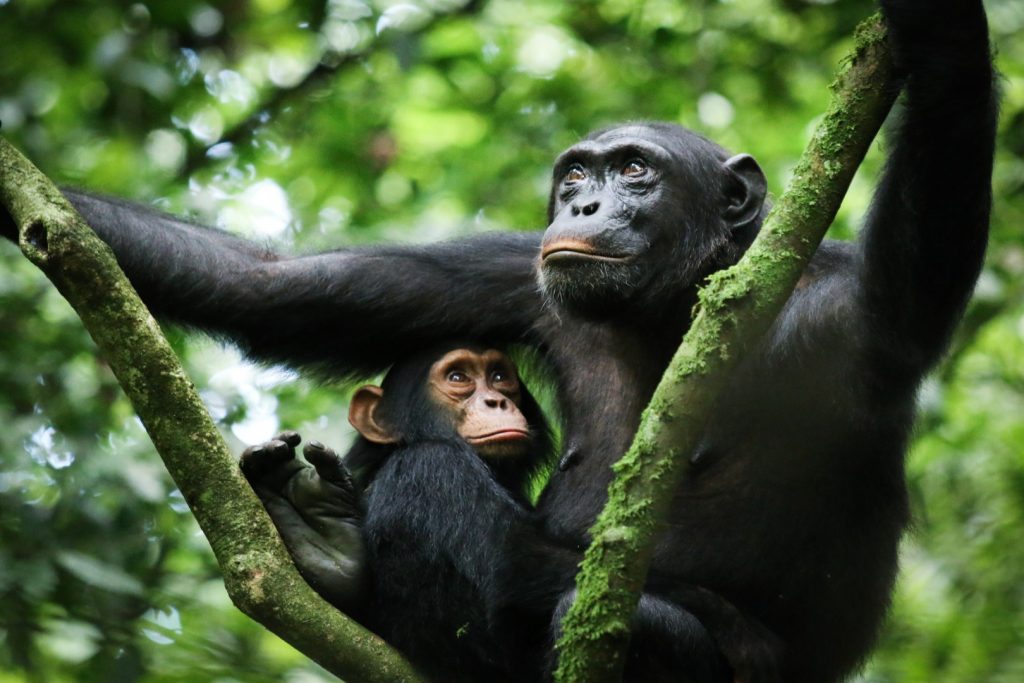
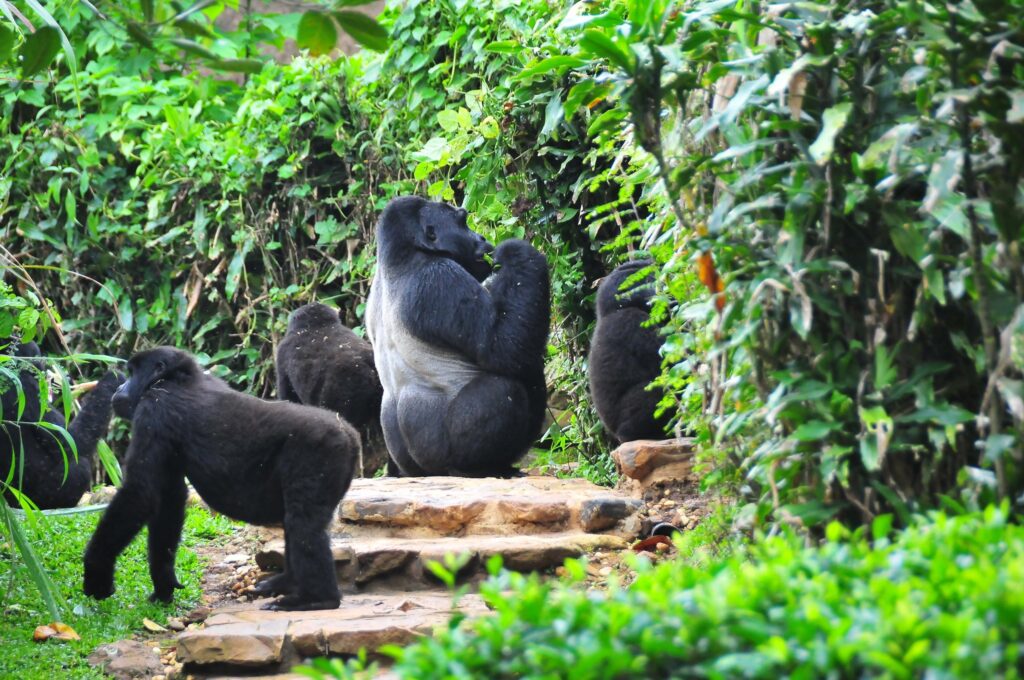
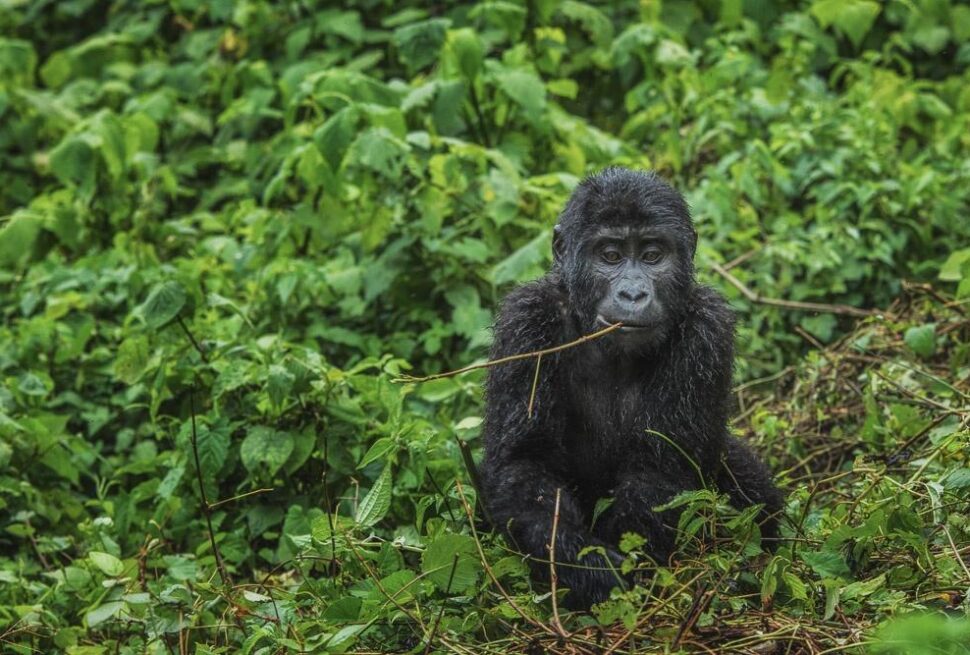
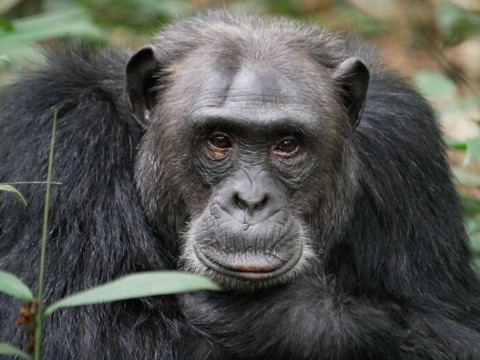
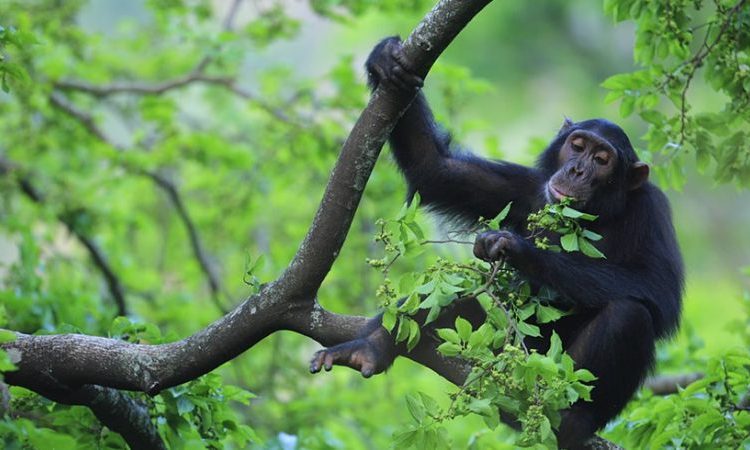
The difference between chimpanzee trekking and gorilla trekking comes down to four things: the animal, the terrain, the reliability, and the price. Gorillas are larger, slower-moving and generally more stationary during the viewing hour; they sit, eat, groom, and let you watch at close range. Chimpanzees are faster, louder, more arboreal, and often move through the forest while you follow — which means the viewing hour can feel more like tracking than observing. The two species are very different to spend an hour with, and that difference is the core of the choice.
Terrain follows from the animal. Gorillas live in Bwindi’s steep, high-altitude forest and Mgahinga’s volcanic slopes, and their trekking sectors are physically demanding. Chimpanzees live across several forests in Uganda — Kibale, Budongo, Kyambura, and others — and most of those forests are lower, gentler, and easier to walk through. The gorilla trekking day is generally harder on the body than the chimpanzee equivalent, with the exception of Kyambura Gorge, which is a descent into a gorge and rivals Bwindi for difficulty.
Reliability and price are the other two differences. Gorilla sightings are effectively guaranteed — the tracking system locates each habituated family before the trekkers even leave the trailhead, and success rates are consistently above 95%. Chimpanzee sighting rates are also high at the main sites (Kibale and Budongo), but more variable because chimpanzees range more widely and are less predictable. On price, the gorilla permit is several times the cost of a chimpanzee permit — but that reflects scarcity and the conservation model, not the quality of the experience.
Chimpanzee trekking vs gorilla trekking: side-by-side comparison
Side by side, the two experiences differ in almost every practical dimension except the one-hour viewing window and the seven-metre distance rule. The table below shows how they compare on the points that matter most to travellers planning a Uganda primate trip.
| Factor | Gorilla trekking | Chimpanzee trekking |
|---|---|---|
| Where | Bwindi, Mgahinga (south-west Uganda) | Kibale, Budongo, Kyambura, other forests |
| Permit cost | Significantly higher | Substantially lower |
| Viewing window | 1 hour | 1 hour |
| Minimum age | 15 | 15 |
| Terrain | Steep, high altitude (1,500–2,600m) | Generally lower and gentler, with Kyambura as an exception |
| Reliability of sighting | Very high (95%+) | High at Kibale and Budongo; lower at Kyambura |
| Typical trek duration | 4–9 hours | 2–4 hours (standard trek) |
| Viewing character | Close range, often stationary | Sometimes at distance; more mobile |
| Best season | Dry months easier; year-round | Dry months easier; year-round |
| Habituation experience | Not offered | Yes — full-day at Kibale |
Cost figures change with UWA tariff updates. Confirm current rates and categories on the permits page.
Two things stand out from this table. First, the two experiences are not substitutes — they are complements. A traveller who loves spending an hour at close range with a habituated family will also love the very different challenge of tracking chimpanzees through a forest. Second, the main practical constraint on doing both is time and budget, not availability. The permit system, the rules, and the tracking infrastructure are separate for each species, so there is no conflict between them.
Which is physically harder?
Gorilla trekking is generally physically harder than chimpanzee trekking. Bwindi’s trailheads sit at 1,500 to 2,600 metres depending on the sector, and the walks involve sustained climbing, steep descents and dense understory. Kibale and Budongo are lower, gentler and shorter. Kyambura Gorge is the exception — the descent and ascent are comparable to the hardest Bwindi sectors — but Kyambura is an outlier among the chimpanzee sites, not the rule.
Three practical consequences for travellers weighing fitness:
- If you have knee or hip concerns, chimpanzee trekking at Kibale or Budongo is the easier option. The terrain is gentler, the walking distances are shorter, and the total day is far shorter than a gorilla trekking day.
- If you want a full-day physical challenge, gorilla trekking delivers it. The range from four to nine hours is a genuine test for travellers who walk on hills regularly.
- If you want both and you are not particularly fit, do the chimp trek first and build confidence. For travellers who are unsure about fitness, doing the easier trek first tends to reduce anxiety about the harder one.
The one exception to remember: Kyambura Gorge. Kyambura sits inside Queen Elizabeth National Park, and the descent into the gorge is around 100 metres of vertical trail on muddy ground. The ascent at the end is arguably the hardest single climb of any trekking site in Uganda outside Bwindi’s Nkuringo sector. Our guide on Kyambura Gorge chimpanzee tracking covers the descent and ascent in detail.
Which is better for photographers?
Gorilla trekking is generally better for photographers, for three reasons. First, gorillas are larger and usually closer — the seven-metre distance at which trekkers view gorillas means a 70-200mm lens fills the frame easily. Second, gorillas move slowly during the viewing hour, which allows for careful composition. Third, the light in Bwindi’s forest is often shaded by canopy, which produces soft, even lighting that flatters both animals and forest.
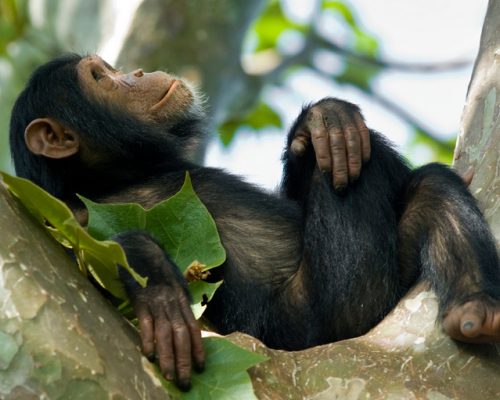
Chimpanzee photography is more variable. The animals are smaller, more arboreal, and often moving. They frequently sit in trees with leaves in front of them, which means the light is dappled and the composition is difficult. The result is that chimp photography produces excellent images on some days and difficult conditions on others. Photographers who want reliable results should not rely solely on the chimp trek for their portfolio work.
What shifts the balance for some photographers is the full-day habituation experience at Kibale. Because you are with the community for hours rather than one hour, you have far more time to get the shot — and you see the community in feeding, socialising and nesting contexts that a one-hour window rarely captures. Our guide on the chimpanzee habituation experience covers the format in detail.
Which is better for families and less-fit travellers?
Chimpanzee trekking is generally better for families and less-fit travellers. The treks are shorter, the terrain is gentler at most sites, and the total day commitment is smaller. The minimum age is the same — 15 — so the family decision is really about how well each traveller handles the physical demands, not about whether children can trek at all.
Choosing between them by traveller type
- Regular hikers and fit travellers: Do gorillas first, then chimps if time allows. Both are manageable.
- Travellers with knee or hip concerns: Chimps first (Kibale or Budongo), gorillas only in Buhoma or Rushaga.
- Families with teenagers 15+: Either works; gorilla trekking is the more memorable shared experience.
- Older travellers with reasonable fitness: Gorillas in Buhoma or Rushaga; chimps at Budongo or Kyambura (if they can handle the descent).
- Travellers short on time: Gorillas only — the permit is the biggest investment and Bwindi is the headline experience.
- Travellers short on budget: Chimps only — the permit is far cheaper and the experience is excellent.
- Photographers: Both, with the chimp habituation experience added if possible.
- Travel with a mix of fitness levels: Chimps at Kibale or Budongo; gorillas only if the whole party can manage Bwindi terrain.
The common thread is that chimpanzee trekking is the easier entry point. Travellers who are unsure about the physical demands of a gorilla trek often find that a chimpanzee trek builds confidence and helps them calibrate what they can do before committing to Bwindi. Our guide on gorilla trekking fitness level covers the gorilla side in detail.
Can you do both on one trip?
Yes — and doing both is the standard format for travellers who come to Uganda specifically for primates. The typical structure is three to four days in Kibale or Budongo for chimpanzees, followed by a drive south-west to Bwindi or Mgahinga for gorillas. The drive between Kibale and Bwindi takes most of a day, so most itineraries build in a rest day between the two.
| Day | Activity | Where |
|---|---|---|
| 1–2 | Travel to Kibale or Budongo; chimpanzee trek | West or north-west Uganda |
| 3 | Rest day; transfer south | Kibale to Bwindi (long drive) |
| 4 | Gorilla trekking day | Bwindi or Mgahinga |
| 5–6 | Queen Elizabeth or Lake Bunyonyi extension | South-west |
Structure assumes both treks and a rest day between. Longer itineraries allow additional game drives, boat safaris and cultural activities.
Two things worth building into the plan. First, the rest day between the two treks makes the second one far more enjoyable — arriving at Bwindi having just done a chimp trek is possible but tiring. Second, the two treks should be booked together if possible, so availability on both can be managed as a single plan rather than two separate ones. Chimpanzee permits are more forgiving than gorilla permits at most sites, but the combined booking still benefits from early commitment.
Our 7-day Uganda and Rwanda primate safari is built around both trekks, and the 16-day Rwanda and Uganda gorilla trekking and big five safari shows how the primate sections fit into a longer East African trip. The 18-day Uganda safari is the extended version.
Common mistakes when choosing between them
Most of what goes wrong with the chimp-vs-gorilla decision comes down to a small set of avoidable mistakes, and all of them can be prevented with one careful planning conversation.
- Treating them as substitutes. They are complementary experiences. A traveller who loves gorillas will almost always love chimps too, and vice versa.
- Assuming chimpanzee trekking is “the easier version of gorilla trekking.” It is easier physically, but the viewing hour is genuinely different — more mobile, often at distance, and with a different relationship between the trekkers and the animals.
- Underestimating Kyambura Gorge. Kyambura is the exception to the “chimps are easier” rule. The gorge descent and ascent are comparable to the hardest Bwindi sectors.
- Skipping the habituation experience at Kibale. For photographers and behaviour-focused travellers, the full-day format is worth the extra cost and the longer booking lead time.
- Doing both on back-to-back days without a rest day. The combined itinerary is much more enjoyable with a day between the two treks.
- Booking them separately. Booking permits for both in a single plan makes availability management far easier, especially if dates are tight.
- Assuming chimpanzee permits are always available at short notice. Budongo is often open at short notice; Kibale habituation permits are tightly booked; Kyambura permits are more limited than they appear.
- Forgetting the minimum age is 15 for both. Families travelling with children under 15 need an alternative plan for them regardless of which trek they are considering.
Can one permit cover two people?
No. One permit covers one person for one trek — this applies to both chimpanzee permits and gorilla permits, and there is no combined permit that covers both species for one traveller. A party of four doing both experiences needs eight permits: four chimpanzee permits and four gorilla permits. Each permit is tied to a named individual, and there is no way to share one or transfer it to another person. Current permit categories and rates for both species sit on the gorilla permits Uganda page.
The daily caps are separate. Gorilla permits are capped per habituated family per sector per day, and chimpanzee permits are capped per habituated community per site per day. The two caps do not interact, so booking a chimpanzee trek does not affect gorilla availability on the same dates, and vice versa. This is one of the reasons the combined itinerary is logistically straightforward — the two systems run in parallel rather than competing.
Once you have your permits, each trek has its own group allocation confirmed on the morning of the trek. The gorilla family or chimpanzee community you visit is determined by the ranger on the day, based on where the animals nested overnight. The one-hour viewing window, the seven-metre distance, the no-flash rule and the health exclusion apply to both. The species differ; the rules do not. The wider country map is on the Uganda destinations page, and the conservation context for both species sits with the International Gorilla Conservation Programme.
Afraeka field note: A traveller who had already done chimpanzee trekking in Kibale two years earlier contacted us about a return trip specifically for gorillas, and asked us a direct question: was he going to be disappointed after having had such a good chimp experience? The honest answer was that chimpanzee trekking vs gorilla trekking is not a comparison you win — they are different sports. He trekked in Buhoma, and came back with a version of the same observation we hear from most travellers who do both. Gorilla trekking had been the more physically demanding, more emotionally weighty experience, and the hour with the family had felt almost ceremonial. Chimpanzee trekking had been more like tracking — louder, more active, more of a chase. He loved both, but for different reasons, and the two didn’t compete in his memory at all. That is the honest framing. The choice is rarely about which is better. It is about which one you want first.
A question that comes up regularly on TripAdvisor’s Uganda forum and on r/Uganda is some version of: “If I can only do one, should I do chimps or gorillas?” The honest answer, for most travellers, is gorillas. The permit is more expensive and the experience is more physically demanding, but the one-hour viewing with a habituated mountain gorilla family is the single experience that draws travellers to Uganda in the first place, and it delivers on that reputation. Chimpanzee trekking is the excellent second — easier, cheaper, more variable, and often scheduled around the gorilla permit rather than in competition with it. Travellers who come for both get the strongest possible primate itinerary. Travellers who come for one usually come for gorillas.
Frequently asked questions
Is chimpanzee trekking vs gorilla trekking a fair comparison?
It is a fair comparison in the sense that the two experiences are closely related and travellers often have to choose between them. But they are different sports — gorilla trekking is closer to a formal viewing, chimpanzee trekking is closer to a chase. The fair comparison is not “which is better” but “which suits your priorities.”
Which is more expensive — chimpanzee trekking or gorilla trekking?
Gorilla trekking is significantly more expensive. Gorilla permits cost several times what chimpanzee permits cost, reflecting the scarcity of habituated mountain gorilla families and the scale of the conservation programme. Chimpanzee permits are substantially cheaper. Current rates for both are kept on the gorilla permits Uganda page.
Which is physically harder — chimps or gorillas?
Gorilla trekking is generally harder. Bwindi’s terrain is steeper, at higher altitude, and the total trekking day is longer. Chimpanzee trekking at Kibale and Budongo is on gentler terrain and typically runs two to four hours. Kyambura Gorge is the exception — it involves a steep descent into a gorge and rivals Bwindi for difficulty.
Which is better for photography?
Gorilla trekking is generally better — the gorillas are larger, closer and more stationary during the viewing hour. Chimpanzees are smaller, more arboreal and more mobile, which makes composition harder. The full-day habituation experience at Kibale narrows the gap by giving photographers several hours with the community instead of one.
Can you do both chimpanzee and gorilla trekking on one trip?
Yes, and it is the standard format for primate-focused travellers. A typical itinerary spends three to four days in Kibale or Budongo, transfers south over a day, then does gorillas in Bwindi or Mgahinga. Most itineraries include a rest day between the two treks.
Which is better for families?
Chimpanzee trekking is generally easier for families because the terrain is gentler and the day is shorter. The minimum age is 15 for both, so children under 15 cannot do either. For families whose teenagers are comfortable on hills, gorilla trekking is the more memorable shared experience — but it is more demanding.
Do you see more animals on a chimpanzee trek or a gorilla trek?
You see more animals — in the sense of other wildlife — on a chimpanzee trek. Kibale and Budongo are both excellent for birds and other primates, and chimpanzee trekking often includes sightings of red colobus, black-and-white colobus, mangabeys and other monkeys. Gorilla trekking is more focused on the one species.
Is the viewing hour the same for both?
Yes — one hour with the family or community, strictly enforced, at the same minimum distance. The seven-metre distance rule, the no-flash rule, the health exclusion and the behaviour rules apply to both. The species differ but the rules do not.
Which should I book first if I am doing both?
Book the gorilla permit first. Gorilla permits are the scarcer and more expensive of the two, and availability on specific dates is tighter. Chimpanzee permits are more forgiving at most sites. Once the gorilla date is confirmed, build the chimpanzee trek around it, adding a rest day between the two.
Planning a primate trip with both?
Send us your dates, party size and an honest sense of your fitness, and we will tell you which order to do the two treks in, where to base yourself between them, and how to fit both into one itinerary without rushing. If you can only do one, we will tell you which is right for you. No price figures until we know your route, because the permits are only one line of the total.
About the author: Victoria Kayaga is a Ugandan-born safari expert and founder of Afraeka Adventures, with 15+ years in East African tourism. Based in Kampala, she has planned primate-focused itineraries across Kibale, Budongo, Kyambura, Bwindi and Mgahinga for years, and she advises travellers on combining chimpanzee and gorilla trekking on a single trip. More about Victoria.
Keep planning
- 7-day Uganda and Rwanda primate safari
- 16-day Rwanda and Uganda gorilla trekking and big five safari
- 18-day Uganda safari
- All Afraeka trips