Last updated: 26 September 2026. Rates and availability are set by UWA and subject to change — confirm before booking.
Short answer: Kyambura Gorge chimpanzee tracking is a gorilla-style descent into a 100-metre-deep forested gorge inside Queen Elizabeth National Park, with a chimpanzee community that lives isolated on the gorge floor. It is a fundamentally different experience from Kibale or Budongo: the terrain is a descent and climb, the vegetation is dense riverine forest, and the chimpanzees are less habituated — which means the sighting success rate is lower (typically 50 to 70 per cent) than at the established trekking forests. What it offers is atmosphere, and a natural pairing with Queen Elizabeth’s big game, boat safaris and tree-climbing lions. Minimum age 15, and permits are limited to a small group per day.
Most travellers who trek chimpanzees in Uganda go to Kibale or Budongo. Both are excellent, both are well-established, and both deliver very high sighting rates. Kyambura is a third option — less known, less reliable, and in many ways more interesting. It is not a forest trek in the way Kibale is. It is a descent into a gorge.
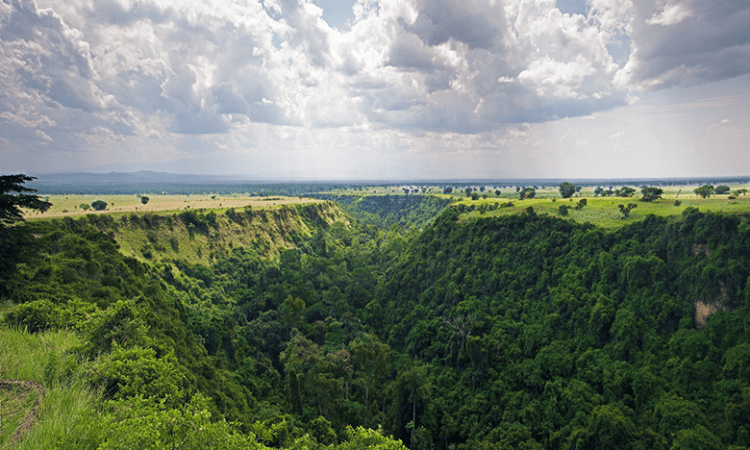
Kyambura Gorge is a dramatic feature of the Queen Elizabeth landscape: a 100-metre-deep chasm cut by the Kyambura River, with dense riverine forest on the floor and open savannah on the surrounding plateau. It is often called the “Valley of the Apes” because of its isolated chimpanzee community — a population that has been cut off from other chimpanzee groups for decades by the surrounding savannah. This guide covers what Kyambura Gorge chimpanzee tracking actually involves, how it differs from the forest trekking options, and how to plan it as part of a Queen Elizabeth National Park itinerary. Permit categories and current rates sit on the gorilla permits Uganda page, the wider primate picture is on the primate tracking experiences page, and the regulatory framework for chimpanzee trekking is published by the Uganda Wildlife Authority.
Kyambura Gorge chimpanzee tracking — key facts
- Location: Kyambura Gorge, inside Queen Elizabeth National Park
- Gorge depth: Around 100 metres, with a steep descent and ascent
- Chimpanzee community: Isolated on the gorge floor; less habituated than Kibale or Budongo
- Sighting success rate: Typically 50–70 per cent (lower than forest trekking sites)
- Group size: Small; typically 6–8 trekkers maximum per departure
- Trek duration: 2–4 hours including the descent, search and ascent
- Minimum age: 15 years
- Best paired with: Kazinga Channel boat safari, Kasenyi game drives, Ishasha tree-climbing lions
What is Kyambura Gorge chimpanzee tracking?
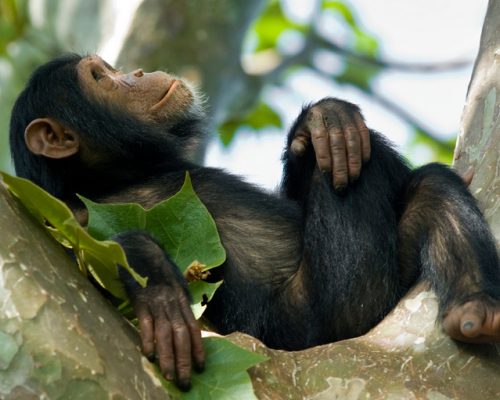
Kyambura Gorge chimpanzee tracking is a chimpanzee trekking experience in the Kyambura Gorge, a steep forested chasm inside Queen Elizabeth National Park. The trek begins on the gorge rim, descends to the forest floor on foot, and follows the ranger and trackers in search of the resident chimpanzee community. If the community is located, the viewing follows the standard UWA format: one hour with the chimpanzees, seven-metre distance, no flash, quiet behaviour, health exclusion for anyone ill.
Three things define the experience and separate it from the forest-based options:
- The gorge is a descent. You walk down a steep trail from the rim to the forest floor — roughly 100 metres of vertical descent — and you walk back up at the end. The trail is often muddy and the gradient is significant. This is closer in feel to a gorilla trek than a typical chimpanzee walk.
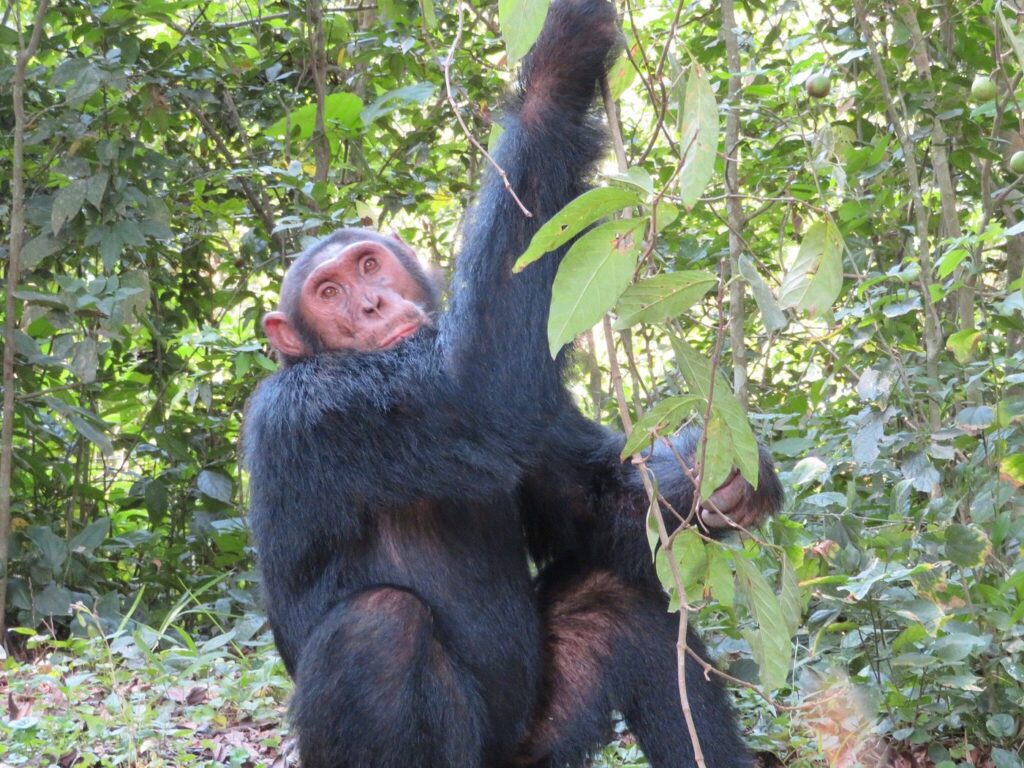
- The chimpanzees are less habituated. The Kyambura community has been monitored but not habituated to the same degree as the communities at Kibale and Budongo. They are more sensitive to human presence, and they range across an area that is difficult to move through quickly. This is why the sighting success rate is lower — often quoted at around 50 to 70 per cent.
- The setting is unique. The gorge floor is dense riverine forest, isolated from the surrounding savannah and completely different from the surrounding Queen Elizabeth landscape. The contrast between the open plateau and the enclosed forest below is dramatic.
The community at Kyambura is one of the more scientifically interesting in Uganda because of its isolation. The chimpanzees have been cut off from other populations by the surrounding savannah for decades, and their long-term survival has been the subject of conservation work focused on maintaining the gorge corridor. Treks here contribute directly to that work.
Afraeka tip: Kyambura is the right choice if you want a chimpanzee experience that feels different from the established forest treks — not if you want the highest possible chance of a sighting. If a guaranteed encounter is your priority, book Kibale instead. If you are already doing Queen Elizabeth and want to add chimpanzees without a major detour, Kyambura is the natural choice — and the sighting rate is still better than even odds.
How does Kyambura compare with other chimpanzee sites?
Kyambura Gorge chimpanzee tracking differs from the forest-based options in three main ways: terrain, success rate, and location on the Uganda map. The trek format is the same — briefing, walk in, one-hour viewing window, walk back — but the conditions and the likelihood of success are genuinely different, and it is worth being honest about that before booking.
| Factor | Kyambura Gorge | Kibale | Budongo |
|---|---|---|---|
| Setting | Steep forested gorge inside savannah | Dense tropical rainforest | Mature mahogany forest |
| Terrain | Descent and climb; steep and often muddy | Rolling forest trails | Gentle forest trails |
| Chimpanzee habituation | Lower; sighting less guaranteed | High; very reliable | High; very reliable |
| Sighting success rate | Typically 50–70% | Very high (usually well above 90%) | Very high |
| Pairing | Queen Elizabeth (Kazinga, Kasenyi, Ishasha) | Bwindi or Queen Elizabeth | Murchison Falls |
| Best for | Travellers already in Queen Elizabeth | Maximum reliability and full-day habituation | Northern circuit travellers |
The trekking rules are the same at every site — one-hour viewing window, seven-metre distance, no flash. What differs is the terrain, the habituation level, and the surrounding landscape.
Two things follow from this comparison. First, Kyambura is the right choice for travellers whose primary draw is Queen Elizabeth National Park — the game drives, the boat safari on the Kazinga Channel, and the tree-climbing lions in Ishasha. Adding a Kyambura trek to a QE itinerary is a half-day detour; it does not require a separate trip to western Uganda.
Second, Kyambura is a poorer fit for travellers whose primary goal is a guaranteed chimpanzee sighting. If you are choosing Uganda specifically for the chimpanzees, Kibale or Budongo is the better use of the trip. Our guides on Budongo Forest chimpanzee trekking and the wider primate options on primate tracking experiences cover those alternatives in more detail.
What happens during a Kyambura Gorge chimpanzee trek?
A Kyambura Gorge chimpanzee trek follows a fixed sequence: a briefing at the gorge rim, a descent to the forest floor, a search for the community with trackers, a one-hour viewing window if the community is located, and the ascent back to the rim. The trek usually runs two to four hours in total, but the length depends heavily on whether the community is found and how far along the gorge they have moved.
The Kyambura trekking day, step by step
- Morning briefing at the gorge rim. The ranger guide confirms the group, the rules, and the day’s conditions. This is where the lower success rate is explained honestly — the community is not always found.
- Descent to the gorge floor. A steep trail drops around 100 metres from the rim to the forest. The trail is often muddy, particularly in the wet season, and the descent requires care. Porters may be available to assist.
- Search for the community. Trackers go ahead on radio. The forest floor is dense, and the search can take anywhere from 20 minutes to over an hour.
- Contact with the chimpanzees (if located). The ranger confirms the group is in view and positions it at seven metres. The one-hour viewing window begins.
- One hour with the chimpanzees. A strict cap, as at every other UWA chimpanzee trekking site. Cameras, no flash, quiet behaviour, no touching.
- Walk back to the base of the trail. If the community has moved, the walk back can itself take time. The terrain is uneven and dense.
- Ascent to the gorge rim. The climb back out of the gorge is the hardest part of the trek for most travellers. Steep, often muddy, and taken slowly.
- Certificate and return. The ranger issues the trekking certificate at the rim. The driver is waiting at the trailhead.
The two hardest parts of the trek are the descent and the ascent. The descent is steep and often slippery, and the ascent is steep and physically demanding. For travellers with knee, hip or general fitness concerns, this is the most demanding of Uganda’s chimpanzee trekking sites. Porters are available to assist on the descent and ascent, and a walking stick is worth bringing.
If the community is not located during the trek, UWA’s standard practice is to end the trek at the allotted time and issue the certificate. The permit is not refunded in this case, and no alternative viewing is arranged. This is one of the honest trade-offs of a lower-habituation community, and it is worth understanding before booking. The same applies at every UWA chimpanzee site, but the probability is higher at Kyambura than at Kibale or Budongo.
When is the best time for Kyambura Gorge chimpanzee tracking?
Kyambura Gorge chimpanzee tracking runs year-round, but the conditions vary significantly by season. The drier months — December to February and June to September — are the best time, both for the trail conditions and for the sighting rate. In the wet months, the descent and ascent become muddy and genuinely slippery, and the chimpanzees tend to range further along the gorge, which lowers the sighting rate further.
Three practical points on timing:
- Dry season is easier and more reliable. The trails are firmer, the descent and ascent are safer, and the chimpanzees are more likely to be found in accessible parts of the gorge. If your dates are flexible, book in the dry months.
- Wet season is harder but still possible. The trek runs year-round and the sighting rate is still reasonable in the wet months, but the physical demand of the descent and ascent is greater. Bring proper boots with grip, and expect to take the descent slowly.
- Morning treks are standard. Kyambura treks depart in the morning, usually around 8am. Afternoon treks are sometimes available but are less common. The morning departure aligns naturally with a Queen Elizabeth itinerary — a trek in the morning, a Kazinga Channel boat safari in the afternoon.
The permit numbers at Kyambura are small — often a maximum of six to eight trekkers per departure — so availability can be tighter than the general impression of Kyambura as a “secondary” chimp site. Book at least two to three months ahead for dry-season dates, and four to six months for fixed departures in peak season. The permit is booked through a registered operator or directly with UWA, the same way as for Kibale and Budongo, and the full permit fee is payable at booking.
How do you combine Kyambura with Queen Elizabeth activities?
Kyambura Gorge chimpanzee tracking fits most naturally into a Queen Elizabeth National Park itinerary. The gorge sits on the northern edge of the park, roughly 30 minutes from the main Mweya peninsula area and about an hour from the Kasenyi plains. A morning Kyambura trek leaves the afternoon open for the boat safari on the Kazinga Channel, and the following days can be spent on game drives and Ishasha.
| Day | Morning | Afternoon |
|---|---|---|
| Day 1 | Arrive QE; check in at Mweya or nearby lodge | Game drive on Kasenyi plains |
| Day 2 | Kyambura Gorge chimpanzee trek | Kazinga Channel boat safari |
| Day 3 | Game drive; cross to Ishasha | Ishasha tree-climbing lions; continue south |
Structure assumes a two- or three-night QE stay. Longer stays allow additional game drives and a slower pace.
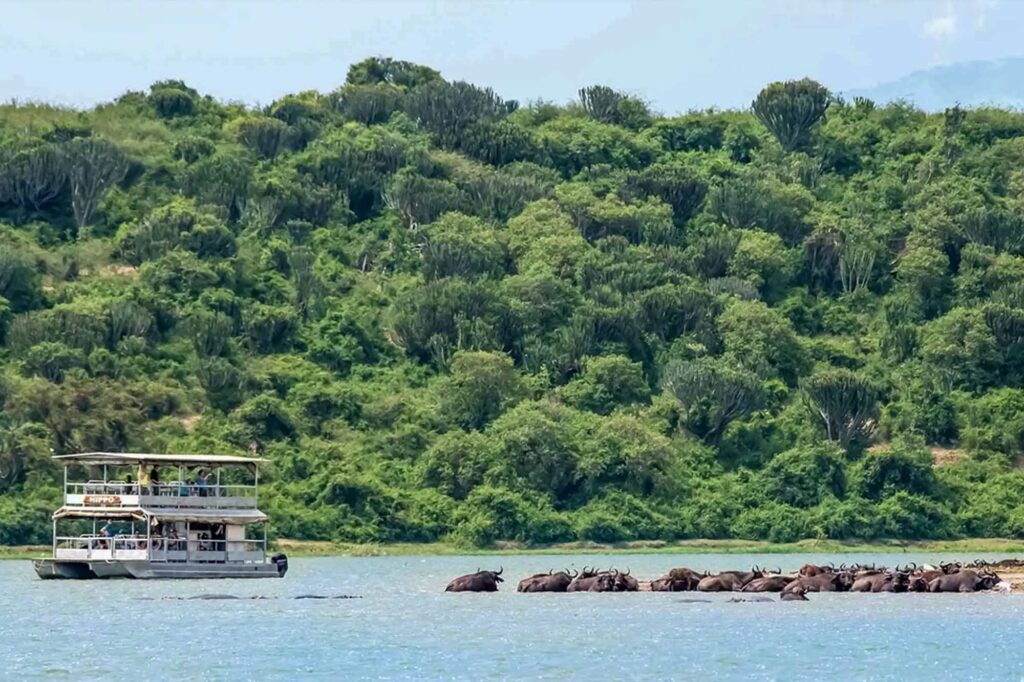
The pairing with the Kazinga Channel boat safari is the natural one. The boat safari runs in the early afternoon, departing from near Mweya, and takes two to three hours along the channel. Hippos, crocodiles, buffalo, elephants and an enormous range of birdlife are all visible from the boat, and the timing lines up naturally with a morning Kyambura trek.
For travellers extending the QE stay, Ishasha is the natural next stop — the southern sector of the park, famous for its tree-climbing lions and roughly two hours by road from Mweya. Our big game safaris page covers the wider QE and western Uganda game-viewing options, and the 5-day Uganda safari is a common format that combines Queen Elizabeth with Bwindi or Mgahinga.
Two things are worth confirming when you book. First, that your Kyambura permit is for the departure you want — treks run once or twice a day depending on demand. Second, that your QE lodge is positioned to make the morning trek transfer workable. Mweya and the nearby lodges are the most convenient for Kyambura; lodges closer to Ishasha add about two hours of driving to the trekking morning and are usually not the right base for a Kyambura trek.
Common mistakes with Kyambura Gorge chimpanzee tracking
Most of what goes wrong with a Kyambura trek comes down to a small set of avoidable mistakes, and all of them can be prevented with one careful planning conversation.
- Assuming the sighting is guaranteed. The success rate is typically 50 to 70 per cent. This is lower than Kibale or Budongo because the chimpanzees are less habituated. Travellers who expect the same reliability are often disappointed.
- Underestimating the descent and ascent. The gorge is around 100 metres deep and the trails are steep. This is the most physically demanding of Uganda’s chimpanzee trekking sites.
- Wearing the wrong footwear. Trail runners without aggressive grip are not sufficient for the steep, often muddy gorge trails. Proper hiking boots with deep tread are essential.
- Skipping the porter. Porters are available to assist on the descent and ascent. For travellers with any knee, hip or fitness concerns, a porter makes a real difference.
- Choosing Kyambura when a guaranteed sighting is the priority. If the chimpanzees are the main draw, Kibale or Budongo is the right choice.
- Booking Kyambura as a same-day add-on to a game drive. The trek runs two to four hours, often longer if the community is not found quickly. It is a half-day commitment, not an hour-long activity.
- Booking from a lodge far from Mweya. Kyambura is on the northern edge of the park. Lodges near Ishasha add roughly two hours of driving to the trekking morning.
- Forgetting the minimum age. Trekkers must be 15 or older. This applies to Kyambura the same as to every other UWA chimpanzee trekking site.
Can one permit cover two people?
No. One permit covers one person for one trek, and this applies to Kyambura Gorge chimpanzee tracking the same as to any other Uganda chimpanzee experience. A party of four needs four permits for the same departure, and each permit is tied to a named individual. There is no way to share a permit or transfer it to another person. Current permit categories and rates sit on the gorilla permits Uganda page.
Because Kyambura is a smaller trekking operation than Kibale or Budongo, the daily permit pool is limited — usually six to eight trekkers per departure. This means the site sells out faster for fixed dates than its reputation suggests. Travellers often assume Kyambura is the easy booking because it is the less-known option, but in practice the smaller permit numbers make it a tighter booking than Budongo for the same dates.
Once you have your permits, the community you follow is confirmed at the briefing on the day. The ranger will explain the tracking plan, and the trackers will have been out since dawn checking the community’s overnight position. If the community is found, the trek proceeds as normal. If not, the trek ends at the allotted time and the certificate is issued — the sighting is never guaranteed at Kyambura, and the honest success rate is part of what makes the trek what it is. The wider country map is on the Uganda destinations page, and the regulatory framework for the trekking day is set by the Uganda Wildlife Authority.
Afraeka field note: A couple who had already trekked chimpanzees at Kibale two years earlier booked Kyambura Gorge chimpanzee tracking during a Queen Elizabeth trip, and we warned them in advance that the sighting was not guaranteed. They were found — briefly — after a ninety-minute search along the gorge floor, and they spent about forty minutes with the community before the group moved into dense vegetation. What they said afterwards was that the trek had been the right one for their trip, but for reasons they had not anticipated. The descent into the gorge, the isolation of the forest below the savannah, and the sense that the chimpanzees were genuinely wild and unrehearsed had made the trek feel more like exploration than observation. They said the forty minutes with the community had felt more significant than a full hour at Kibale would have, precisely because the encounter had not been guaranteed. That is the honest trade at Kyambura — a lower success rate in exchange for an atmosphere that the more established sites cannot match.
A question that comes up occasionally on TripAdvisor’s Uganda forum and on r/Uganda is some version of: “Is Kyambura worth doing if the sighting rate is lower than Kibale?” The honest answer depends on what you want. If you are travelling specifically for chimpanzees and the sighting is the point, book Kibale or Budongo — the higher habituation level makes them the more reliable choices. If you are already doing Queen Elizabeth and want to add a chimpanzee experience without a major detour, Kyambura is the natural option, and the combination of gorge, forest and the possibility of not finding the community gives it a character that the more certain sites do not have. Both are valid reasons to trek, and both deserve an honest booking decision rather than a comparison on success rate alone.
Frequently asked questions
What is Kyambura Gorge chimpanzee tracking?
A chimpanzee trekking experience in the Kyambura Gorge, a steep forested chasm inside Queen Elizabeth National Park. The trek involves a descent of around 100 metres to the gorge floor, a search for the resident chimpanzee community with trackers, a one-hour viewing window if the community is located, and an ascent back to the rim. The chimpanzees are less habituated than at Kibale or Budongo, so the sighting rate is lower.
What is the success rate at Kyambura Gorge?
Typically 50 to 70 per cent. This is lower than Kibale or Budongo because the Kyambura community is less habituated and ranges across a difficult gorge terrain. The sighting is never guaranteed at Kyambura, and the honest success rate is one of the things that distinguishes the experience from the more established chimpanzee trekking forests.
How difficult is the Kyambura Gorge trek?
It is the most physically demanding of Uganda’s chimpanzee trekking sites. The gorge is around 100 metres deep, and both the descent and the ascent are steep and often muddy. Porters are available to assist, and proper hiking boots with deep tread are essential. Travellers with knee, hip or general fitness concerns should consider this before booking.
How long does the Kyambura Gorge trek take?
Two to four hours including the descent, search, viewing window and ascent. If the community is not found quickly, the trek can run longer. The trek is a half-day commitment rather than an hour-long activity, and it is best planned as a morning activity with the afternoon free.
Is Kyambura better than Kibale for chimpanzees?
Neither is better — they are different. Kibale has a very high sighting rate and the option of the full-day habituation experience. Kyambura has a lower sighting rate but a more dramatic setting, with the gorge descent and the isolated forest floor. If reliability is the priority, book Kibale. If you are already doing Queen Elizabeth and want to add chimpanzees without a major detour, Kyambura is the right choice.
When is the best time for Kyambura Gorge chimpanzee tracking?
The drier months of December to February and June to September are best. Trails are firmer, the descent and ascent are safer, and the sighting rate is higher. The wet months are still workable but the trails are muddier and the ascent is harder. Treks run year-round.
How do I book a Kyambura Gorge chimp permit?
Book through a registered operator or directly with UWA. Kyambura is a small trekking operation — usually six to eight trekkers per departure — so permits can be tighter than expected. Book two to three months ahead for dry-season dates, and four to six months for fixed departures in peak season. The full permit fee is payable at booking, and permits are non-refundable once issued.
Can I combine Kyambura with the Kazinga Channel boat safari?
Yes, and it is the natural pairing. A morning Kyambura trek leaves the afternoon open for the Kazinga Channel boat safari, which departs from near Mweya and runs two to three hours along the channel. The combination gives you chimpanzees in the morning and hippos, crocodiles and birdlife in the afternoon.
Is Kyambura Gorge chimpanzee tracking suitable for families?
Yes, subject to the minimum age of 15. The trek is physically demanding because of the steep descent and ascent, so families with teenagers should be confident in their fitness before booking. Families with younger children cannot trek and should plan a separate activity for them, such as a game drive or a boat safari in Queen Elizabeth.
Planning Queen Elizabeth with a Kyambura trek?
Send us your dates, party size and the shape of your Queen Elizabeth itinerary, and we will check Kyambura permit availability, recommend the best base for the trekking morning, and outline how the day fits around the Kazinga Channel boat safari and your game drives. If Kibale or Budongo would suit you better, we will say so. No price figures until we know your route, because the permits are only one line of the total.
Plan your Queen Elizabeth trip
About the author: Victoria Kayaga is a Ugandan-born safari expert and founder of Afraeka Adventures, with 15+ years in East African tourism. Based in Kampala, she has planned chimpanzee trekking itineraries across Kyambura, Kibale and Budongo for years, and she advises travellers on the trade-offs between reliability and atmosphere when choosing between the Uganda chimpanzee sites. More about Victoria.
Keep planning
- 5-day Uganda safari
- 16-day Rwanda and Uganda gorilla trekking and big five safari
- Primate tracking experiences
- All Afraeka trips