Last updated: 24 September 2026. Rates and availability are set by UWA and subject to change — confirm before booking.
Short answer: Gorilla trekking for seniors over 60 is entirely achievable — but the honest answer is that fitness matters far more than age. UWA sets no upper age limit, and travellers in their 60s, 70s and even 80s complete gorilla treks every year. What decides whether the day is manageable is your cardiovascular fitness, your knees, and the sector and family you are assigned. Buhoma and Rushaga are the most forgiving sectors; Nkuringo is the most demanding. Hiring a porter is close to essential for most older trekkers, and a sedan chair is available for those with serious mobility concerns.
Age alone tells you almost nothing about whether gorilla trekking will suit you. We have organised treks for travellers in their late seventies who hike regularly and found the day straightforward, and we have organised treks for travellers in their forties who found it one of the hardest physical days they had ever had. The variables that actually matter are fitness, knee and hip health, how well you handle altitude, and which sector and family you end up with. Those are the things worth thinking about in advance.
This guide is the honest reference for travellers over 60 who are considering a Uganda gorilla trek — what the day actually involves, which sectors suit older trekkers, how porters and sedan chairs work, what to prepare before you travel, and what to tell your ranger at the briefing. If you have not yet chosen a park or sector, the Uganda gorilla trekking hub covers the wider picture, and permit fees and booking requirements are kept current on the gorilla permits Uganda page.
Gorilla trekking over 60 — key facts
- Upper age limit: None — UWA sets no maximum age for gorilla trekking
- What matters: Fitness and health, not age
- Most forgiving sectors: Buhoma and Rushaga (lower altitude, gentler gradients)
- Most demanding sectors: Nkuringo and Ruhija (steep terrain, higher altitude)
- Altitude at the trailheads: Bwindi sectors range roughly 1,500–2,600 metres; Mgahinga trailhead sits around 2,200 metres and rises
- Typical trekking day: 4–9 hours, most of it on your feet
- Viewing time with gorillas: 1 hour
- Porter: Available at all sectors, booked the evening before, carries daypack and steadies you on descents
- Sedan chair: Available in Bwindi, must be arranged in advance, suitable for trekkers with limited mobility
- Minimum age: 15 years (the only age rule UWA enforces)
- Permit conditions: Subject to UWA’s current booking, cancellation and rescheduling rules
Is gorilla trekking suitable for travellers over 60?
Yes, and there is no upper age limit for gorilla trekking in Uganda. UWA sets a minimum age of 15 but no maximum, and travellers in their 60s, 70s and 80s complete the trek every year. The question is not whether you are “too old” but whether the day is a good physical fit for you at your current level of fitness and health.
The trekking day itself is best understood as a forest hike at altitude on uneven ground. It begins with a briefing before dawn, followed by a walk to the gorilla family that can take anywhere from under an hour to several hours depending on where the family has moved overnight. After the one-hour viewing, you walk back to the trailhead. In total, most treks involve between four and nine hours on your feet, with the walking portion depending heavily on the family’s location and the sector.
Two things make the day harder than the distance suggests. First, the ground is uneven — roots, mud, bamboo, and steep gradients are common, and wet-season clay is genuinely slippery. Second, the altitude. Bwindi’s trailheads sit between roughly 1,500 and 2,600 metres depending on the sector, and Mgahinga is higher still. Even fit travellers from sea level feel the altitude on climbs, and it is worth arriving a day early to acclimatise.
None of this is beyond a reasonably active adult in their 60s or 70s. Hikers, walkers, cyclists, swimmers and people who regularly walk on hills tend to do well. Travellers whose only exercise is flat-ground walking or who have significant knee, hip or cardiovascular concerns should think carefully about whether the day is right for them — or about which sector and support options would make it manageable.
Afraeka tip: The single most useful thing you can do before your trip is to walk on hilly, uneven ground two or three times a week for the two months leading up to it. Gym fitness does not fully transfer to forest trails — the muscles you need for balance and stability on uneven ground are trained by walking on uneven ground. If you can walk for three hours on a hill trail without significant discomfort, you are in a good position for a trek in a forgiving sector.
How fit do you need to be for gorilla trekking over 60?
You need enough cardiovascular fitness to walk for several hours at a moderate pace on uneven ground, and enough stability in your legs and ankles to handle steep, sometimes slippery descents. That is the honest bar. If you walk regularly on hills or uneven paths, you are likely fine. If your walking is limited to flat ground and short distances, a demanding sector may be more than you want to take on.
Three self-assessment questions help decide honestly:
- Can you walk for three to four hours on hilly, uneven ground, with breaks, and still feel functional at the end? If yes, a trek in a forgiving sector is within reach. If not, consider the sedan chair or a less demanding sector.
- Do your knees or hips complain on steep downhills? The descent is the hardest part of a gorilla trek on joints, not the climb. If your knees are a concern, a porter and a trekking pole make a real difference, and a gentler sector helps further.
- How do you handle altitude? If you live at or near sea level, give yourself at least one acclimatisation day before the trek. Bwindi and Mgahinga sit higher than most travellers expect, and altitude fatigue is real.
What rarely matters as much as people think: chronological age. We have seen travellers in their late 70s complete treks comfortably because they hike regularly at home, and travellers in their 50s struggle because they do not. The right question is not “am I too old” but “am I currently fit enough for a moderate forest hike, and which sector suits me best.”
Which Bwindi sector is best for older trekkers?
Buhoma and Rushaga are the most forgiving sectors for older trekkers. Buhoma has the gentlest terrain and the lowest average altitude of Bwindi’s four sectors, and Rushaga is comparable with more varied terrain. Ruhija is moderate to high — the altitude and bamboo zones make it more demanding. Nkuringo is the hardest, because the sector’s ridge-and-valley geography means every trek begins with a descent into the forest and ends with a climb back to the ridge.
| Sector | Difficulty for seniors | What makes it so |
|---|---|---|
| Buhoma | Low — the best fit | Lowest average altitude, gentlest gradients, shortest average approach |
| Rushaga | Low to moderate | Mixed terrain but generally moderate; good family variety and lodge choice |
| Ruhija | Moderate to high | Higher altitude, steep ridges, bamboo zones, longer approaches |
| Nkuringo | High — least suitable | Ridge-to-valley geography means a sustained return climb at the end of the day |
| Mgahinga | Moderate to high | Volcanic slopes, trailhead around 2,200 metres, single habituated family |
Difficulty reflects typical conditions. Trekking demands vary daily depending on where the gorilla family has moved.
The sector detail that matters most for older trekkers is the return leg. All gorilla treks involve walking back to the trailhead after the viewing hour, and the return is where most trekkers feel the day — knees, hips and general fatigue accumulate. In Buhoma and Rushaga, the return is generally a gentler walk; in Nkuringo, it is a steep climb. That structural difference is why Nkuringo is the sector to avoid if you have knee or hip concerns. Our sector guides cover the terrain in depth — Buhoma and Nkuringo are the two that most often decide the choice for older trekkers.
Within a sector, the family you are assigned also matters. Families with compact home ranges tend to produce shorter and more predictable approaches — the Kutu family in Rushaga is a good example, and Bweza is a smaller, tighter family that often produces a calmer viewing. Families with wider ranges — Busingye in Rushaga, for instance — can produce longer walks. You cannot choose your family, but telling the ranger about your fitness at the briefing is worth doing, because the allocation process considers expected pace.
Can you use a sedan chair for gorilla trekking?
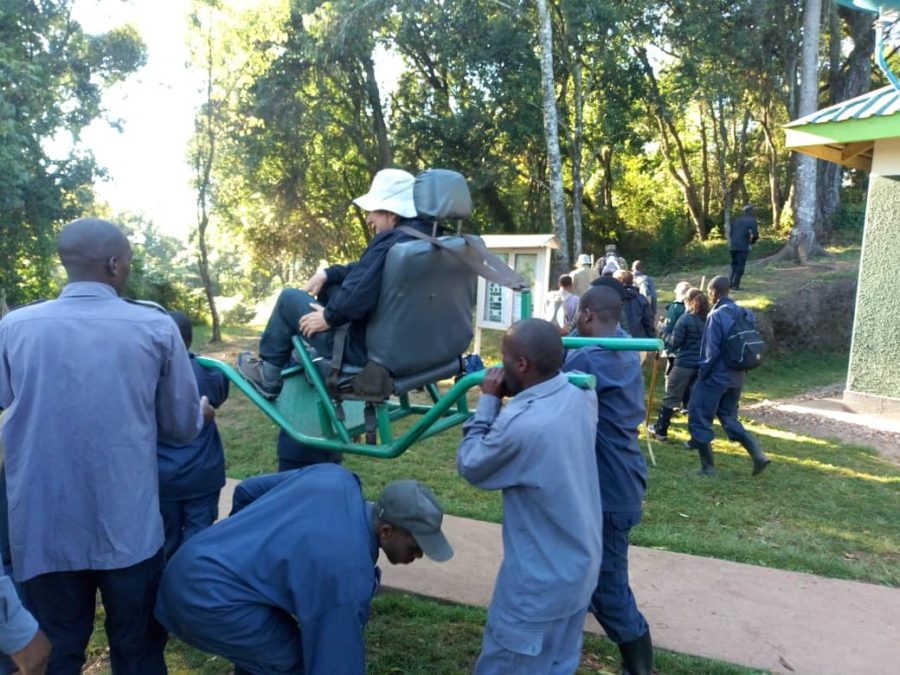
Yes. A sedan chair — sometimes called a “stretcher” or “helicopter” locally — is a litter carried by a team of porters that allows trekkers with limited mobility or serious fitness concerns to complete a gorilla trek. It is available in Bwindi, and it must be arranged in advance rather than requested on the day. For some travellers over 60, the sedan chair is the difference between trekking and not trekking at all.
How the sedan chair works:
How the sedan chair service works
- Arrange in advance. The service is booked through your operator or your lodge, typically at the time of trip planning rather than on the morning of the trek. Availability varies by sector and date.
- Meet the team at the trailhead. A team of porters is assigned to you on the trekking day. Team size depends on the terrain and the distance.
- The trek proceeds with the chair. You are carried on sections where walking is not feasible and can walk on gentler sections if you prefer. The ranger and porters coordinate the pace with the rest of your trekking group.
- You still spend the full hour with the gorillas. The viewing itself is unaffected — the chair is a transport solution for the walk, not a change to the trekking experience itself.
The sedan chair is not a lesser experience. Many travellers who use it describe the hour with the gorillas as completely unaffected by the fact that they were carried for parts of the walk. What changes is the physical demand of the day, which is often the deciding factor for travellers over 60 with mobility concerns. If you are unsure whether you need one, ask your operator honestly during planning — the worst outcome is booking one unnecessarily, and the second-worst is needing one and not having arranged it.
Do porters help older trekkers?
Yes, substantially. Hiring a porter is close to essential for most older trekkers. A porter carries your daypack, steadies you on steep and slippery sections, and offers a hand on the descents where most trekkers feel the day. On the harder sectors, porters are not a luxury — they are the difference between a manageable day and an uncomfortable one.
Three practical points about porters:
- They carry more than a daypack. A porter’s role includes physical assistance on steep or slippery ground. On wet-season clay, having a steadying hand on the descent is genuinely useful.
- Arrange one the evening before. Most lodges and operators arrange porters at the time of booking, but they can often be added at short notice if you decide on the morning of the trek.
- The fee goes directly to the local community. Porter fees are one of the main ways gorilla tourism distributes income to communities around the parks. Hiring a porter is both practically useful and part of the trekking economy.
If you are trekking with a group that includes both fit and less-fit travellers, hiring porters for the whole group is often the simplest approach. It keeps the group pace reasonable, and it makes the day more comfortable for everyone. Details on porters and how they are arranged are covered on the Uganda gorilla trekking hub.
What medical considerations matter for senior trekkers?
Two medical considerations matter most for gorilla trekking over 60: cardiovascular health and joint health. If you have any diagnosed heart, lung or joint condition, the trek is still potentially possible — but you should discuss it with your doctor before booking, and you should share relevant information with your operator so the trekking group can be planned accordingly.
Three specific points worth raising with your doctor:
- Altitude. Bwindi’s trailheads sit between roughly 1,500 and 2,600 metres, and Mgahinga’s sits around 2,200 metres. Travellers with heart or lung conditions should discuss altitude tolerance before booking. Arriving a day early to acclimatise helps, and it applies equally to fit and less-fit travellers.
- Joint stability. The terrain is uneven and often slippery. Trekkers with knee, hip or ankle issues should discuss whether a trekking pole, a porter, a sedan chair, or a less demanding sector is the right combination. Buhoma is the most forgiving sector; Nkuringo is the least.
- Travel insurance and medical evacuation. Medical evacuation cover is worth confirming before any trek. Bwindi is remote, and evacuation from the trailhead to Kampala or Nairobi is by air. Full details on medical evacuation coverage sit on our terms and conditions page, and travel insurance discussions are best held with your insurer before booking.
None of this is meant to discourage older trekkers — quite the opposite. The point is that the trek is manageable for most travellers over 60 when the right preparations are made, and being honest with your doctor and your operator about your health is the single most reliable way to have a good day.
How should older trekkers prepare before the trip?
Preparation for a gorilla trek over 60 is mostly about two things: building and maintaining fitness in the months before travel, and choosing the right sector, family and support options for your trip. Neither requires extraordinary effort — but both make a real difference to how the day feels.
Preparation checklist for trekkers over 60
- Walk on hilly, uneven ground two to three times a week for at least two months before travel
- Build up to a three-hour walk with a daypack before you fly
- Confirm your travel insurance covers medical evacuation from remote areas
- Discuss altitude and any cardiovascular concerns with your doctor
- Discuss knee, hip and ankle health and whether a trekking pole is appropriate
- Book a porter for your trekking day — do not assume one will be available on the day
- If you have mobility concerns, arrange a sedan chair in advance
- Arrive in Uganda at least one day before the trekking day to acclimatise and rest
- Break in your boots thoroughly before the trip
- Pack layers, a waterproof shell, and a trekking pole if you use one
- Tell your ranger at the briefing about any fitness or mobility concerns
The single most underrated preparation step is walking on hills and uneven ground before you travel. Gym fitness does not fully transfer to a forest trail, and the muscles you need for balance and stability on uneven ground are best trained by walking on uneven ground. Two or three hill walks a week for two months makes a real difference to how the day feels.
What should you tell the ranger at the briefing?
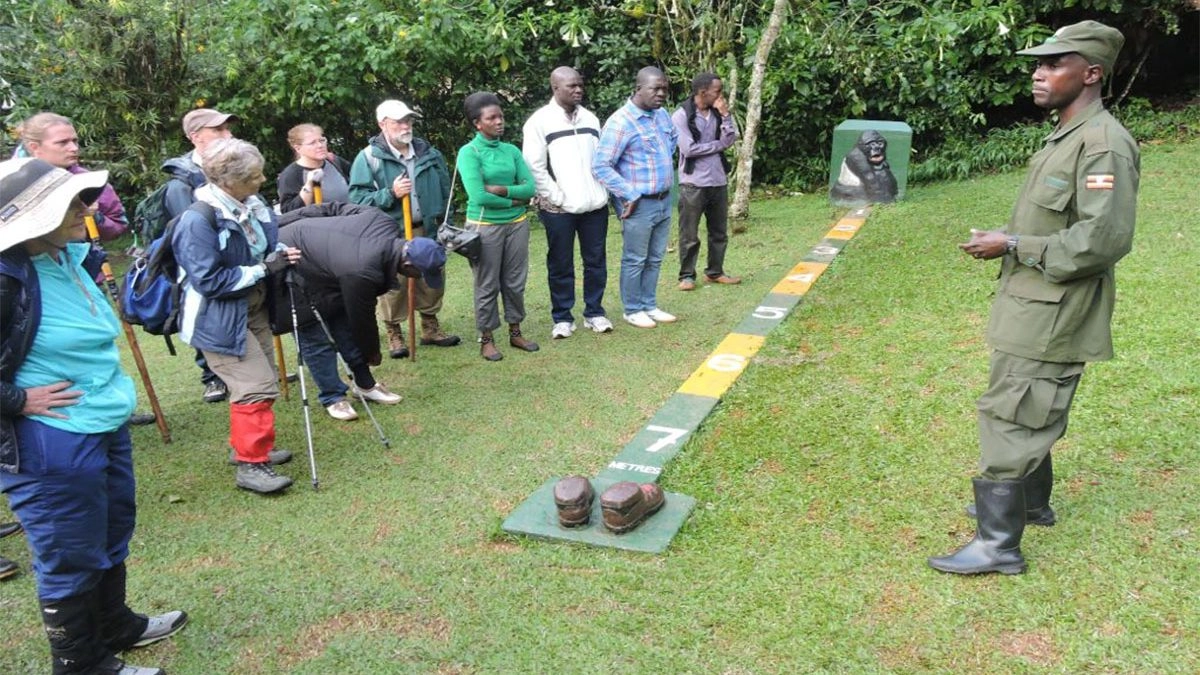
Tell the ranger about any fitness or mobility concerns, and be honest about the pace you can sustain. The ranger briefing at the trailhead is the point at which trekking groups are allocated, and rangers use the information they gather to match groups to families. Fit trekkers are placed with faster-moving groups; trekkers who need a slower pace are placed with groups that will accommodate it. Rangers want you to complete the trek and enjoy it, and they have more flexibility than most travellers realise — but only if they know what to plan for.
Specific things worth mentioning:
- Any knee, hip or ankle concerns, and whether you use a trekking pole
- Whether you have a porter arranged or need one
- Whether you have a sedan chair arranged
- How you have been training, and how many hours you can comfortably walk
- Any altitude concerns
The briefing is not the place to understate your needs in the hope of not slowing the group down. Rangers prefer honesty, and groups are built to accommodate a range of paces. A trekker who struggles on the descent without having said anything at the briefing creates a harder day for everyone, including themselves. Detailed guidance on how the briefing works sits on the Uganda gorilla trekking hub.
Common mistakes older trekkers make
Most of what goes wrong with a senior gorilla trek comes down to a small set of avoidable decisions, and all of them can be prevented with one careful planning conversation.
- Assuming age disqualifies you. There is no upper age limit, and many travellers over 60 trek successfully. The right question is fitness and preparation, not age.
- Choosing Nkuringo for the scenery. Nkuringo is the most demanding sector, and its return climb is the hardest part of the day on knees and hips. Buhoma and Rushaga are the more forgiving choices.
- Not hiring a porter. The single most common regret after a wet-season trek. Porters are close to essential for most older trekkers.
- Not arranging a sedan chair if mobility is a concern. The service exists and it works, but it must be arranged in advance rather than requested on the day.
- Flying in and trekking the next morning. Jet lag plus altitude plus a dawn start is a poor combination. Build in a full day to rest and acclimatise.
- Not discussing medical concerns with a doctor. Altitude, cardiovascular health and joint stability are all worth raising with a professional before booking.
- Understating fitness at the briefing. Rangers can only match you to a suitable group if they know what to plan for. Tell them the truth about what your knees and lungs can do.
- Training only on flat ground. Gym fitness does not fully transfer to forest terrain. Walk on hills and uneven ground for weeks before travelling.
- Wearing new boots on the trek. Break boots in thoroughly before the trip. A trekking day is not the day to discover that your boots rub.
Can one permit cover two people?
No. One permit covers one person for one trek, and this applies to travellers over 60 the same as any other trekker. A party of four needs four permits in the same sector on the same date. Each permit is tied to a named individual, and there is no way to share one or to transfer it to another person.
The eight-visitor daily cap per habituated gorilla group applies equally. A group of eight trekkers fills an entire day’s allocation for one gorilla group, and each of those eight trekkers is subject to the same UWA rules — including the minimum age of 15 and the same distance, photography and viewing-time requirements. There is no exception for older trekkers, and there is no reduced-fee category for seniors. The permit is the same document for everyone.
Once you have your permits, the gorilla group you actually visit is allocated according to the trekking sector, with final group allocation managed by UWA on the morning of the trek. You will know your sector in advance because it is on your permit; you will learn your family at the briefing alongside everyone else — and this is the moment to tell the ranger about your fitness and any mobility concerns.
Afraeka field note: A couple in their early seventies contacted us a few months before a planned Uganda trip, worried that they had left the trek too late. Both were active — one played tennis twice a week, the other walked daily on hilly local paths — but neither had done anything resembling a forest hike in years. We booked them into Buhoma, arranged porters for both, and added an extra acclimatisation day at the trailhead before their trek. Their ranger assigned them to a group that moved at a slower pace, and by their account the trek was comfortable. What they said afterwards stayed with us: they had spent so long worrying about whether they were “too old” that they nearly didn’t book at all. The trek itself was neither harder nor easier than they had expected — it was, in their words, simply a good day’s walk in a forest with gorillas at the end of it. That is often the honest reality of a well-planned senior trek. It is not a mountaineering expedition. It is a long walk on uneven ground, and most active adults can do it with the right preparation.
A question that comes up regularly on TripAdvisor’s Uganda forum and on r/Uganda is some version of: “I’m 68 and reasonably fit — is gorilla trekking realistic for me, or should I skip it?” The honest answer depends almost entirely on what “reasonably fit” means in practice. If you walk on hills regularly, you are in a good position for a trek in a forgiving sector. If your exercise is mostly flat-ground walking or gym-based, a few months of hill walking before the trip will make a significant difference, and choosing Buhoma or Rushaga rather than Nkuringo will help further. What we tell every traveller over 60 is the same: the trek is a long walk, not a test of youth. Prepare for it honestly, pick the right sector, hire a porter, and it is achievable for most active adults.
Frequently asked questions about gorilla trekking for seniors
Is there an upper age limit for gorilla trekking?
No. UWA sets a minimum age of 15 but no maximum age for gorilla trekking in Uganda. Travellers in their 60s, 70s and 80s complete gorilla treks every year. What matters is your fitness and health, not your age, and the trek can be adapted to a range of fitness levels with the right sector and support arrangements.
How fit do you need to be for gorilla trekking over 60?
You need enough cardiovascular fitness to walk for several hours at a moderate pace on uneven ground, and enough stability in your legs to handle steep, sometimes slippery descents. If you walk regularly on hills or uneven paths, you are likely fine. If your exercise is limited to flat-ground walking, a few months of hill training before the trip makes a significant difference.
Which Bwindi sector is best for older trekkers?
Buhoma is the best fit for older trekkers — it has the lowest average altitude and the gentlest gradients of Bwindi’s four sectors. Rushaga is the second most forgiving. Ruhija is moderate to high because of altitude and steep ridges. Nkuringo is the most demanding, because every trek begins with a descent and ends with a climb back to the ridge.
Can I use a sedan chair for gorilla trekking?
Yes. A sedan chair is a litter carried by a team of porters that allows trekkers with limited mobility to complete a gorilla trek. It is available in Bwindi and must be arranged in advance. The service does not change the hour with the gorillas — it is a transport solution for the walk to and from the family.
Do I need to hire a porter for gorilla trekking over 60?
Hiring a porter is close to essential for most older trekkers. A porter carries your daypack, steadies you on steep and slippery sections, and offers a hand on the descents where most trekkers feel the day. Arrange one in advance through your operator or your lodge, and do not rely on one being available on the morning of the trek.
What medical considerations matter for senior trekkers?
The two most important are cardiovascular health and joint health. If you have a diagnosed heart, lung or joint condition, discuss the trek with your doctor before booking — altitude, uneven terrain and several hours of walking are all relevant considerations. Confirm your travel insurance covers medical evacuation from remote areas, and share relevant information with your operator during planning.
How should I prepare for a gorilla trek over 60?
Walk on hilly, uneven ground two to three times a week for at least two months before travel, building up to a three-hour walk with a daypack. Break in your boots thoroughly, confirm your insurance covers medical evacuation, arrange a porter and — if relevant — a sedan chair, and arrive in Uganda at least one day before the trekking day to acclimatise and rest.
Should I tell the ranger about my fitness at the briefing?
Yes. The ranger briefing is where trekking groups are allocated, and rangers use the information they gather to match groups to families. Tell them about any fitness or mobility concerns, whether you use a trekking pole, whether you have a porter or sedan chair arranged, and how many hours you can comfortably walk. Rangers can only plan for what they know about.
What should I pack for a gorilla trek over 60?
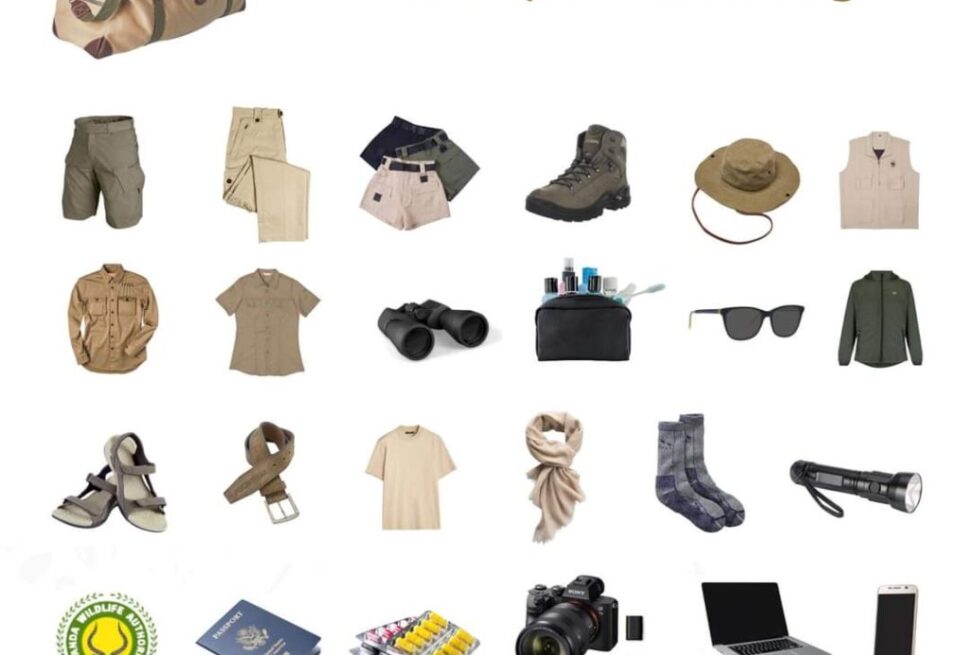
Waterproof hiking boots with good tread (broken in before travel), gaiters, long trousers and sleeves, gardening gloves for nettles, a light waterproof shell, a warm layer for the morning briefing, a trekking pole if you use one, a small daypack with water and a snack, and any personal medication. Hire a porter and let them carry the pack on the trail.
Considering a gorilla trek over 60?
Send us your dates, your party size and an honest sense of your fitness, and we will tell you which sectors suit you best, whether a porter or sedan chair makes sense, and what to plan before the trip. If a specific sector is not the right fit for your mobility, we will say so and suggest an alternative. No price figures until we know your route, because the permit is only one line of the total.
About the author: Victoria Kayaga is a Ugandan-born safari expert and founder of Afraeka Adventures, with 15+ years in East African tourism. Based in Kampala, she has planned gorilla trekking itineraries across Bwindi’s four sectors and Mgahinga for years, including many trips with travellers over 60. More about Victoria.
Keep planning
- Gorilla permits Uganda — fees and booking
- Uganda gorilla trekking hub
- Uganda destinations
- Primate tracking experiences
- Adventure hiking
- 3-day Uganda gorilla safari
- 5-day Uganda safari
- 5-day Bwindi and Lake Mburo safari
- All Afraeka trips