Last updated: 25 September 2026. Rates and availability are set by UWA and subject to change — confirm before booking.
Short answer: The chimpanzee habituation experience in Kibale Forest is a full day with a habituated chimpanzee community — from the moment they wake in their nests at dawn to the moment they build new nests at dusk. It is a fundamentally different experience from standard chimpanzee trekking, which caps viewing at one hour. The habituation format gives you hours with the community as it feeds, moves, socialises and rests across its home range, with a small group and a smaller number of permits per day. The minimum age is 15, and it runs year-round, though demand is high and the number of daily slots is limited.
Most travellers who trek chimpanzees in Kibale do the standard trek — one hour with a habituated community, in a group of up to eight, usually starting in the morning. It is a good experience and it is the right choice for most visitors. But a minority of travellers come to Kibale specifically for the habituation experience: a full day following one community, watching it do all the things it does across the course of a day. It is longer, more expensive, more demanding, and — for travellers interested in chimpanzee behaviour — considerably more rewarding.
This guide explains what the chimpanzee habituation experience in Kibale actually involves — how it differs from standard trekking, what happens across the day, who it suits, and what the booking logistics look like. If you are choosing between standard trekking and habituation, the comparison table below is the place to start. For the wider primate context in Uganda, our primate tracking experiences page covers the options across the country, and permit requirements for the gorilla side of the trip are kept current on the gorilla permits Uganda page. The regulatory framework that governs chimpanzee trekking and habituation is published by the Uganda Wildlife Authority.
Chimpanzee habituation in Kibale — key facts
- Where: Kibale Forest National Park, western Uganda
- Duration: Full day, typically 6:00am to 5:00pm
- Group size: Very small — a handful of trekkers per day
- Time with chimpanzees: Hours, across the whole day, not a one-hour cap
- Minimum age: 15 years
- Best for: Travellers specifically interested in chimpanzee behaviour, photographers, and return visitors
- Physical demand: Moderate to high — you follow the community off-trail through the forest
- Availability: Limited daily slots; book well in advance
What is the chimpanzee habituation experience?
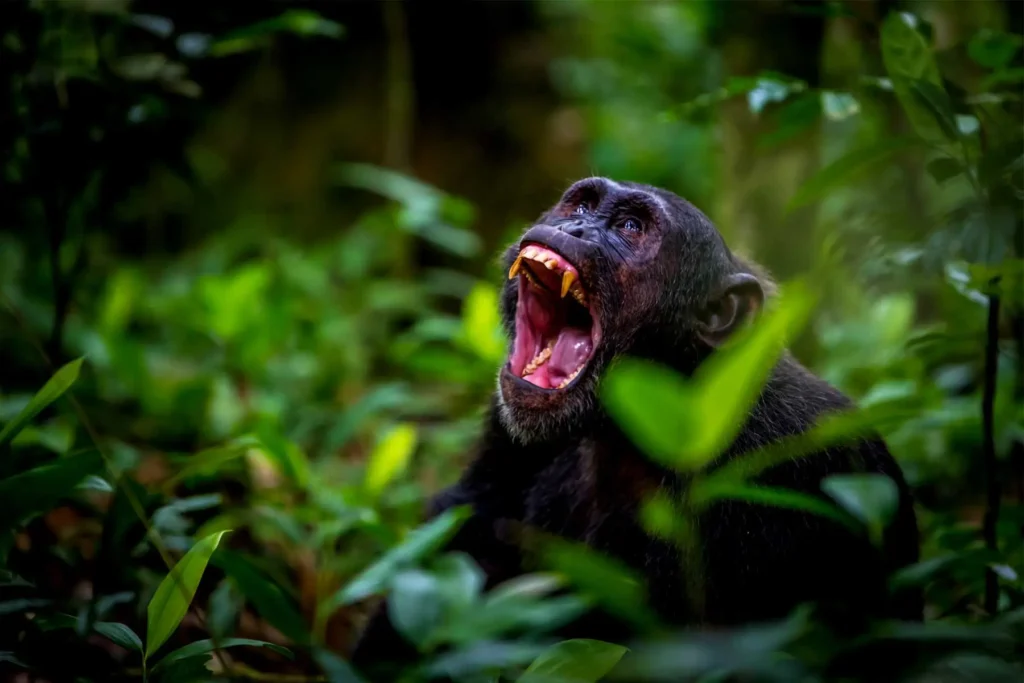
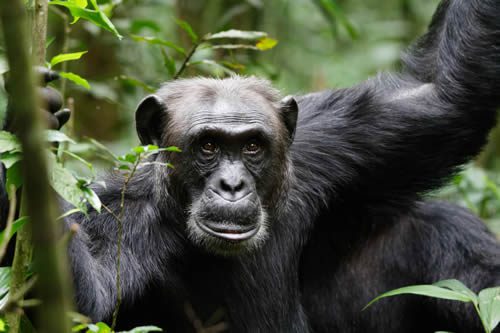
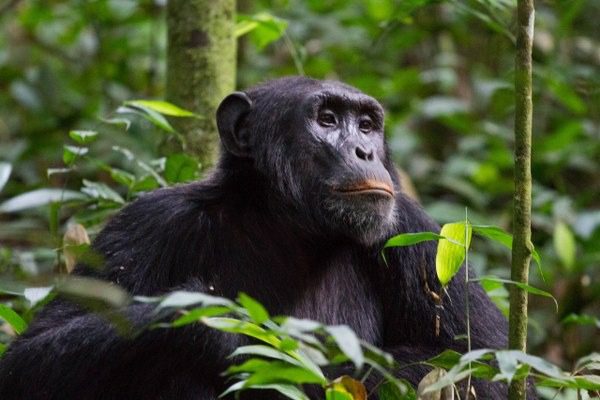
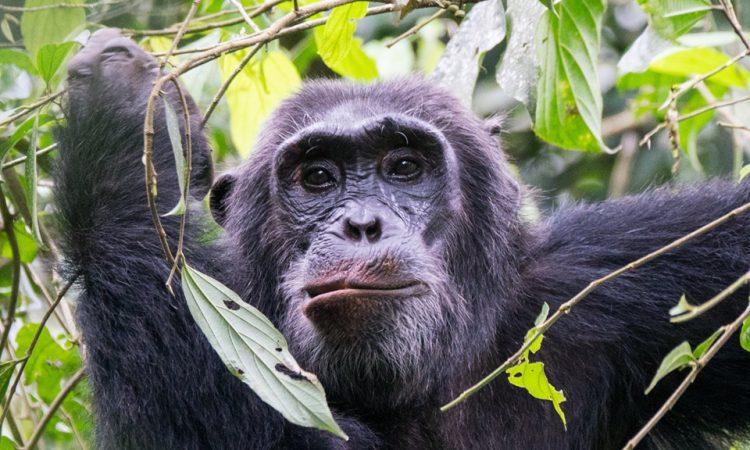
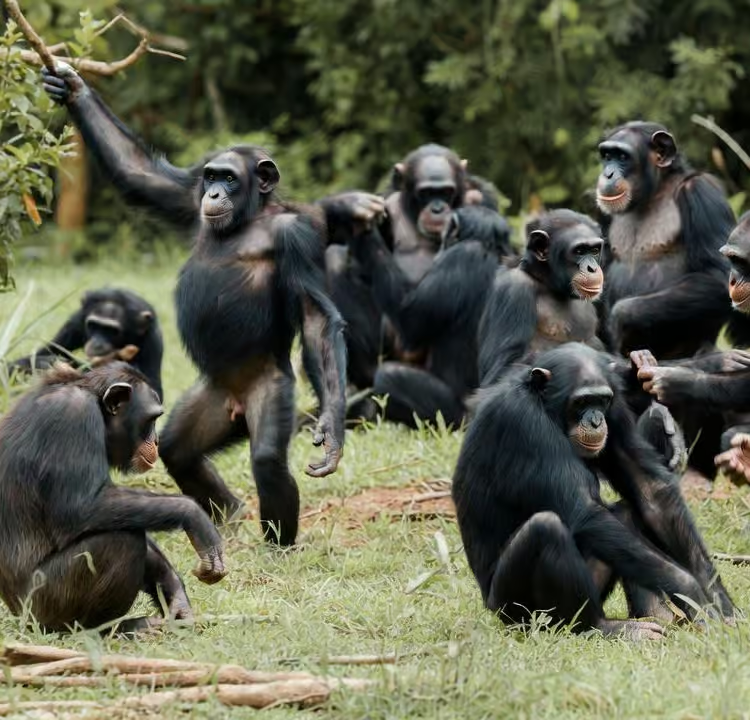
The chimpanzee habituation experience is a full day spent with a habituated chimpanzee community in Kibale Forest National Park. You are with the community as it wakes in its nests at dawn, follows it as it moves through the forest during the day, and — if you stay to the end — you are with it as it builds new nests for the night. Instead of the one-hour viewing cap that governs standard chimpanzee trekking, the habituation experience runs across the full span of the chimpanzees’ active day.
Three things define the experience:
- You follow the community, not the other way around. Chimpanzees move constantly — between feeding trees, through territory, across the forest floor and canopy. The day is spent tracking them at their pace, off established trails, through undergrowth that standard trekking routes do not use.
- You see the full range of chimpanzee behaviour. Over a full day, a community will feed, groom, rest, patrol, vocalise, and interact in ways a one-hour trek rarely captures. For travellers interested in primate behaviour, this is the point of the experience.
- Groups are very small. Habituation permits are limited to a handful of trekkers per day, which means you are rarely in a group larger than your own party. The ranger and trackers are effectively with you rather than managing a crowd.
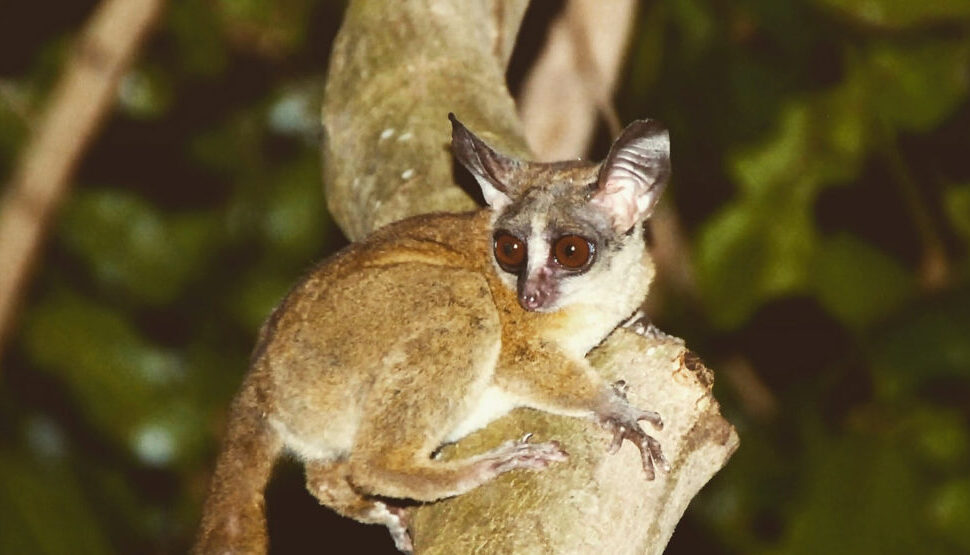
Kibale is one of the best places in Africa for this experience. It has the highest concentration of primates in East Africa — thirteen species — and its habituated chimpanzee communities are among the most studied wild populations on the continent. Research at Kibale has been ongoing for decades, and the tracking teams that lead the habituation experience work with communities that are known individually by researchers.
Afraeka tip: The chimpanzee habituation experience is worth booking only if you are genuinely interested in spending the day with the community. If what you want is a good chimpanzee encounter with a clean structure, the standard trek is the better choice — it is shorter, cheaper, and almost always delivers excellent sightings. Habituation is for travellers who want the full day.
How does it differ from standard chimpanzee trekking?
The habituation experience differs from standard chimpanzee trekking in four dimensions: duration, permit cost, group size and pace. Standard trekking is a one-hour viewing experience in a group of up to eight, with a fixed price and a predictable shape. Habituation is a full day in a very small group, at a higher cost, with a much less structured shape — the day follows the community’s behaviour, not a fixed schedule.
| Factor | Standard chimpanzee trekking | Habituation experience |
|---|---|---|
| Duration | 2–4 hours total, ~1 hour with chimps | Full day, ~6:00am to 5:00pm |
| Group size | Up to 8 trekkers | A handful of trekkers |
| Time with chimpanzees | Strictly 1 hour | Hours, across the day |
| Terrain | Mainly on established trails | Off-trail, following the community |
| Pace | Set by the ranger, moderate | Set by the chimpanzees, variable |
| Physical demand | Moderate | Moderate to high |
| Best for | Most travellers, first-time visitors | Behaviour-focused travellers, photographers, return visitors |
| Cost | Lower | Higher — full-day permit |
| Booking lead time | Weeks to months | Months, often longer |
Rates and permit categories change over time. Confirm current pricing with your operator and see the permits page for guidance on how we handle rates.
The most important practical difference is the terrain. Standard trekking follows established trails that are cleared and maintained. The habituation experience does not — you follow the community wherever it goes, including through undergrowth, over fallen trees, and into areas where there is no trail at all. Footing is uneven, vegetation is dense, and the pace is driven by the chimpanzees. This is a real step up in physical demand, and travellers should be honest about their fitness before booking.
The second important difference is the shape of the day. Standard trekking has a beginning, a middle and an end that everyone knows in advance. The habituation experience does not. Some days the community stays in a small area and the walking is light; on others they range widely and the day is long. If the community is restless, the group follows. If they settle, the group settles. Rangers manage the tracking and the safety, but the day is fundamentally dictated by the chimpanzees.
What happens during the day, hour by hour
A typical habituation day begins before dawn at the Kibale trailhead and ends in the late afternoon. The exact timings vary with the community’s behaviour on the day, but the general shape is consistent.
A full habituation day, from dawn to dusk
- 5:30am — trailhead briefing. Meet the ranger and trackers at the Kibale trailhead before dawn. A short briefing on the day, the community being followed, and what to expect. You will be with a very small group — often just your party.
- 6:00am — walk to the nests. The trackers know where the community nested the night before. The group walks to the nesting site to be there as the chimpanzees wake.
- 6:30am — wake-up. You are with the community as it wakes, grooms, and begins to move. This is one of the most active periods of the day and one of the least seen by standard trekkers.
- 7:00am–10:00am — morning feeding. The community moves between fruiting trees, feeding and travelling. You follow. Pace is dictated by the chimpanzees; stops are frequent. Vocalisations and territorial calls are common at this time of day.
- 10:00am–12:00pm — mid-morning activity. Feeding continues, then usually shifts into grooming, resting, and socialising. This is where a full day delivers something a one-hour trek rarely shows — extended grooming sessions, play between juveniles, and the slow social texture of community life.
- 12:00pm–2:00pm — midday rest. Chimpanzees often rest at midday, particularly in the heat. You will be with them, quietly watching, and this is often when photographers get their best shots. Lunch is eaten in the field, at a distance from the community.
- 2:00pm–4:30pm — afternoon activity. More feeding, moving, and social interaction. Groups sometimes patrol territory boundaries or move toward specific feeding areas.
- 4:30pm–5:00pm — nest building. The community settles and begins to build the night’s nests — a different set from the previous night. Watching this is the natural end of the day and one of the most distinctive parts of the habituation experience.
- 5:00pm — walk back to the trailhead. The group returns to the trailhead and disperses to their lodges, usually in the early evening.
The day is long and physical. You will be on your feet for much of it, following the community, and the walking is off-trail in forest conditions. Two litres of water, snacks, a proper packed lunch and a lightweight daypack are the minimum. Boots should be broken in and waterproof.
| Time | Chimpanzee activity | What you do |
|---|---|---|
| 6:00–7:00am | Waking, grooming, first movement | Watch quietly near the nests; minimal movement |
| 7:00–10:00am | Feeding and travelling | Follow the community; frequent stops; watch vocalisations |
| 10:00am–12:00pm | Grooming, resting, socialising | Sit or stand with the group; long observation periods |
| 12:00–2:00pm | Midday rest | Eat lunch in the field; observe quietly from distance |
| 2:00–4:30pm | Afternoon feeding and movement | Follow the community; watch for patrols and territorial calls |
| 4:30–5:00pm | Nest building | Watch as the community builds the night’s nests |
The exact shape of the day depends on the community’s behaviour. Timings are typical, not guaranteed.
Who should book the habituation experience?
The habituation experience is a good fit for three types of traveller, and a poor fit for three others. Being honest about which category you fall into saves money and disappointment.
Book habituation if you are…
- Seriously interested in chimpanzee behaviour, not just a sighting
- A photographer who wants extended time with the community in varied light and activity
- A return visitor who has done standard trekking before and wants something deeper
- Comfortable with a full day on your feet in off-trail forest conditions
- OK with a day whose structure depends on the chimpanzees rather than the clock
- Travelling as a couple or small group with a specific primate focus
Stick with standard trekking if you are…
- A first-time visitor with limited time — standard trekking delivers excellent sightings
- Travelling with a mixed-fitness group or travellers with mobility concerns
- On a tight budget — the habituation permit is significantly more expensive
- Mainly in Uganda for the gorillas and adding a chimp experience as a secondary activity
- Less interested in extended observation and more interested in a clean, well-shaped experience
- Booking at short notice — habituation slots fill up faster than standard trekking slots
The most common profile of a habituation traveller is someone who has already trekked chimpanzees or gorillas before, has a genuine interest in primate behaviour, and is willing to spend a full day in the forest to see the full arc of a chimpanzee’s active day. The most common profile of a traveller who regrets the choice is someone who booked it thinking it was simply “a longer version” of the standard trek — it is not, and the pacing, terrain and cost all reflect a genuinely different kind of day.
Minimum age and rules
The minimum age for chimpanzee trekking and habituation in Uganda is 15 years, set by UWA and enforced at the point of booking and at the briefing. The minimum age applies to every trekker regardless of fitness or maturity. This is the same age rule as for gorilla trekking, and the same as for standard chimpanzee trekking. Families travelling with younger children should plan an alternative activity for them.
Three rules that apply to the habituation day specifically:
- You must stay with the ranger at all times. The community is habituated but wild, and the ranger’s instructions take priority over any individual’s desire to get a better position or a closer view. Habituation permits give you a full day with the community — they do not relax the safety rules.
- No flash photography, no drones. Chimpanzees are sensitive to sudden light and sound, and flash is prohibited during the entire experience. Drones are prohibited in Uganda’s national parks.
- No trekking while ill. Chimpanzees are susceptible to human respiratory illnesses, and the health rule applies for the same reason it does on gorilla treks. Anyone with a cold, flu, or infectious illness will not be permitted to participate.
Detailed guidance on the rules that apply to primate trekking in Uganda sits on the Uganda gorilla trekking hub and in our guide on gorilla trekking rules and regulations — most of the equivalent rules apply to chimpanzee experiences as well, and understanding them in advance is part of the preparation.
When to book and when to go
The chimpanzee habituation experience runs year-round, but the best conditions are in the drier months — June to September and December to February. The trails are firmer, off-trail following is easier, and the group moves more comfortably through the forest. During the wet months of April, May and November, the walking is harder, the ground is muddier, and the day is longer in feel if not in hours.
Two booking considerations:
- Book well in advance. Habituation permits are limited to a small number of slots per day, and demand is high in peak season. Book at least three to six months ahead for peak-season dates, and six to twelve months ahead for groups or specific dates.
- Confirm the permit type. Standard chimpanzee trekking and habituation are separate permit categories with separate pricing. When you book, confirm explicitly which one you are purchasing. Some operators do not offer habituation as standard, and it needs to be requested specifically.
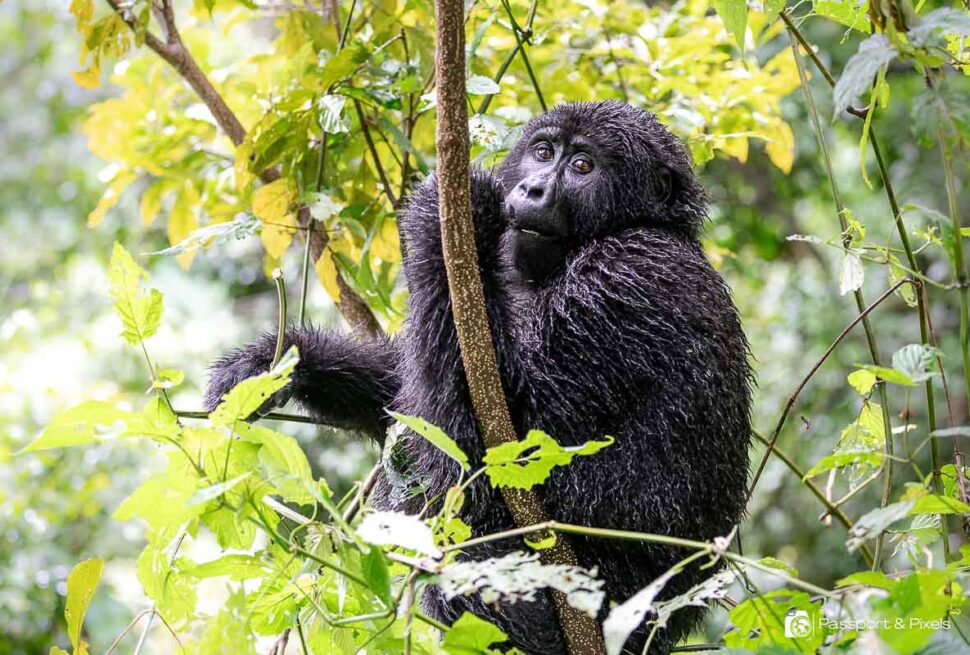
For travellers combining chimpanzees with gorillas — which is the common pattern — the usual structure is a few days in Kibale followed by a drive south-west to Bwindi or Mgahinga. Kibale to Bwindi is roughly a full day’s drive, and the combination is best done over an eight- to ten-day itinerary. Our 7-day Uganda and Rwanda primate safari is built around this combination, and the 18-day Uganda safari shows how the primate-focused sections fit into a longer trip. The full range of trips sits on the trips page.
Common mistakes with the habituation experience
Most of what goes wrong with the habituation experience comes down to a small set of avoidable mistakes, and all of them can be prevented with one careful planning conversation.
- Confusing habituation with standard trekking. They are different products at different price points. Confirm which one you have booked.
- Underestimating the physical demand. Off-trail following through Kibale’s undergrowth is harder than standard trekking trails. Reasonable fitness is required.
- Wearing the wrong footwear. Trail runners without aggressive grip are not enough for off-trail conditions. Proper hiking boots with deep tread, broken in before travel, are the correct choice.
- Not bringing enough water. A full day in a humid forest needs two to three litres per person. Refills are not available in the forest.
- Booking for a mixed-fitness group. The habituation day is built around following the community, and a slow trekker will slow the group and reduce the day for everyone. Consider splitting the group, or book standard trekking for less mobile travellers.
- Booking at short notice. Habituation slots are limited and fill early. Peak-season dates need months of lead time.
- Assuming the day is fully predictable. The shape of the day depends on the chimpanzees. Some days they settle in a small area; others they range widely. Both are normal.
- Not telling the operator about fitness or medical concerns. These shape the day’s pace and planning. The earlier the operator knows, the better the day.
Can one permit cover two people?
No. One permit covers one person for one experience, and this applies to the chimpanzee habituation experience the same as to any other primate trekking permit. A party of four needs four permits on the same date, and habituation permits are more limited than standard trekking permits, so booking early is more important. Details on how permits work, including the gorilla side of the trip, are kept current on the gorilla permits Uganda page.
The overall group size for the habituation experience is very small — smaller than the eight-trekker cap that applies to gorilla trekking and standard chimpanzee trekking. This is one of the reasons permits are limited and expensive. It also means you should expect the experience to be intimate, with a ranger and trackers who are effectively working with your party rather than managing a large group.
Once you have your permits, the specific chimpanzee community you follow is allocated by the trackers on the day. Kibale has more than one habituated community, and the ranger will confirm which one is being followed. The community shapes the feel of the day — a community with young infants behaves differently from one with restless adolescents — but not the structure. The surrounding landscape is mapped on the Uganda destinations page, and the wider conservation context for the region’s chimpanzees sits with the International Gorilla Conservation Programme.
Afraeka field note: A traveller who had done the standard chimpanzee trek two years earlier came back specifically for the habituation experience, and told us afterwards that the two days felt like different species of experience. On the standard trek she had seen about fifteen minutes of actual chimpanzee activity in the middle of the hour, because the community had been resting. On the habituation day she watched for two full hours in the morning as the community travelled and fed, stood with them through a long grooming session in the early afternoon, and ended the day watching them build nests in the fading light. The final hour, she said, was the one she would remember — not because anything dramatic happened, but because she was watching a wild community do something that had nothing to do with her. That is the difference the full day delivers. The hour is a great introduction. The day is the whole thing.
A question that comes up on TripAdvisor’s Uganda forum and on r/Uganda is some version of: “Is the chimpanzee habituation experience worth the extra cost over standard chimp trekking?” The honest answer depends on why you are going. If you want a good chimpanzee encounter, standard trekking delivers that at a lower price and with more availability. If you want to understand how a chimpanzee community actually spends a day — its rhythm, its social dynamics, the way it moves through the forest — the habituation experience is genuinely a different product, and the difference is visible within the first two hours. Travellers with a real interest in primate behaviour almost always say it was worth it. Travellers who booked it as “a longer version of the trek” sometimes say it was not.
Frequently asked questions
What is the chimpanzee habituation experience in Kibale?
A full-day experience with a habituated chimpanzee community in Kibale Forest National Park. Unlike standard chimpanzee trekking, which caps viewing at one hour, the habituation experience runs from the community’s wake-up at dawn to their nest-building at dusk. It is limited to a very small number of trekkers per day and involves following the community off-trail through the forest.
How is it different from standard chimpanzee trekking?
Four ways: duration (a full day instead of 2–4 hours), group size (a handful of trekkers instead of up to eight), time with the chimpanzees (hours instead of one hour), and terrain (off-trail following instead of established trails). It is also more expensive and requires longer booking lead time.
How long does the chimpanzee habituation experience last?
Typically from around 6:00am to 5:00pm. The day starts at the trailhead before dawn, includes a walk to the nests to be with the community as they wake, follows them through the day, and usually ends as they build their nests for the night. Exact timings vary depending on the community’s behaviour.
How many people are in a chimpanzee habituation group?
A very small number — usually a handful of trekkers, often just your own party. This is one of the main differences from standard chimpanzee trekking, which allows groups of up to eight. The small group size is one reason habituation permits are limited and costly.
What is the minimum age for chimpanzee habituation?
15 years, set by UWA and enforced at booking and at the briefing. The rule applies to every trekker regardless of fitness or maturity. Families travelling with younger children should plan an alternative activity for them, and standard chimpanzee trekking has the same minimum age.
How fit do I need to be for the chimpanzee habituation experience?
Reasonably fit. The day involves following the community off-trail through Kibale Forest, over uneven ground, fallen trees and dense undergrowth. Pace is set by the chimpanzees, not the group, and some days involve several hours of movement. This is more physically demanding than standard chimpanzee trekking.
When is the best time for the chimpanzee habituation experience?
Year-round, but the drier months of June to September and December to February are easier on the trails and off-trail following. The wet months of April, May and November involve muddier conditions and slower walking. Demand is highest in peak season and permits fill fastest then.
How far in advance should I book?
At least three to six months ahead for peak-season dates, and six to twelve months ahead for groups or specific dates. Habituation permits are limited to a small number of slots per day and are booked more heavily than standard chimpanzee trekking permits. Book early and confirm explicitly that you are booking the habituation experience, not the standard trek.
Can I combine chimpanzee habituation with gorilla trekking?
Yes, and it is a common combination. The usual structure is a few days in Kibale for the chimpanzee experience, followed by a drive south-west to Bwindi or Mgahinga for gorillas. The drive from Kibale to Bwindi takes most of a day, so the combination is best done over an eight- to ten-day itinerary, with a rest day between the two primate experiences.
Thinking about the full-day habituation experience?
Send us your dates, your party size and an honest picture of your fitness, and we will confirm availability for the habituation experience, tell you how it fits into a wider Uganda itinerary with gorillas and other parks, and outline the whole trip with everything included. If standard chimpanzee trekking suits you better, we will say so. No price figures until we know your route, because the permits are only one line of the total.
About the author: Victoria Kayaga is a Ugandan-born safari expert and founder of Afraeka Adventures, with 15+ years in East African tourism. Based in Kampala, she has planned primate-focused itineraries across Kibale, Bwindi and Mgahinga for years, and she advises travellers on choosing between standard trekking and the habituation experience. More about Victoria.
Keep planning