Last updated: 25 September 2026. Rates and availability are set by UWA and subject to change — confirm before booking.
Short answer: What happens on a gorilla trekking day, in brief — a 4:30am wake-up, a pre-dawn drive to the trailhead, a 30-minute briefing, a forest walk of one to three hours, one hour with a habituated gorilla family, the walk back to the trailhead, a certificate handover, and a return to the lodge by early afternoon. What varies is the length of the walking, which the tracking team decides on the morning of the trek. What is fixed is the viewing hour, and it is the part of the day that stays with travellers longest.
Most of what travellers read about a gorilla trekking day is the mechanics — timings, rules, distances, permits. What they rarely get is an honest account of what the day actually feels like: the cold at 5am, the strange flat quality of the trailhead before dawn, the radio static on the walk in, the moment the ranger holds up a hand and tells the group to stop talking, and the silence that follows. That is what this guide is about.
The post is written as a walkthrough — step by step, from the wake-up at the lodge to the certificate handover. It is designed to sit alongside the timing guide, not repeat it. Where timings matter, they are covered in our separate post on how long a gorilla trek takes. Where permits, rules and support options sit, they are covered on the gorilla permits Uganda page and the Uganda gorilla trekking hub. The regulatory framework that governs the day is published by the Uganda Wildlife Authority.
Gorilla trekking day — key facts
- Wake-up: around 4:30am at the lodge
- Lodge departure: 4:45–5:30am depending on distance to the trailhead
- Briefing: around 7:00am, roughly 30 minutes
- Walk in: 45 minutes to 3 hours
- Time with gorillas: exactly 1 hour
- Walk back: usually faster than the walk in
- Certificate handover: at the trailhead after the trek
- Return to lodge: 12:30–3:30pm; the afternoon is free
The pre-dawn start — 4:30am to 6:30am
The day begins with an alarm at 4:30am in a cold room. Most Bwindi lodges are at altitude, and the temperature before dawn sits in the low teens Celsius or colder depending on the sector. Ruhija and Nkuringo are the coldest; Buhoma and Rushaga are more mild. You dress in the dark — long trousers, long sleeves, a fleece, boots by the door — and head to the main lodge building for coffee.
Breakfast is usually light but proper — eggs, toast, fruit, coffee or tea. If the drive to the trailhead is long, the lodge will pack it in a box for the car. You will eat it on the way, or at the trailhead while waiting for the briefing. Most lodges also prepare a packed lunch for the day.
The drive to the trailhead takes 15 minutes to 1.5 hours depending on your sector and lodge. In the dark, on murram roads, in a Land Cruiser with the windows up against the mist. Wildlife is often visible on the road at this hour — buffalo, bushbuck, the occasional elephant in the Queen Elizabeth area for travellers combining parks. The drive is quiet. Most travellers sleep, or watch the headlights cut through the trees.
Afraeka tip: Wear a proper layer for the drive and the briefing. You will not need it once you start walking, but you will want it in the first hour. A lightweight fleece that packs into your daypack is the right choice — the layering decision most first-timers get wrong is assuming Uganda is uniformly warm.
The briefing and registration — 6:30am to 7:30am
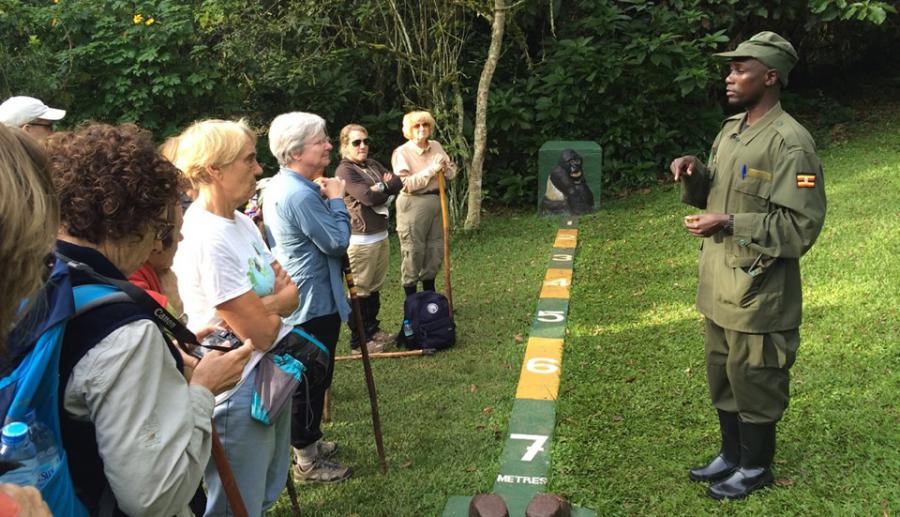
Registration at the trailhead opens around 6:30am. You present your passport and permit details at the desk, receive a briefing card, and are directed to the covered area where the ranger guides are organising the day’s groups. Tea and coffee are usually available, and the trailhead has bathrooms. The atmosphere is functional — the rangers are busy, the trackers are already out in the forest, and the radios are active with their position reports.
What happens at the briefing
- Registration. Passport and permit confirmed at the desk. You are given a briefing card and a trekking group number.
- Group allocation. The ranger guides divide the day’s trekkers into groups of up to eight. Groups are built around fitness, expected pace, and — where relevant — language and specific needs.
- Rules refresher. A short talk on the seven-metre distance, the one-hour cap, no flash photography, no drones, no trekking while ill, and behaviour around the family.
- Family assignment. You are told which habituated family your group will visit. This is not something you requested in advance — it is allocated by UWA based on where each family is and how the day’s treks are balanced.
- Operational update. The ranger describes what the trackers have reported — roughly where the family is, and what the walk in is expected to involve. This is the moment the day takes its shape.
- Departure. Groups leave the trailhead one by one, walking into the forest at around 7:30am.
The family assignment is the point in the day that most travellers do not expect. You do not choose the family; the ranger tells you which one your group will visit, based on where the family nested overnight and how the day’s eight-person groups are best matched. In practice, this is one of the more interesting parts of the briefing — the ranger usually shares a little about the family’s composition, and returning trekkers may recognise the name from their previous trip.
The briefing is also where honesty matters most. Rangers use the information they gather to place trekkers into groups. If you have knee concerns, say so. If you walk slowly, say so. If you have altitude concerns, say so. Rangers want you to enjoy the day and have more flexibility than most travellers realise — but only if they know what to plan for. Our gorilla trekking fitness level guide covers this in more detail.
The walk in — the forest, the sounds, the radios
The walk in begins at the trailhead and ends when the ranger signals that the family is in view. Between those two points, the forest does what it does — you walk, listen, sweat, stop, drink water, watch the light shift through the canopy, and notice that the trackers are somewhere ahead of you, calling in position updates on their radios. This is the longest stretch of the day, and for many travellers it is the most atmospheric.
Three things happen on the walk in that are worth understanding in advance:
- The ranger leads and sets the pace. The ranger guide walks at the front, choosing the route and setting a walking pace the group can sustain. You do not need to navigate or make decisions on the trail — you follow the ranger. This is one of the least stressful parts of the day for travellers who are used to leading their own hikes.
- Trackers are ahead, on radio. UWA trackers leave the trailhead before the trekkers and follow the family from its nest site. They stay in radio contact with the ranger throughout the walk in, updating position as the group moves. If you hear the ranger speak into a radio, that is the trackers on the other end.
- The forest is louder than expected. Bwindi is not silent. It is a working rainforest — birds call, insects buzz, bamboo creaks, branches fall. The sounds build as you go deeper, and the noise you make gets quieter as the group settles into the rhythm of the walk.
The walk in is broken by rest stops, usually every 30 to 40 minutes. Porters carry daypacks and offer a hand on the steeper sections. Rangers hand out water and check on the group. The stops are short but welcome — they let you look around, catch your breath, and take in the fact that you are walking through a forest that contains mountain gorillas, which is not something most people do more than once.
Somewhere along the walk, the ranger will hold up a hand and tell the group to lower their voices. This is the moment the family is close. From here to the family, the group moves more slowly, more quietly, one behind the other. The trackers are nearby. The ranger knows exactly where the family is, and the final stretch is often the most charged part of the day.
The viewing hour — the point of the whole day
The viewing hour begins when the ranger confirms contact and positions the group at the required seven-metre distance. The hour is strictly enforced — sixty minutes, no extensions — and it does not flex for the length of the walk in, the difficulty of the day, or how many more photographs anyone wants to take. Our gorilla trekking rules and regulations guide covers the distance, the no-flash rule, and the behaviour expectations in detail.
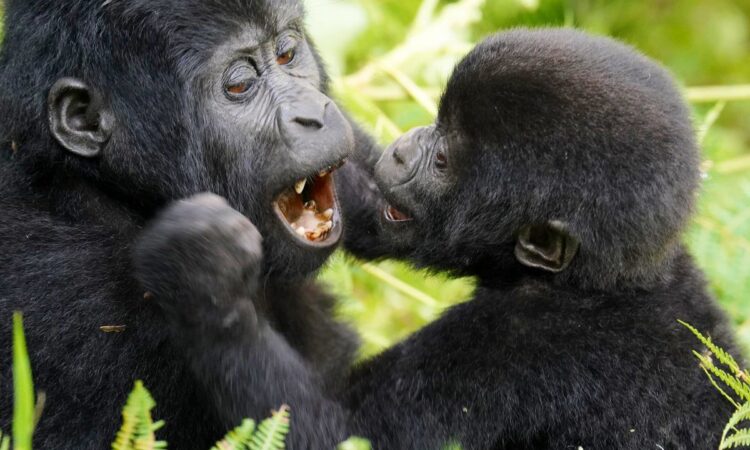
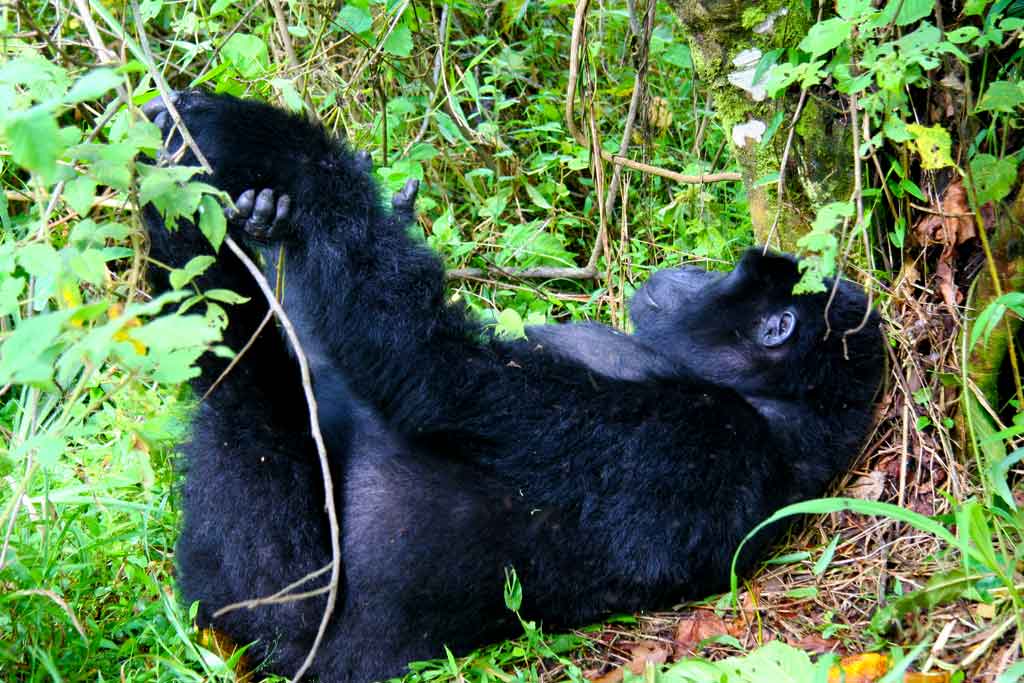
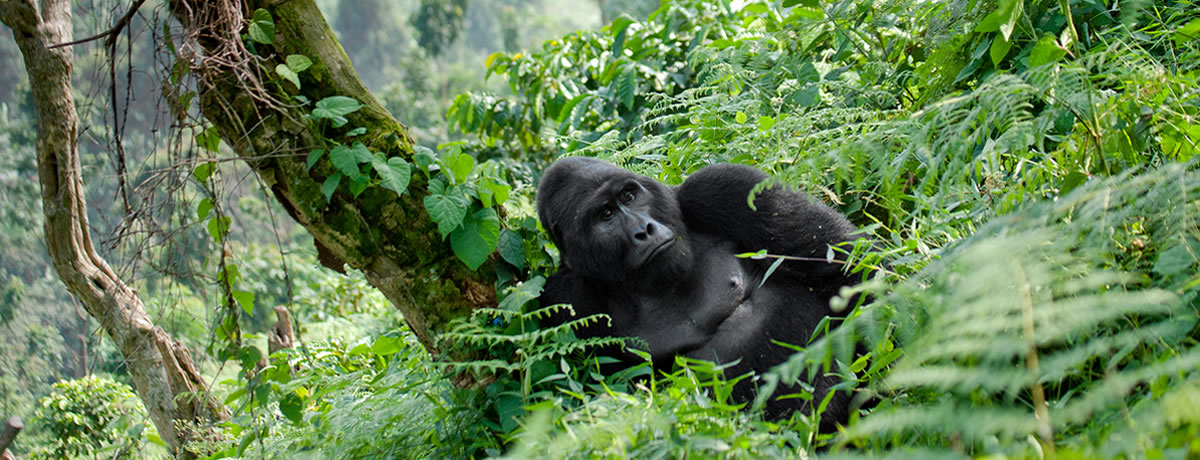
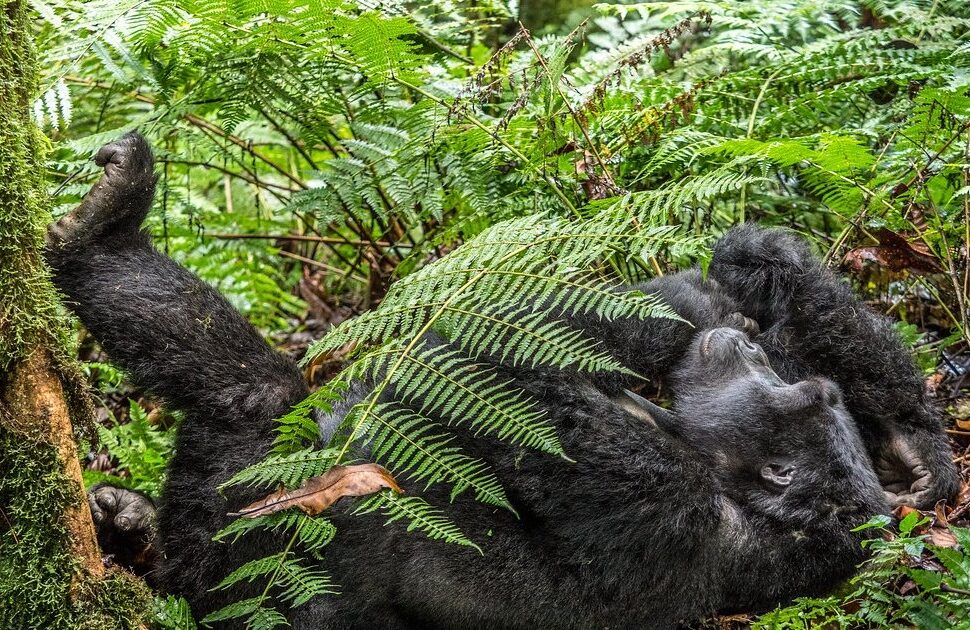
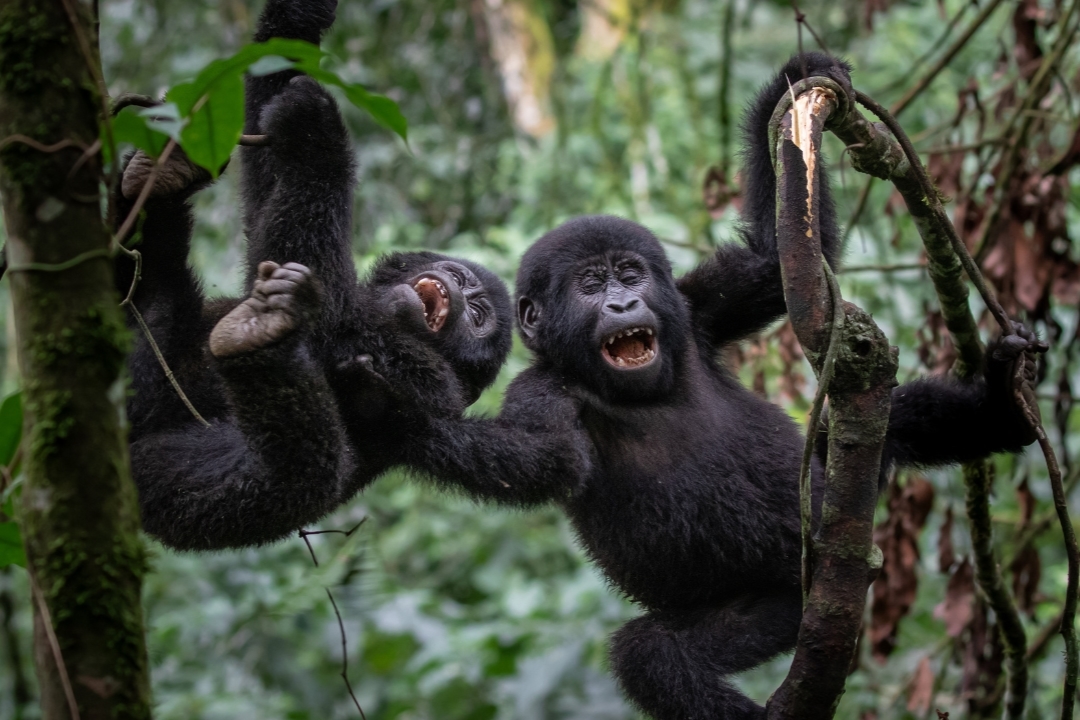
What actually happens during the hour is quieter than most travellers expect. The family does not perform. They eat, groom, nap, move a few metres, interact with each other, and largely ignore the group watching them. Younger gorillas may approach and test the seven-metre boundary; the silverback usually stays further back, watching. The ranger guides the group’s positioning, occasionally asks for quiet, and answers whispered questions about behaviour. If the family moves, the group moves with them — carefully, in formation, staying at the required distance.
| What happens | How common | What to do |
|---|---|---|
| Family feeding and moving through vegetation | Very common | Watch quietly; reposition as directed |
| Silverback watching the group | Common | Do not stare; avoid direct eye contact for long periods |
| Young gorillas approaching the seven-metre boundary | Occasional | Stay still; let the ranger manage the situation |
| Juveniles playing or climbing | Occasional | These are often the highlights — watch, do not move |
| Family moving off into dense vegetation | Occasional | The group follows carefully; do not rush |
| Rain during the hour | Occasional | Keep shooting if you can; the gorillas are unbothered |
Patterns vary by family, season and time of day. Rangers guide positioning in every situation.
The hour feels shorter than most travellers expect. The most consistent piece of feedback we receive from clients afterwards is that they wished they had spent less time behind the camera. If you are deciding how to use the hour, the honest advice is to put the camera down for at least ten minutes and simply watch the family doing what it does. That is the part that stays.
Afraeka tip: Watch the silverback’s reactions to the group. He is usually aware of the trekkers and monitors the scene without showing obvious concern. Rangers read his behaviour closely — if he becomes restless, they will move the group back. Watching him and the ranger together is one of the more interesting dynamics of the hour and one most travellers miss entirely.
The walk back and the certificate — the last stretch
The walk back begins when the ranger signals the end of the viewing hour. It is usually faster than the walk in — the trail is familiar, the route is downhill more often than not, and the group has a known destination. In Buhoma and Rushaga, the descent is usually gentle. In Nkuringo, the walk back is a climb out of the valley and is the hardest part of the day. In Ruhija, the descent is steady but the altitude makes it feel longer than it is.
What most travellers notice on the walk back is the shift in mood. The tension of finding the family is gone, the hour has happened, and the walk out is often the most talkative part of the day. Groups compare notes on what they saw, rangers point out birds and plants they did not mention on the walk in, and the trail seems shorter than the approach even when it is not.
Back at the trailhead, the ranger hands out trekking certificates and gives a short debrief. Photos are taken against the UWA sign. Tips are given to porters and the ranger. The driver is waiting with the vehicle. You are back at your lodge by early afternoon, usually between 12:30pm and 3:30pm depending on the day.
The afternoon after a trek is quiet. Most travellers shower, eat a late lunch, and do very little else. The body is tired, the mind is still processing what it saw, and the lodge feels like the right place to be. The evening is often spent looking at photographs, and the sense that the day has mattered tends to settle in slowly.
How the day differs by sector, season and traveller
The structure of the day is the same across every sector and every group, but the feel of it changes. Three variables make the biggest difference:
| Sector | Feel of the day | What it demands from you |
|---|---|---|
| Buhoma | Gentlest; the classic version of the day | Moderate fitness; the descent is manageable |
| Rushaga | Varied; the sector with the most family options | Moderate fitness; good for groups and short-notice bookings |
| Ruhija | Cold, highland forest; misty mornings; longer walks | Better fitness; good for birders and return trekkers |
| Nkuringo | Most demanding; a descent in and a climb back out | Fit, regular hikers; knees and hips will feel it |
| Mgahinga | Quietest; single family; volcano landscape | Moderate to good fitness; volcanic slopes and altitude |
Season affects the day mostly through the walking. Wet season means mud, slower progress, and a harder descent; dry season means firmer trail and easier footing. The viewing hour is unaffected. Our guide on gorilla trekking in the rain covers the wet-season experience in more detail.
Group composition shapes the day too. A group of fit solo travellers moves fast and finishes early. A group with mixed fitness moves at the slowest pace, which is fine but lengthens the day. A family group with teenagers tends to be slower on the walk in and much livelier on the walk back. None of these is a problem — the pace is set by the ranger — but the day you get depends partly on who is in your group.
What first-timers most often get wrong about the day
Most first-timers come away from their first trek with the same short list of things they wish they had known. All of them are avoidable.
- Underestimating the cold before the walk. The briefing is cold. Bring a layer. Do not rely on Uganda being uniformly warm.
- Assuming the walk will be short. The walk in can be under an hour or three hours. Come prepared for the longer version and be pleasantly surprised by the shorter one.
- Not carrying enough water. Bwindi is humid, and the walk in often happens in the warmest part of the morning. Two litres per person is the sensible minimum.
- Spending the whole viewing hour behind the camera. The most consistently reported regret. Put the camera down for at least ten minutes.
- Skipping the porter. A porter carries the daypack and steadies you on the descent. It is the most consistently recommended choice on any trek.
- Rushing the descent. Wet clay is slippery. The pace on the way back is not a race, and a fall on the last stretch is the most common injury on a gorilla trek.
- Not eating breakfast. The day is long and physical. Eat properly at the lodge, even at 4:30am.
- Not telling the ranger about a fitness or knee concern at the briefing. The ranger will build a group around your pace if they know. They cannot if they do not.
Can one permit cover two people?
No. One permit covers one person for one trek. A party of four needs four permits in the same sector on the same date. Each permit is tied to a named individual, and there is no way to share one or to transfer it to another person. Details on how permits work, including current requirements, are kept current on the gorilla permits Uganda page.
The eight-visitor daily cap per habituated gorilla group applies equally. It is one of the reasons trekking groups are built at a consistent size rather than pooling a larger party onto a single family. The viewing hour is unaffected by group size, and the overall shape of the day — the walk in, the hour, the walk back — is the same for every group of eight or fewer.
Once you have your permits, the gorilla group you actually visit is allocated according to the trekking sector, with final group allocation managed by UWA on the morning of the trek. You will know your sector in advance because it is on your permit; you will learn your family at the briefing alongside everyone else. The family you are assigned shapes the character of the viewing hour — a family with juveniles behaves differently from one dominated by adult males — but not the structure of the day itself. The family-level guides on the blog cover the individual habituated groups in detail, and the wider landscape is mapped on the Uganda destinations page. The International Gorilla Conservation Programme documents the broader conservation context behind every trekking day.
Afraeka field note: A traveller once told us that the moment she remembers most clearly from her trekking day was not the viewing hour, but a minute on the walk in. The group had stopped for water, and the ranger had held up a hand for silence. Somewhere ahead in the bamboo, a gorilla had moved — she heard the branches shift, then a low sound that was almost like a cough, and she realised the family was closer than she had thought. Nothing dramatic happened. She did not see a gorilla at that moment. But the walk in became real for her at that point, and the hour with the family afterwards felt like an answer to the sound. The structure of the day is what most travellers prepare for. The texture is what they remember.
A question that comes up regularly on TripAdvisor’s Uganda forum and on r/Uganda is some version of: “What actually happens on the day — is it what I expect from videos?” The honest answer is that videos tend to compress the day into the viewing hour, which is the shortest part of the experience. The walk in, the briefing, the radios, the cold start, the walk back — together these make up most of the day, and they are why travellers describe the trek as an experience rather than a sighting. Prepare for the shape of the day as well as for the hour, and the day delivers more than the videos suggest.
Frequently asked questions
What happens on a gorilla trekking day, start to finish?
The day begins with a 4:30am wake-up at the lodge, a pre-dawn drive to the trailhead, registration and a 30-minute briefing around 7am, a forest walk of one to three hours, one hour with a habituated gorilla family, the walk back to the trailhead, a certificate handover, and a return to the lodge by early afternoon. What varies most is the length of the walk in.
Do you walk the whole day?
No. The walking is broken up by rest stops and by the viewing hour, which is stationary. Most of the day is spent either walking slowly or standing still. The total time on foot is usually three to five hours, spread across a longer day that includes the briefing, the viewing, and the drives.
What do you wear for a gorilla trekking day?
Long trousers, long sleeves, a lightweight fleece for the morning, waterproof hiking boots with good tread, gaiters, and gardening gloves for nettles. Bring a light waterproof shell in case of rain, and a small daypack with water, snacks and camera. Our guide on what to pack for gorilla trekking covers the kit list in detail.
How much of the day is spent with the gorillas?
Exactly one hour. This is a fixed cap set by UWA and enforced by rangers. The walk in and walk back together usually take longer than the hour itself. The rest of the day — the briefing, the drives, the certificate handover — accounts for the remaining time.
What do you eat during the day?
Breakfast at the lodge or in the vehicle, a packed lunch carried in your daypack, and snacks on the trail. You can eat and drink during the walk in and walk back, at a distance from the gorillas. Eating and smoking are not permitted within sight of the family.
Is the trekking day quiet or social?
Both. The walk in is often quiet — the group walks in single file, in the rhythm of the forest. The viewing hour is quiet, with only whispered questions. The walk back is often social, with the group comparing notes on what they saw. Briefing and trailhead time is functional and busy.
What happens if it rains on the trekking day?
The trek goes ahead. Rain does not affect whether the family is found or whether the viewing hour happens. Trails become muddy and the walking slows, and the descent is more slippery. Bring waterproof layers and expect a longer day. Our guide on gorilla trekking in the rain covers what to expect.
What happens after the trek ends?
You return to the lodge by early to mid-afternoon and the rest of the day is free. Most travellers shower, eat a late lunch, rest, and spend the evening looking at photographs. If you have a second trek booked the following day, that evening is best spent resting and preparing rather than planning other activities.
Can you trek in the afternoon instead of the morning?
No. Gorilla trekking in Uganda runs as a morning activity. The tracking teams go out at first light to locate the families, and the groups leave the trailhead around 7:30am. Afternoon trekking is not offered. If you have an afternoon flight on the day of your trek, you should not book a trek for that day.
Planning your first trekking day?
Send us your dates, your party size and an honest sense of what you want from the day, and we will tell you which sector suits you best, what to expect from the walk in, and how to plan around the shape of the day. If you have fitness or mobility considerations, we will flag them and suggest the right support. No price figures until we know your route, because the permit is only one line of the total.
About the author: Victoria Kayaga is a Ugandan-born safari expert and founder of Afraeka Adventures, with 15+ years in East African tourism. Based in Kampala, she has planned gorilla trekking itineraries across Bwindi’s four sectors and Mgahinga for years, and she walks the trekking day regularly with clients. More about Victoria.
Keep planning
- 3-day Uganda gorilla safari
- 5-day Bwindi and Lake Mburo safari
- Primate tracking experiences
- All Afraeka trips