Last updated: 26 September 2026. Rates and availability are set by UWA and subject to change — confirm before booking.
Short answer: The other primates in Kibale Forest — beyond chimpanzees — number twelve species, including red colobus, black-and-white colobus, red-tailed monkeys, blue monkeys, L’Hoest’s monkeys, grey-cheeked mangabeys, vervet monkeys, olive baboons, and nocturnal species like galagos and pottos. Kibale has the highest primate diversity of any forest in East Africa, and the non-chimp species are visible on the same treks, on the Bigodi Wetland Sanctuary walk, and on the night forest walks the area offers. Most travellers come for the chimpanzees and leave surprised at how much else they saw.
Kibale Forest National Park has thirteen recorded primate species. This is the highest concentration anywhere in East Africa, and one of the highest in the world. The chimpanzees dominate the conversation — and rightly so — but the thirteen-species list is what makes Kibale one of the richest primate habitats on the continent, and the reason a two- or three-night stay here delivers far more than a single trek.
Most travellers who visit Kibale come for the chimp trek, see a handful of the other species en route, and only later realise how much more the forest holds. This guide is about the other twelve — the species that share the forest, where they sit in the canopy and on the ground, and how to build a Kibale itinerary that gives you a chance to see most of them. Permit categories and current rates sit on the gorilla permits Uganda page, and the broader picture across Uganda’s primate sites sits on the primate tracking experiences page. The regulatory framework for Uganda’s protected areas is published by the Uganda Wildlife Authority.
Other primates in Kibale Forest — key facts
- Total primate species: 13, the highest diversity in East Africa
- Beyond chimpanzees: 12 species, daytime and nocturnal
- Diurnal species: Red colobus, black-and-white colobus, red-tailed, blue, L’Hoest’s, mangabeys, vervets, baboons, patas
- Nocturnal species: Galagos (bushbabies) and pottos
- Best place to see them: On the chimp trek, the Bigodi Wetland Sanctuary walk, and the Kibale night walks
- Best season: Dry months easier; primates visible year-round
- Minimum age: None for the walk and night walk; 15 for the chimp trek
- Pairing: Bigodi walk and night walk add the widest species coverage
What are the other primates in Kibale Forest?
The other primates in Kibale Forest are the twelve non-chimpanzee species that share the park’s 795 square kilometres. They span the canopy, the mid-storey and the forest floor, and they range in size from the five-kilogram red colobus down to the galagos that weigh less than a can of soft drink. Some are common and easy to see on any trek; others are shy, nocturnal, and require a dedicated walk to find.
Three groups make up the list:
- The large diurnal species. Red colobus, black-and-white colobus, and grey-cheeked mangabeys are the most visible. They are canopy dwellers, often in large troops, and they are commonly seen on the chimp trek and on any forest walk in the area.
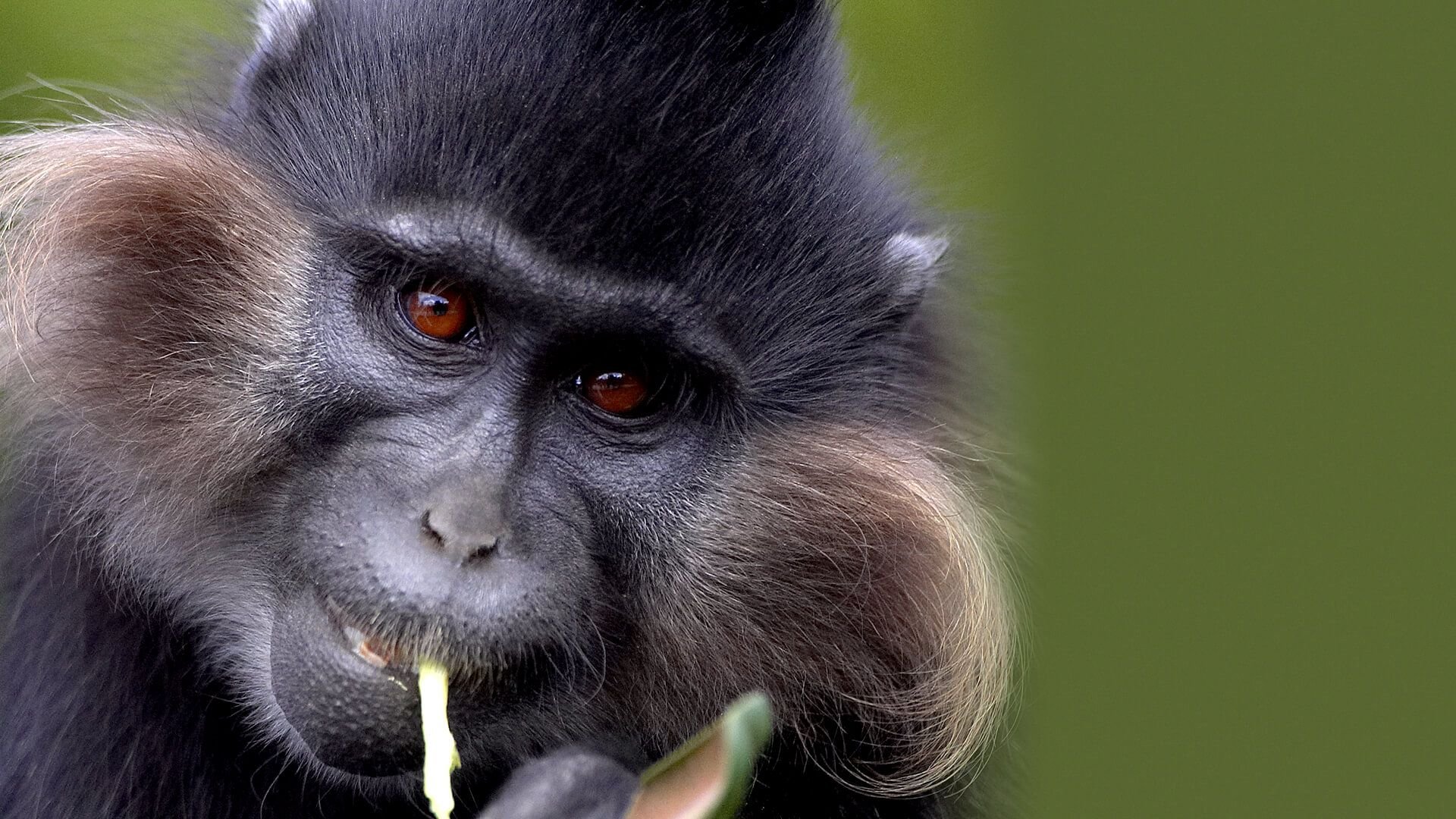
- The mid-sized diurnal species. Red-tailed monkeys, blue monkeys, L’Hoest’s monkeys, vervet monkeys, and olive baboons are widely distributed in the forest and around its edges. They are frequently seen along the trails and at the forest boundary.
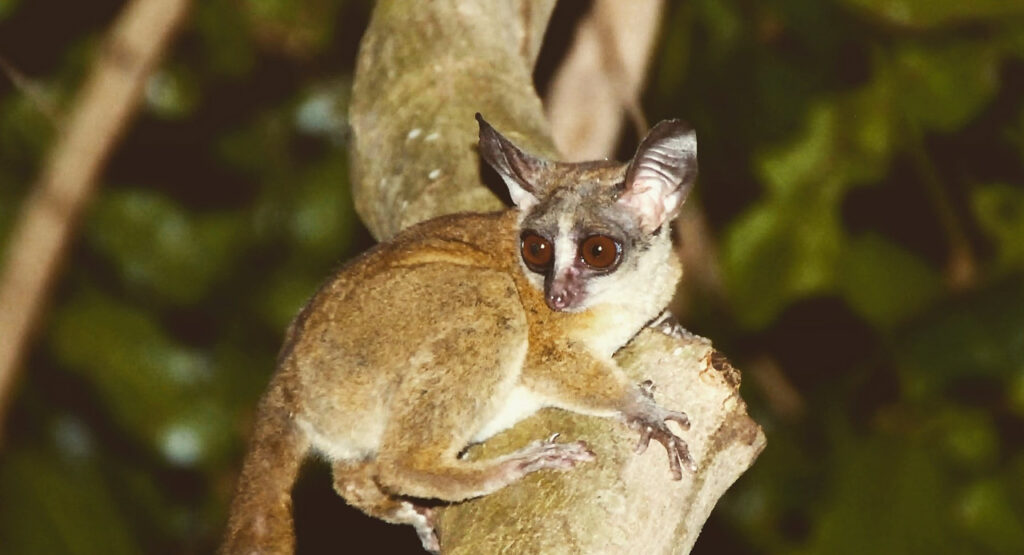
- The nocturnal species. Galagos (also called bushbabies) and pottos are the only primates in Kibale that are active at night. They are not visible on the daytime treks and require a night walk to find. Patas monkeys are also present but rare and largely restricted to the dry northern edge of the park.
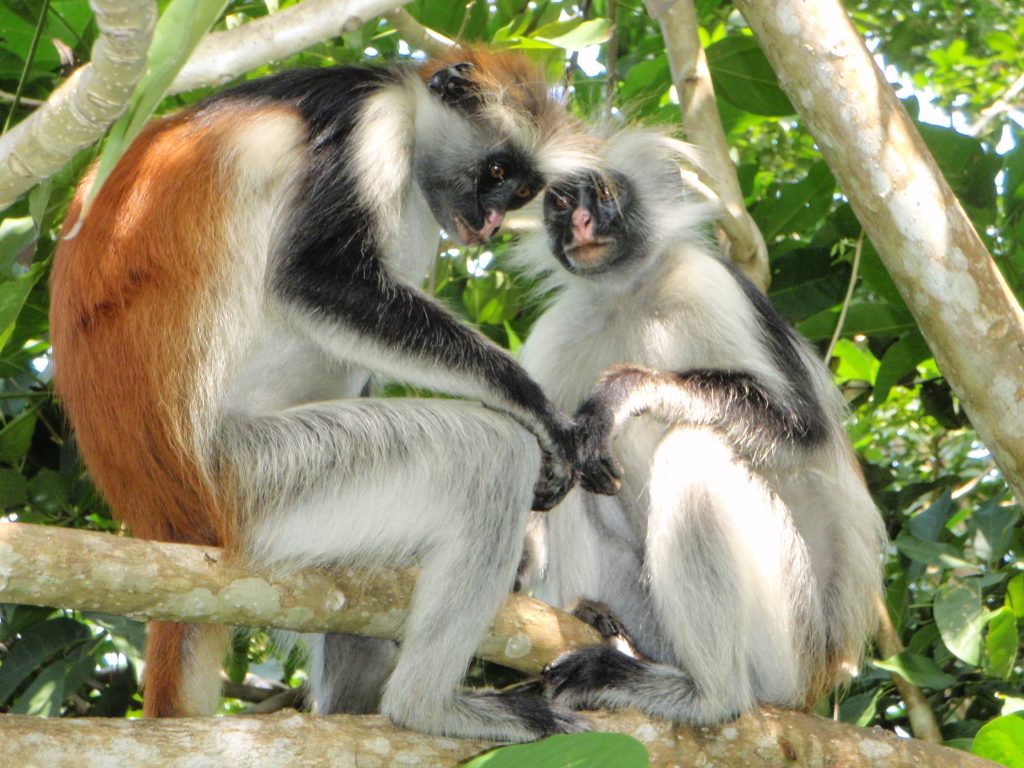
The species list is genuinely impressive. Red colobus in particular is an endangered monkey whose global stronghold is this region, and Kibale is one of the best places in Africa to see them. L’Hoest’s monkeys, which are Albertine Rift endemics, are also commonly seen in Kibale and rarely seen anywhere else. For travellers interested in primates beyond gorillas and chimps, Kibale is one of the most rewarding forests on the continent.
Afraeka tip: If you are building a primate-focused Uganda trip, think of Kibale as the forest where you see the widest range of species, and Bwindi or Mgahinga as the park where you see the one species — gorillas — that you cannot see here. Kibale is a diversity forest; Bwindi is a singular experience. Both are excellent, and they complement each other rather than competing.
Species by species — what you might see
Understanding the twelve species individually is useful for two reasons. First, it helps you know what you are looking at when you spot a monkey in the canopy. Second, it helps you plan which Kibale activities will give you the widest coverage — the chimp trek, the Bigodi walk, or a night walk each favour different species.
| Species | Size | Where seen | Best activity |
|---|---|---|---|
| Red colobus | Medium | Canopy; primary forest | Chimp trek; forest walks |
| Black-and-white colobus | Medium | Canopy; forest edge | Chimp trek; Bigodi walk |
| Grey-cheeked mangabey | Medium | Mid-storey; forest edge | Chimp trek; Bigodi walk |
| Red-tailed monkey | Small | Mid-storey; forest edge | Bigodi walk; forest walks |
| Blue monkey | Small | Mid-storey; primary forest | Chimp trek; forest walks |
| L’Hoest’s monkey | Small | Understorey; forest floor | Chimp trek; forest walks |
| Vervet monkey | Small | Forest edge; gardens | Bigodi walk; road edges |
| Olive baboon | Large | Forest edge; open areas | Bigodi walk; road edges |
| Patas monkey | Medium | Northern dry edge; rare | Occasional; not reliable |
| Galago (bushbaby) | Very small | Nocturnal; trees | Night forest walk |
| Potto | Very small | Nocturnal; canopy | Night forest walk |
| Chimpanzee | Large | Forest-wide | Chimp trek |
The thirteenth species is the chimpanzee, covered in the separate Kibale chimpanzee posts. Sightings vary by season, time of day and activity.
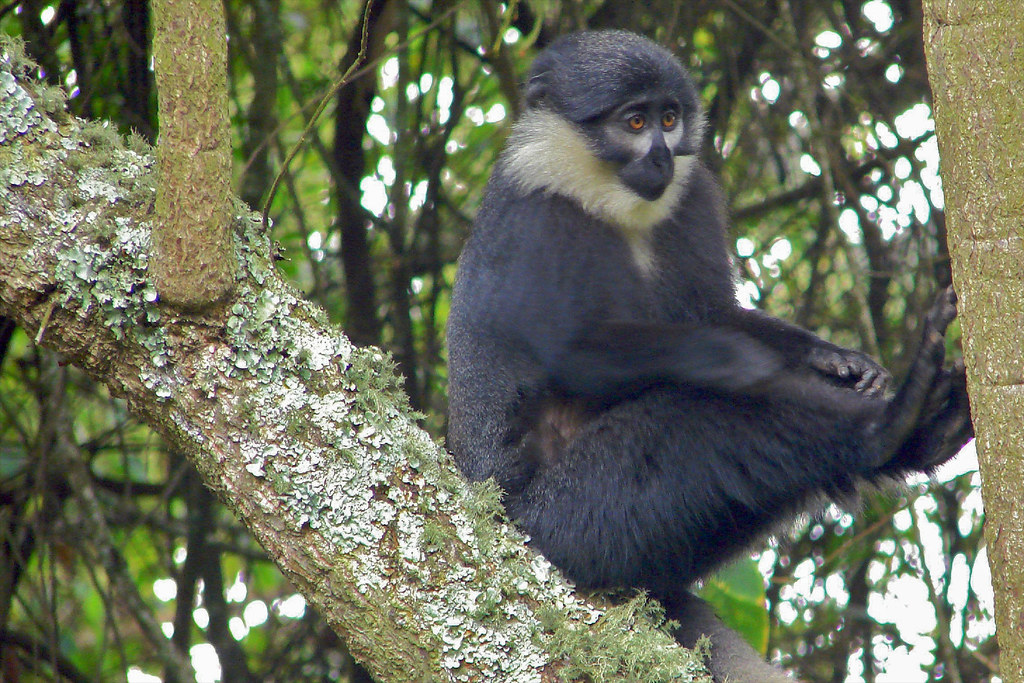
Two species deserve a specific note. Red colobus is classified as endangered, and its population is fragmented across equatorial Africa. Kibale is one of the strongest remaining populations, and the species is regularly seen in mixed troops alongside black-and-white colobus and mangabeys. L’Hoest’s monkey is an Albertine Rift endemic with a distinctive white eyebrow and face pattern — shy, mostly on the forest floor, but commonly seen on the chimp trekking trails when they pass through suitable habitat.
Where do you see them on a Kibale visit?
The other primates in Kibale Forest are seen on three main activities, each with a different emphasis. Understanding which activity favours which species is the key to building a Kibale stay that covers the widest range of animals.
Activities and what each favours
- The chimp trek. Best for the forest-interior species — red colobus, blue monkeys, L’Hoest’s monkeys. The walk passes through primary forest where these species live, and sightings are common en route to the chimpanzees. Black-and-white colobus and mangabeys are also seen on the trek.
- The Bigodi Wetland Sanctuary walk. Best for the forest-edge species — red-tailed monkeys, black-and-white colobus, grey-cheeked mangabeys, vervet monkeys. The boardwalk trail passes through a mix of papyrus, forest edge and gardens, and the primate activity is often high. Our guide on the Bigodi Wetland Sanctuary walk covers the trail in detail.
- The Kibale night forest walk. The only way to see the nocturnal species — galagos and pottos. These walks run after dark, guided, and focus on the forest edge and the trail system. They are short (usually 1.5 to 2 hours) and are not physically demanding.
The three activities together give the widest species coverage. A two-night Kibale stay with one chimp trek, one Bigodi walk, and one night walk is enough to see the majority of the twelve species — and most travellers who do all three are surprised at how much they see. The chimp trek on its own delivers four to six species; the Bigodi walk adds another three or four; the night walk adds the nocturnal two.
For travellers combining Kibale with other parks, the primate species seen here do not overlap with the gorillas at Bwindi or the golden monkeys at Mgahinga, so the species list grows significantly across a full Uganda primate itinerary. Our guide on the Kibale Forest day trip from Fort Portal shows how to fit these activities into a Fort Portal-based itinerary.
How do you build a primate-focused Kibale itinerary?
Building a primate-focused Kibale itinerary means combining the chimp trek with at least one of the two additional primate activities. A one-night stay gives you the chimp trek only; a two-night stay allows the chimp trek plus either the Bigodi walk or the night walk; a three-night stay lets you do all three without rushing.
| Nights at Kibale | Activities | Species coverage |
|---|---|---|
| 1 night | Chimp trek | 4–6 species, mainly forest-interior |
| 2 nights | Chimp trek + Bigodi walk | 8–10 species, forest and forest-edge |
| 2 nights | Chimp trek + night walk | 6–8 species, forest and nocturnal |
| 3 nights | Chimp trek + Bigodi + night walk | 10–12 species, near-full coverage |
| 3 nights + habituation | Add full-day habituation | Full-day chimp coverage, same primate list |
Species coverage depends on season, weather and individual wildlife movements on the day. The estimates are indicative.
Three practical points about building the itinerary:
- Do the chimp trek first. It is the most physically demanding activity and the one with the most fixed schedule. Getting it out of the way early in the stay allows the other activities to fit around it.
- Do the night walk on a non-trekking day. The night walk runs after dark and finishes late, so it is best scheduled on a day when you are not also doing an early-morning activity.
- Book the chimp permit early. Kibale permits are more contested than the Bigodi or night walk bookings. Our guide on Kibale chimpanzee permit availability covers the booking windows in detail.
For travellers with only two nights at Kibale, the choice between the Bigodi walk and the night walk comes down to priorities. The Bigodi walk is easier, family-friendly, and delivers more total species. The night walk is more unusual, focuses on a completely different set of animals, and suits travellers who have already done a lot of daytime primate watching. Both are excellent.
Is primate watching at Kibale suitable for families?
Primate watching at Kibale is broadly family-friendly, with one important caveat. The chimpanzee trek has a minimum age of 15, so families with younger children cannot do the main primate activity at Kibale. The Bigodi walk and the night walk, however, have no minimum age — so families with younger children can still see a significant portion of Kibale’s primate diversity.
Three practical points for families:
- Bigodi is the primary family activity. The boardwalk trail is easy, the pace is gentle, and the primates and birds are visible along the way. Families with young children almost always rate Bigodi highly.
- The night walk suits children 8 and over. Night walks are guided and usually short (1.5 to 2 hours), but they involve walking after dark on uneven ground. Children comfortable with a torch and a late finish will find them exciting.
- The chimp trek requires everyone in the party to be 15 or older. Families with a younger child need to plan an alternative activity for them while the adults trek. Bigodi and the crater lakes are the natural family-friendly alternatives.
For families with children aged 15 and over, Kibale delivers the full primate experience — chimp trek, Bigodi, and night walk — and the three activities together make a genuinely excellent two- or three-night stay. For families with younger children, Kibale becomes a Bigodi-plus-night-walk destination, with the chimpanzees deferred to a future trip or replaced with a golden monkey trek at Mgahinga.
When is the best time to see the other primates?
The other primates in Kibale Forest are visible year-round, but the best conditions are in the drier months of December to February and June to September. The trails are firmer, the canopy is more visible through thinner foliage, and the primate troops are often more active in the cooler dry-season mornings. The wet months bring denser vegetation and muddier trails, but the primates are still present.
Three practical points on timing:
- Early morning is best. Primates are most active in the first few hours after dawn. The chimp trek starts early by necessity; the Bigodi walk can also be started early if you arrange it with your guide.
- The night walk runs year-round. Night walks operate in all seasons, with the dry months being more comfortable underfoot. The nocturnal species are equally visible in the wet months.
- Red colobus and mangabeys are less seasonal. These canopy species are resident and visible across the year. Chimpanzee sightings are less predictable, but the chimp trek’s success rate remains high due to the tracking system.
If your priority is seeing the widest range of species, a two- or three-night stay during the dry season gives you the best conditions. If your dates are fixed in the wet season, the primates are still there and the treks still run, but expect more mud and lower visibility through the canopy.
How do you book the primate activities?
Booking the primate activities at Kibale is different for each one. The chimp trek requires a permit booked in advance; the Bigodi walk and night walk are booked on arrival or through your lodge. Understanding which is which saves confusion when you plan the trip.
What to arrange before your Kibale stay
- Kibale chimpanzee trekking permit — booked in advance, paid in full at booking
- Bigodi Wetland Sanctuary walk — no advance permit; pay at the gate
- Kibale night forest walk — arranged through your lodge or operator; usually bookable on arrival
- Lodge in the Kibale area for the duration of the stay
- Binoculars — genuinely useful for the smaller primate species
- Camera with strap and spare battery
- Headlamp or torch for the night walk
- Boots with grip and long sleeves for the forest trails
Two things are worth confirming when you book. First, that your chimp permit is a standard trekking permit and not a habituation permit — the habituation is a full-day format and will not leave time for the other activities. Second, that your night walk is scheduled on a non-trekking day so you are not exhausted from the early-morning start. Current permit categories and rates sit on the gorilla permits Uganda page.
For the wider primate picture across Uganda, including how Kibale compares with Mgahinga’s golden monkeys and Bwindi’s gorillas, our guide on chimpanzee trekking vs gorilla trekking covers the comparisons. The full itinerary options are on the Uganda destinations page, and the wider primate activities are on the primate tracking experiences page.
Common mistakes with primate-watching at Kibale
Most of what goes wrong with a Kibale primate itinerary comes down to a small set of avoidable mistakes, and all of them can be prevented with one careful planning conversation.
- Staying only one night. One night gives you the chimp trek only. Two or three nights allow the Bigodi walk and night walk, which together add six or seven more species.
- Skipping the Bigodi walk. Many travellers treat Bigodi as optional. It is not — it is one of the best forest-edge primate sites in Uganda, and it takes half a day.
- Forgetting the night walk. The nocturnal primates — galagos and pottos — are only visible on night walks. Skipping the night walk leaves those species out of the count.
- Not carrying binoculars. The smaller primates are hard to see without optics. Binoculars transform the experience.
- Trying to fit the chimp trek and the night walk on the same day. The chimp trek starts before dawn; the night walk finishes late. Doing both on the same day leaves little recovery time.
- Assuming every species is visible on every visit. Some species — like patas monkeys — are rare and not reliably seen. Others are common but seasonal. Adjust expectations accordingly.
- Bringing children under 15 on the chimp trek. The minimum age is 15 and it is enforced. Plan Bigodi and the night walk for younger children instead.
- Booking a habituation permit without realising it. The habituation is a full-day format and takes the place of a standard trek. If you want to do the chimp trek plus the other primate activities, book the standard trekking permit.
Can one permit cover two people?
No. One permit covers one person for one trek, and this applies to the chimpanzee trek at Kibale the same as to any other Uganda primate experience. The Bigodi walk and the night walk do not use permits — they are paid for on arrival on a per-person basis. Current permit categories and rates sit on the gorilla permits Uganda page.
Because the Bigodi walk and the night walk operate on a first-come basis rather than a permit system, they do not have the same daily caps as the chimp trek. This means families and groups can usually be accommodated on these activities at relatively short notice. The chimp trek is the constraint — its permit pool is limited and books out ahead of peak-season dates.
Once the chimp permit is confirmed, the other primate activities can be arranged around it. The chimp trek’s group allocation happens on the morning of the trek. The Bigodi walk and the night walk do not have group allocation in the same sense — groups are formed on arrival and the guide leads the visitors. The regulatory framework for Uganda’s protected areas is set by the Uganda Wildlife Authority.
Afraeka field note: A traveller once told us she had visited Kibale twice before realising the park had more than chimpanzees. On her third trip she stayed three nights, did the chimp trek, the Bigodi walk and the night walk, and came back with a species list that included red colobus, L’Hoest’s monkeys, grey-cheeked mangabeys, and a galago she had watched for twenty minutes on a night walk without anyone else in the group. Her comment afterwards was that the “other primates” had been the surprise of the trip, and that the smaller species had been the ones she had actually spent the most time watching. The chimpanzees were the reason she went; the other twelve were the reason she stayed. That is the honest argument for building a longer Kibale stay — the forest is not a single-animal destination, and it rewards visitors who give it more than one morning.
A question that comes up occasionally on TripAdvisor’s Uganda forum and on r/Uganda is some version of: “Are there monkeys at Kibale besides the chimpanzees?” The honest answer is yes — twelve species, and some of them are among the most visible primates in East Africa. Red colobus in particular is an endangered species whose global stronghold is this region, and it is regularly seen on the chimp trek. What travellers most often miss is that the wider species list is only fully accessible if they stay more than one night and book the additional activities.
Frequently asked questions
How many primate species are there in Kibale Forest?
Thirteen in total — chimpanzees plus twelve others. The non-chimpanzee species are red colobus, black-and-white colobus, grey-cheeked mangabey, red-tailed monkey, blue monkey, L’Hoest’s monkey, vervet monkey, olive baboon, patas monkey, galago, and potto. This is the highest primate diversity of any forest in East Africa.
Which primates can I see without the chimpanzee trek?
Several. Red-tailed monkeys, black-and-white colobus, grey-cheeked mangabeys and vervet monkeys are all visible on the Bigodi Wetland Sanctuary walk, and galagos and pottos are visible on the Kibale night forest walks. Neither of these activities requires a permit or has a minimum age, so families with children can do them.
What is the best activity for seeing the most primate species?
A combination of all three — the chimp trek, the Bigodi walk, and a night walk. Each favours different species. A three-night Kibale stay with all three activities delivers near-full species coverage. Two nights gives you the chimp trek plus one additional activity; one night gives you the chimp trek only.
Are the smaller primates easy to see?
The mid-sized species — red-tailed monkeys, blue monkeys, and black-and-white colobus — are common and frequently seen on the forest trails. The shyer species, like L’Hoest’s monkeys, require more luck, and patas monkeys are rare. Binoculars help considerably, particularly for the canopy species.
Is the Bigodi walk part of Kibale Forest?
Not officially — Bigodi is a community-run wetland sanctuary on the edge of Kibale Forest, managed by KAFRED. It sits roughly 6 km from the main chimp trekking trailhead, and its primates are the same species that occur in Kibale. For practical purposes, the two are complementary and usually booked together.
What is a night forest walk at Kibale?
A guided walk after dark, usually 1.5 to 2 hours, focused on the nocturnal primates and other night wildlife. Galagos (bushbabies) and pottos are the target species, along with owls and nightjars. The walk is guided by a local ranger and requires a torch or headlamp.
What is the minimum age for the non-chimp primate activities?
The Bigodi walk and the night forest walk have no minimum age. The chimp trek has a minimum age of 15. Families with children under 15 can still do the Bigodi walk and the night walk, which together cover a good portion of Kibale’s primate diversity.
When is the best time for primate watching at Kibale?
The drier months of December to February and June to September are the easiest and most productive. Early mornings are best for the diurnal species. The nocturnal species are visible year-round on the night walks.
Can I do the chimp trek and a night walk on the same day?
It is possible but not recommended. The chimp trek starts before dawn and finishes by midday; the night walk runs after dark. Doing both on the same day is tiring, particularly after the long chimp trekking morning. It is better to do them on separate days if your itinerary allows.
Planning a primate-focused Kibale stay?
Send us your dates, party size and how many nights you have in the Kibale area, and we will build an itinerary that fits the chimp trek, the Bigodi walk and the night walk together, with the right order and the right lead time for each. If you are travelling with children under 15, we will show you what the family can do together. No price figures until we know your route, because the permits are only one line of the total.
About the author: Victoria Kayaga is a Ugandan-born safari expert and founder of Afraeka Adventures, with 15+ years in East African tourism. Based in Kampala, she has planned primate-focused itineraries across Kibale, Bwindi, Mgahinga, Budongo and Kyambura for years, and she advises travellers on the full range of primate experiences that Uganda offers. More about Victoria.
Keep planning