Last updated: 26 September 2026. Rates and availability are set by UWA and subject to change — confirm before booking.
Short answer: A Bigodi Wetland Sanctuary walk is a guided circuit through a community-run papyrus wetland near Kibale Forest, on a raised boardwalk trail. The walk runs two to three hours, requires no permit or advance booking beyond a standard entrance fee, and is one of the best birding and primate-spotting experiences in western Uganda. It pairs naturally with a Kibale chimpanzee trek — most travellers do the chimp trek in the morning and the Bigodi walk the same afternoon or the following morning. There is no minimum age, which makes it a strong family activity, and the fees go directly to the community that manages the sanctuary.
Most travellers who visit the Kibale area come for the chimpanzees. What many of them discover, often on the recommendation of a lodge or guide, is that one of the most enjoyable half-days in western Uganda is a walk they had never heard of before arriving. The Bigodi Wetland Sanctuary sits on the edge of Kibale Forest, on the road between Fort Portal and the main trekking trailhead, and it delivers something the chimp trek does not — a slow, quiet, community-guided walk through a wetland that is genuinely rich in birds, monkeys and plant life.
The Bigodi Wetland Sanctuary walk is not a trek in the primate-trekking sense. There is no permit, no minimum age, no seven-metre rule, and no one-hour viewing window. It is a walk — two to three hours on a well-maintained boardwalk through papyrus, forest edge and small gardens. What it lacks in regulated exclusivity, it makes up for in intimacy, flexibility and a direct connection to the community that runs it. This guide covers what the walk involves, what you are likely to see, how it fits with the Kibale chimp trek, and who it suits. Permit categories for the trekking experiences sit on the gorilla permits Uganda page, and the wider primate picture is on the primate tracking experiences page. The regulatory framework for Uganda’s protected areas is published by the Uganda Wildlife Authority.
Bigodi Wetland Sanctuary walk — key facts
- Where: On the Kibale road, roughly 6 km from the main chimp trekking trailhead
- Managed by: Kibale Association for Rural and Environmental Development (KAFRED)
- Walk duration: 2–3 hours; boardwalk trail through papyrus and forest edge
- Bird species: Around 200 recorded, including turacos, hornbills and kingfishers
- Primates: Red colobus, black-and-white colobus, red-tailed monkeys, grey-cheeked mangabeys
- Minimum age: None — the walk is family-friendly
- Permit: No advance permit required; entry fee paid at the trailhead
- Best paired with: A Kibale chimpanzee trek; a Fort Portal crater lakes drive
What is the Bigodi Wetland Sanctuary walk?
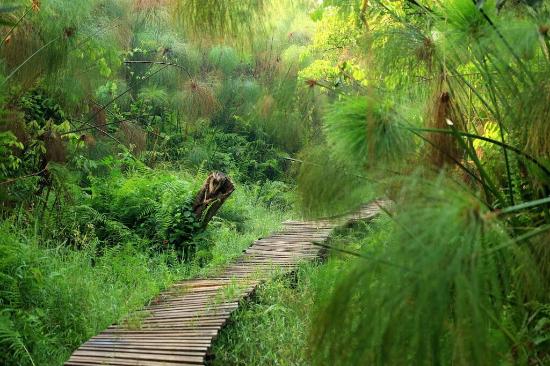
The Bigodi Wetland Sanctuary walk is a guided circuit through a protected papyrus wetland, run by the Kibale Association for Rural and Environmental Development (KAFRED). The sanctuary sits on the edge of Kibale Forest, and the walk follows a raised boardwalk and forest-edge trail through a mix of papyrus swamp, gardens and secondary forest. Local guides lead the walks, and the entrance fee goes directly to the community that manages the site.
Three things define the experience:
- It is a community-run project. KAFRED was founded by local residents to protect the wetland and generate income from tourism. Every fee paid at the gate contributes to community projects — schools, healthcare, and conservation of the wetland itself. This is one of the most direct examples of tourism funding conservation in Uganda.
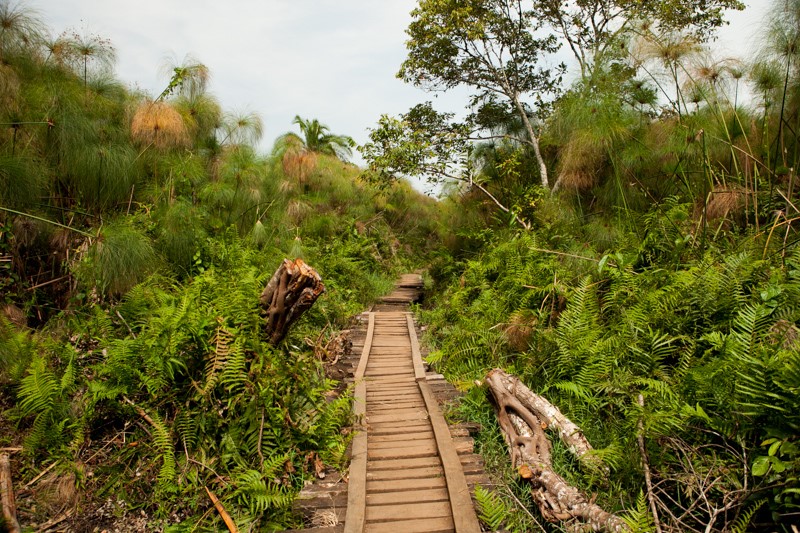
- The boardwalk makes it accessible. The trail is a raised wooden boardwalk through the wettest parts of the wetland, which means you do not need waterproof boots and you do not have to wade through mud. It is a walk, not a hike, and the terrain is genuinely gentle.
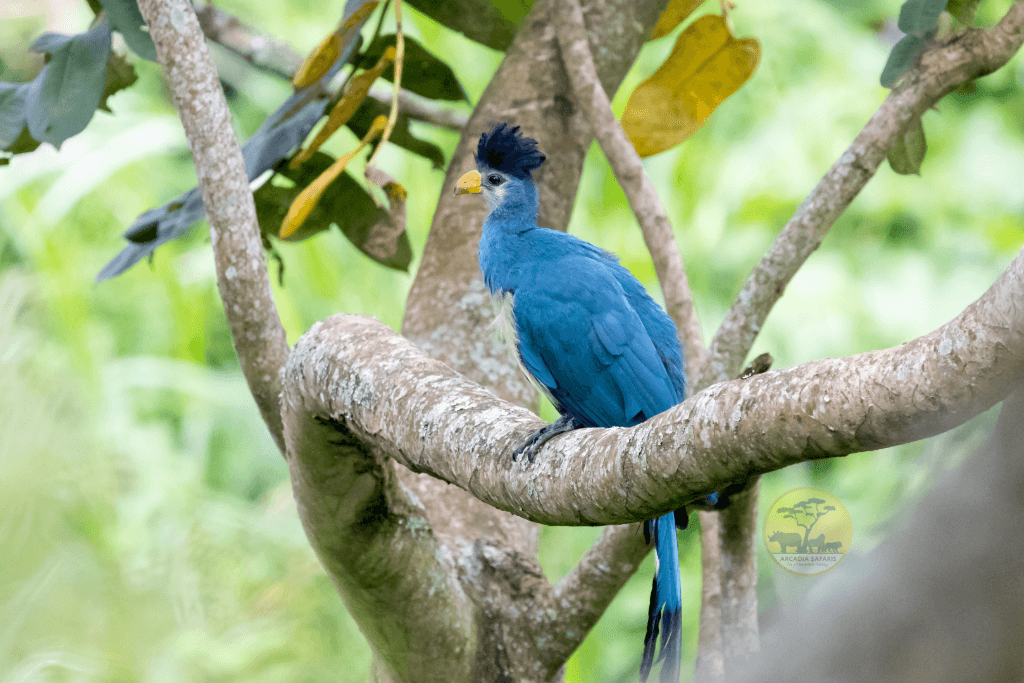
- It is rich in birds and monkeys. Bigodi has around 200 recorded bird species, including the great blue turaco — a striking forest-edge bird that is one of the sanctuary’s emblematic species. Red colobus, black-and-white colobus, red-tailed monkeys and grey-cheeked mangabeys are all commonly seen in the forest edge along the trail.
The walk is guided from start to finish by a local guide, and the guides at Bigodi are among the best in Uganda for forest-edge birding. Most of them have worked the sanctuary for years and know individual turaco territories by heart. If you carry binoculars, the walk becomes genuinely excellent; if you do not, the primates and the forest atmosphere still make it worthwhile.
Afraeka tip: Do the Bigodi walk as a standalone activity rather than trying to squeeze it in on the same day as your chimp trek. A chimp trek already involves a pre-dawn start and a full morning in the forest. Adding a two to three hour walk on the same afternoon is possible but tiring. Doing it the following morning is the more relaxed format, and it means you can be genuinely present for the birds and the wetland rather than thinking about lunch.
Where is Bigodi and how do you get there?
Bigodi Wetland Sanctuary sits roughly 6 kilometres from the main Kibale chimp trekking trailhead, on the Fort Portal–Kamwenge road. The sanctuary is directly on the road, with a small visitor centre and parking area at the gate. Access is straightforward, and travellers based at a Kibale lodge or in Fort Portal can reach the sanctuary in 20 to 45 minutes depending on their starting point.
| From | Distance | Drive time |
|---|---|---|
| Kanyanchu trailhead (Kibale chimp trek) | ~6 km | 10–15 minutes |
| Kibale Forest Camp area | ~6 km | 10–15 minutes |
| Fort Portal town centre | ~40 km | 40–50 minutes |
| Ndali–Kibale lodges | ~30 km | 30–40 minutes |
| Queen Elizabeth National Park (via Kasese) | ~3 hours | Half-day transfer |
Drive times are approximate. Wet-season murram conditions can add 10–15 minutes to the longer routes.
For travellers staying at a Kibale Forest lodge, the sanctuary is essentially next door — 10 to 15 minutes by road. For travellers based in Fort Portal, it is a 40 to 50 minute drive, which pairs naturally with a Kibale day trip. The walk itself takes two to three hours, so half a day is sufficient to do it properly with a return transfer.
What happens on the Bigodi Wetland Sanctuary walk?
The Bigodi Wetland Sanctuary walk follows a fixed circuit through the wetland, on a raised boardwalk and forest-edge trail. A local guide leads the group, and the pace is slow and observation-focused — the walk is not about distance covered but about what you see along the way.
The walk, step by step
- Arrival at the visitor centre. Meet your guide, pay the entrance fee, and receive a short briefing on the sanctuary and its community work.
- Enter the papyrus wetland. The boardwalk leads into the papyrus swamp. This is the wettest section of the walk and often the best for birdlife — herons, kingfishers, and the striking great blue turaco are regularly seen here.
- Cross into forest edge. The trail moves from papyrus into secondary forest and forest edge, where the primate activity is highest. Red colobus and black-and-white colobus are commonly seen in the canopy.
- Walk through community gardens. A stretch of the walk passes through smallholdings on the sanctuary’s edge, where the guide explains the community model and the way the sanctuary balances conservation with local livelihoods.
- Return to the visitor centre. The circuit closes back at the gate, with a final stretch along the road edge where more birdlife is often visible.
- Debrief and departure. The guide answers questions and hands out a birdlist for reference. Tips for the guide are customary but optional.
Two things distinguish the walk from a standard nature walk. First, the guide is not just an escort — they are actively looking for birds and monkeys and calling the group’s attention to what they find. Second, the walk is flexible on pace. If the group is interested in birds, the guide will spend longer at each sighting; if the group is more interested in primates, they will focus on the canopy. Either way, the walk is tailored to the group rather than run to a fixed schedule.
What wildlife can you see on the walk?
Bigodi is one of the richest forest-edge sites in Uganda for both birds and primates. It sits between the deep forest of Kibale and the wetlands and gardens of the surrounding landscape, which means the walk passes through several habitat types in a short distance. The species list reflects this — birds of open wetland, birds of forest edge, and primates of the forest canopy.
| Species or group | Where on the walk | Notes |
|---|---|---|
| Great blue turaco | Forest edge and papyrus | The emblematic species of Bigodi; striking blue and green plumage |
| Black-and-white casqued hornbill | Forest edge and canopy | Often heard before seen; loud calls |
| Various kingfishers | Papyrus and wetland pools | Several species present; the malachite and woodland kingfishers are the most often seen |
| Red colobus monkeys | Forest edge and canopy | Endangered species; stronghold in Kibale and Bigodi |
| Black-and-white colobus | Forest edge | Common in the forest-edge trees near the visitor centre |
| Red-tailed monkeys | Forest edge | Frequently seen at close range along the trail |
| Grey-cheeked mangabeys | Forest edge | Common; often in small groups |
| Vervet monkeys | Gardens and road edge | Occasional; less arboreal than the colobus |
Wildlife sightings vary by season, time of day and group pace. The guide will point out what is active on the day.
Two categories of visitors get the most out of the walk. Birders find it one of the best forest-edge birding sites in the country, and the guides at Bigodi are among the most experienced forest-edge birding guides in Uganda. Primatologists and primate-focused travellers find the monkey viewing genuinely excellent — the red colobus in particular is a species that most travellers do not see elsewhere, and Bigodi offers reliable sightings at close range.
How does the community model work?
The Bigodi Wetland Sanctuary is community-run. It was established in 1995 by residents of Bigodi village, working through the Kibale Association for Rural and Environmental Development, and it has been operating on that model continuously since. The sanctuary is not UWA-managed and is not part of the national park system — it is a community conservation project that runs alongside Kibale Forest, and it manages its own visitor programme.
Three practical consequences of the community model:
- The entrance fee goes to the community. The gate fee is paid directly to KAFRED, and the funds support local schools, healthcare, and the sanctuary’s own conservation and anti-poaching work. The guide fees also go to local guides from the community.
- The sanctuary protects the wetland. Before the sanctuary was established, the wetland was threatened by conversion to agriculture and by hunting of the birds that used it. The sanctuary model has protected the wetland and the birdlife, and the community now has a direct economic interest in keeping it intact.
- The walk is more informal than a UWA experience. There is no permit system, no advance booking, and no minimum age. You arrive, pay the fee, join a guide, and walk. This is the biggest practical difference from the UWA trekking experiences and one of the reasons the walk works so well for families.
The community angle is genuinely important to the experience. Travellers who want to see how conservation and local livelihoods intersect in Uganda will find Bigodi one of the more direct examples. The Uganda Tourism Board maintains national context on community tourism and the wider western circuit.
How does Bigodi pair with the Kibale chimp trek?
Bigodi Wetland Sanctuary pairs naturally with the Kibale chimpanzee trek. The two sites are close together, the walk complements the trek rather than competing with it, and most travellers who do one end up doing the other. The pairing works in either order, though doing the chimp trek first and the Bigodi walk the following morning is the more relaxed format.
Three practical points about the pairing:
- Different activity, different day. The chimp trek is a pre-dawn start and a full morning in the forest; the Bigodi walk is a half-day activity at a slower pace. Doing both on the same day is possible but tiring, especially in the wet season.
- The walk fills a gap in the itinerary. For travellers already in the Kibale area, the Bigodi walk is an easy way to add a second forest experience without booking another trekking permit. It is one of the more efficient uses of a half-day in the region.
- The walk works for travellers who cannot do the chimp trek. Families with children under 15, travellers with mobility concerns, and travellers who simply do not want a full trek all find Bigodi accessible. This makes it a strong pairing for mixed-fitness groups.
The wider Kibale area also offers other short activities that pair with a chimp trek, including the crater lakes drive and the tea plantations around Fort Portal. Our guide on the Kibale Forest day trip from Fort Portal covers those combinations. The chimp trek itself is covered in our guide on the chimpanzee habituation experience for travellers interested in the full-day format.
When is the best time for the Bigodi walk?
The Bigodi Wetland Sanctuary walk runs year-round, and the best conditions are in the drier months — December to February and June to September. The boardwalk is passable in all conditions, but the walk is more comfortable in the dry season and the birdlife is often more concentrated around the remaining wetland pools. The wet months bring lush greenery and more water in the papyrus, but the walk is still enjoyable.
Three practical points on timing:
- Early morning is best for birds. The walk can be done at any time of day, but the first three hours after dawn are the most active for birdlife. If you are staying at a Kibale lodge, an early start gives you the best sightings.
- Mid-morning is best for primates. The colobus and mangabeys are active through the morning and settle in the afternoon. If your priority is primates, aim for the mid-morning walk.
- The walk is rain-tolerant. The boardwalk means you are not wading through mud, and rain does not usually stop the walk. Bring a light waterproof shell in the wet months.
Because Bigodi operates on a walk-in basis rather than a permit system, timing is less about booking and more about when you want to walk. Groups are usually small, and there is no need to book ahead unless you are arriving with a large party. For travellers staying at a Kibale lodge, the walk is easy to fit into the itinerary on almost any day.
How do you book the Bigodi walk?
You book the Bigodi walk on arrival at the sanctuary gate. There is no advance permit requirement and no need to book through an operator. You pay the entrance fee, meet your guide, and walk. This is the simplest booking structure of any of the experiences covered on this blog, and it is one of the reasons Bigodi works so well as a half-day activity.
What to arrange before your Bigodi walk
- Transport to the sanctuary gate — 10–15 minutes from Kibale lodges, 40–50 minutes from Fort Portal
- Entrance fee in cash (the sanctuary is community-run; card facilities are limited)
- Binoculars if you carry them — genuinely useful on this walk
- A light waterproof shell in the wet months
- Long sleeves and long trousers — the trail passes through vegetation
- Comfortable walking shoes — the boardwalk is flat but the trail varies
- Water and a snack
- Cash for guide tips, which are customary but optional
Two things are worth confirming when you arrive. First, that your guide speaks your language — Bigodi’s guides work in English and several local languages, and the guides are usually assigned by language group. Second, that you know the walk duration — the standard circuit is two to three hours, but the guide can shorten it if needed for families with young children.
For travellers combining Bigodi with a wider Kibale itinerary, the walk fits into either a rest day or an afternoon. Our Uganda destinations page maps how the Kibale region connects with the rest of the country, and the 5-day Uganda safari is a common format that includes the area. The 18-day Uganda safari shows how the region fits into a longer route.
Common mistakes with the Bigodi Wetland Sanctuary walk
Most of what goes wrong with a Bigodi walk comes down to a small set of avoidable mistakes, and all of them can be prevented with one careful planning conversation.
- Skipping it because it is not a trek. The Bigodi walk is not a substitute for a chimpanzee or gorilla trek, and it does not try to be. It is a genuinely different experience, and travellers who book it as a companion to the chimp trek almost always rate it highly.
- Not bringing binoculars. Bigodi is one of the best forest-edge birding sites in Uganda. Without binoculars you will still see primates, but you will miss most of the birdlife.
- Trying to do it on the same afternoon as the chimp trek. Possible but tiring. Do it the following morning if you can.
- Underestimating the value of the guide. Bigodi’s guides are the reason the walk works. Engage with them, ask questions, and tip appropriately.
- Wearing sandals or open shoes. The boardwalk is flat but the trail varies. Comfortable closed walking shoes are the right choice.
- Assuming the walk is free. There is an entrance fee, and it goes to the community. Bring cash, as card facilities are limited at the gate.
- Forgetting cash for guide tips. Tips are customary but optional, and the guides rely on them as part of their income. Bring small notes.
- Rushing the walk. The walk is two to three hours for a reason — the pace is deliberately slow. If you rush it, you miss most of what Bigodi offers.
Can one permit cover two people?
Bigodi does not operate on a permit system, so the question of sharing a permit does not apply directly. The entrance fee is per person, and each visitor pays their own fee at the gate. There is no way to enter on someone else’s payment. What makes Bigodi different from the UWA trekking experiences is that there is no advance permit, no minimum age, and no daily cap — you arrive, pay, and walk.
For travellers comparing Bigodi with the UWA-managed experiences, this structural difference is worth understanding. Gorilla, chimpanzee and golden monkey trekking all operate on permits issued in advance, paid in full at booking, and tied to a named individual. Bigodi does not. The sanctuary manages its own visitor numbers and runs on a first-come basis, and the community model means the entrance fees are handled directly by the sanctuary rather than through UWA.
This is one of the reasons Bigodi works so well as a family activity. There is no minimum age, no permit to book, and no risk of a booking falling through. Families with young children, travellers on flexible schedules, and travellers who simply want a walk in the forest can all book the walk on the day. The one-hour viewing window, distance rules and other UWA trekking rules do not apply — Bigodi is a walk, not a trek, and it operates under its own guidelines managed by the community. The regulatory context for Uganda’s protected areas is set by the Uganda Wildlife Authority, and the community tourism side sits with the Uganda Tourism Board.
Afraeka field note: A traveller who had trekked chimpanzees at Kibale the previous day once told us she had almost skipped the Bigodi Wetland Sanctuary walk because she assumed it would be “a lesser version of the forest.” She went anyway, on a quiet Tuesday morning in March, and by the time she reached the middle of the papyrus she was telling her guide that the walk was one of the most interesting hours she had spent in Uganda. What she remembered most, she said, was not any single species — it was the pace. The chimp trek had been a search; the Bigodi walk was a wander, and the wandering was the point. The guide had stopped the group five times in the first thirty minutes for birds, and each stop had opened up a different part of the wetland. What she had expected to be an afterthought had become the memory.
A question that comes up occasionally on TripAdvisor’s Uganda forum and on r/Uganda is some version of: “Is the Bigodi walk worth doing if I am already doing the Kibale chimp trek?” The honest answer is yes, especially if you are staying in the Kibale area for more than one night. The walk adds a different kind of forest experience — slower, quieter, and more focused on birds and forest-edge primates — and the community model adds a dimension that the UWA experiences do not. It is not a substitute for the chimp trek, and it does not claim to be. It is a genuinely different half-day in the same forest landscape, and it costs a fraction of a trekking permit.
Frequently asked questions
What is the Bigodi Wetland Sanctuary walk?
A guided circuit through a community-run papyrus wetland near Kibale Forest, on a raised boardwalk trail. The walk runs two to three hours and is led by local guides. It is one of the best forest-edge birding and primate-spotting experiences in western Uganda, and it is run by the community association KAFRED.
Do I need to book the Bigodi walk in advance?
No. Unlike gorilla and chimpanzee trekking, the Bigodi walk does not require an advance permit. You arrive at the sanctuary gate, pay the entrance fee, and join a guide. It operates on a first-come basis, and booking ahead is not necessary unless you are arriving with a very large group.
How long does the Bigodi walk take?
Two to three hours for the full circuit. The walk is not about distance covered but about what you see along the way — the guide sets a slow, observation-focused pace. The circuit can be shortened for families with young children if needed.
What wildlife can I see at Bigodi?
Around 200 bird species, including the great blue turaco, various hornbills and kingfishers, and several raptors. The primates include red colobus, black-and-white colobus, red-tailed monkeys and grey-cheeked mangabeys. Wildlife sightings vary by season, time of day and group pace.
Is Bigodi suitable for families with young children?
Yes. There is no minimum age for the walk, the boardwalk makes the trail accessible, and the pace is gentle. Families with young children often rate the Bigodi walk as one of the more enjoyable activities of a Uganda trip, precisely because there is no age restriction and no permit to book.
How does Bigodi compare with the Kibale chimp trek?
They are different experiences. The Kibale chimp trek is a permit-based morning activity with a one-hour viewing window; the Bigodi walk is a slower, more open half-day activity with no permit and no fixed schedule. The chimp trek is focused on one species; the Bigodi walk is focused on the wetland ecosystem as a whole.
Where is Bigodi Wetland Sanctuary?
On the Fort Portal–Kamwenge road, roughly 6 km from the main Kibale chimp trekking trailhead. The sanctuary is directly on the road, with a small visitor centre and parking at the gate. Access is straightforward from any Kibale lodge or from Fort Portal.
Does the Bigodi entrance fee go to the community?
Yes. The sanctuary is run by the Kibale Association for Rural and Environmental Development (KAFRED), a community organisation. Entrance fees support local schools, healthcare, and the sanctuary’s conservation and anti-poaching work. Guide fees also go directly to local guides.
What should I bring on the Bigodi walk?
Binoculars if you have them, a light waterproof shell, long sleeves and long trousers, comfortable closed walking shoes, water and a snack, and cash for the entrance fee and guide tips. The boardwalk means you do not need waterproof boots, but comfortable footwear is still recommended.
Adding Bigodi to your Kibale itinerary?
Send us your dates, party size and how many nights you are staying in the Kibale area, and we will fit the Bigodi walk into your itinerary alongside the chimp trek and the other short activities in the region. If you are travelling with young children, the walk is one of the few forest activities everyone can do together. No price figures until we know your route, because the walk is only one line of the total.
About the author: Victoria Kayaga is a Ugandan-born safari expert and founder of Afraeka Adventures, with 15+ years in East African tourism. Based in Kampala, she has planned western Uganda itineraries across Kibale, Fort Portal and the crater lakes region for years, and she advises travellers on the community-run experiences that add depth to a forest trip. More about Victoria.
Keep planning