Quick answer: Tigerfish are fast, aggressive predators with razor-sharp teeth, found in the Victoria Nile below Murchison Falls and in Lake Albert. They hit spinners and small spoons hard, fight explosively and often leap clear of the water. Use a medium spinning rod and a wire trace — their teeth cut through everything else. In Murchison Falls National Park, fishing for tigerfish requires a UWA sport fishing permit (US$50/day) and is strictly catch and release.
- Scientific name
- Hydrocynus vittatus (African tigerfish)
- Where in Uganda
- Nile at Murchison Falls, Lake Albert, Nile delta
- Typical size
- 1–5 kg; larger specimens possible
- Best lures
- Spinners, small spoons, small plugs
- Essential gear
- Wire trace (teeth cut mono, fluoro and light braid)
- Permit (Murchison)
- US$50/day, catch and release only
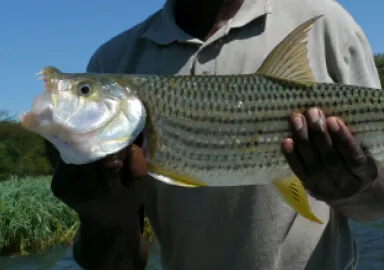
Nile perch gets most of the attention in Uganda, but many experienced anglers say the tigerfish is the most exciting fish in the country. Pound for pound, it fights harder than almost any freshwater species. A hooked tigerfish explodes from the water, shakes its head violently, and runs with a speed that strips line before you can react. Its silver body is marked with dark horizontal stripes, and its mouth is armed with interlocking, razor-sharp teeth that can sever monofilament and fluorocarbon line in an instant. This guide covers everything you need to know to target tigerfish in Uganda.
About the tigerfish
The African tigerfish (Hydrocynus vittatus) is a predatory fish in the family Alestidae, related to piranha and tetras. It is native to the Nile, Congo, Zambezi and other major African river systems. The species is characterised by:
- Teeth: Large, interlocking, razor-sharp teeth visible even when the mouth is closed. Possibly the most formidable dentition of any freshwater fish its size.
- Speed: Tigerfish are among the fastest freshwater fish in Africa. They ambush prey with explosive bursts of speed.
- Jumping: When hooked, tigerfish frequently leap clear of the water — sometimes multiple times in a single fight. This makes hook-ups tricky and losses common.
- Size: In Uganda, most tigerfish caught are 1–5 kg. Larger specimens are possible, especially in Lake Albert. The related goliath tigerfish (Hydrocynus goliath) of the Congo River grows much larger, but that species does not occur in Uganda.
Where to find tigerfish in Uganda
Murchison Falls National Park (Victoria Nile)
The stretch of the Nile below Murchison Falls is the most accessible and productive tigerfish water in Uganda. Tigerfish inhabit faster stretches of the river — rapids, eddies, current seams and the edges of turbulent pools. They are often found in the same general areas as Nile perch, but tend to prefer shallower, faster water.
Many anglers target tigerfish between Nile perch sessions, using lighter tackle and faster-retrieved lures. The area between the falls and Paraa is most productive, with both bank and boat fishing available. All fishing is catch and release with a UWA sport fishing permit.
Read our Murchison Falls sport fishing guide for the full rundown on locations, logistics and accommodation.
Lake Albert
Lake Albert, in the western rift valley on the DRC border, holds tigerfish in its open waters and around the Nile delta where the river enters the lake. Lake Albert tigerfish can be larger than those in the river, as the lake provides more expansive feeding territory. Access is more remote — typically from Butiaba or from lodges on the lake shore.
Fishing Lake Albert for tigerfish is a more adventurous prospect than Murchison Falls. Fewer operators run trips here, and facilities are basic. But the reward is uncrowded water and the chance of larger fish. See our Lake Albert fishing guide.
Nile delta
The area where the Nile broadens into papyrus channels and wetlands before entering Lake Albert holds good numbers of tigerfish. They lurk along channel edges and in openings between papyrus beds. Access is by boat from Paraa, heading downstream.
How to catch tigerfish
Lure selection
Tigerfish are visual predators that chase fast-moving prey. The best lures are:
- Spinners: Mepps Aglia #3–5, Blue Fox Classic, or similar inline spinners. Retrieve at moderate to fast speed. The flash and vibration trigger aggressive strikes.
- Small spoons: 10–30 g casting spoons in chrome, gold or copper. Effective when cast across current and retrieved with an erratic action.
- Small plugs: Rapala Countdown 7–9 cm or similar small diving plugs. Natural baitfish colours (silver, blue-silver). Cast upstream and retrieve with the current.
- Surface lures: Small poppers and stick baits can produce spectacular surface strikes, especially in calm water near the delta.
Retrieve speed is important. Too slow and tigerfish may ignore the lure. Too fast and they cannot connect. Experiment with speed and action until you find what triggers strikes on the day.
Fly fishing for tigerfish
Tigerfish are excellent fly-fishing targets. A 7–9 weight fly rod, floating or intermediate line, and baitfish-pattern flies (Clousers, Deceivers, EP Minnows) in sizes 2–4/0 work well. Wire tippet is essential — even the smallest tigerfish can cut heavy fluorocarbon. Fly fishing for tigerfish is growing in popularity worldwide, and the Nile at Murchison Falls offers some of the best water for it in East Africa.
Hook setting and fighting
- Set the hook hard: Tigerfish have bony, armoured mouths. A sharp, positive hook set is essential — their teeth and jaw structure make penetration difficult.
- Keep constant tension: When a tigerfish jumps, resist the instinct to drop the rod tip. Keep tension on the line to prevent the fish from throwing the hook mid-air.
- Expect losses: Even experienced tigerfish anglers lose a high percentage of hooked fish. The combination of jumping, head-shaking and sharp teeth means many escapes. This is part of the species’ appeal — every landed fish feels earned.
- Fast fight: Tigerfish fights are short and explosive — typically 1–5 minutes. They do not have the sustained power of a big Nile perch, but they pack more action per second into the fight.
Essential tackle
| Item | Specification | Why |
|---|---|---|
| Rod | Medium-heavy spinning, 6–7 ft, fast action | Fast action for sharp hook sets |
| Reel | Spinning size 3000–5000, smooth drag | Responsive drag for explosive runs |
| Main line | Braided, 20–40 lb | Thin diameter, direct contact |
| Leader | Wire trace 20–30 lb, 20–30 cm | Essential — teeth cut everything else |
| Swivels | Quality ball-bearing swivels | Prevent line twist from spinners |
| Pliers | Long-nose, strong | Safe hook removal from toothy mouth |
The wire trace is non-negotiable. Even a single-strand wire of 20 lb is enough — tigerfish teeth are designed to cut, and they will sever any non-wire material in seconds. Knottable wire (such as Tyger Wire) is convenient; single-strand wire with haywire twists is also reliable.
For a complete packing list, see our fishing gear guide for Uganda.
Handling and releasing tigerfish
All fishing in Murchison Falls National Park is catch and release. Tigerfish are hardy fish, but proper handling ensures they survive:
- Use a lip grip or landing tool: Never put your fingers near a tigerfish’s mouth. Their teeth can cause serious injury.
- Long-nose pliers: Essential for safe hook removal. If the hook is deeply embedded, cut the line rather than forcing it — the hook will corrode.
- Wet your hands: Before touching the fish, wet your hands to protect its slime coat.
- Quick photos: Hold the fish horizontally, support its belly, and photograph quickly. Return it to the water within 30 seconds if possible.
- Revive if needed: Hold the fish gently in the current, facing upstream, until it swims away strongly.
Best time to target tigerfish
Tigerfish are active year-round, with the best conditions during the dry seasons (December–March, June–September) when water clarity is higher and fish concentrate in defined channels and eddies.
Time of day matters more than season for tigerfish:
- Early morning (sunrise–9 AM): Excellent. Cooler water, active fish, aggressive strikes.
- Late afternoon (4–6 PM): Often the best period. Tigerfish feed aggressively before dusk.
- Midday: Slower, but fish can still be caught in shaded areas and deeper water.
Read our best time for fishing in Uganda for the full seasonal breakdown.
Tigerfish vs Nile perch: which to target?
| Tigerfish | Nile perch | |
|---|---|---|
| Fight style | Explosive, jumping, fast | Powerful, sustained, deep |
| Typical size | 1–5 kg | 10–40 kg (100 kg+ possible) |
| Tackle | Medium spinning + wire | Heavy spinning + shock leader |
| Hook-up rate | Lower (many misses and losses) | Higher |
| Where | Fast water, eddies, current seams | Deep pools, structure, slower water |
| Best for | Light-tackle excitement | Trophy hunting, power fishing |
The best approach at Murchison Falls is to bring two setups: a heavy rig for Nile perch and a lighter rod for tigerfish. Switch between species throughout the day based on conditions and activity.
Frequently asked questions
Are tigerfish dangerous to humans?
Only to careless fingers during handling. Their teeth are extremely sharp — always use pliers or a lip grip to remove hooks. Tigerfish do not attack humans in the water, despite their fearsome appearance.
Can I catch tigerfish on Lake Victoria?
Tigerfish are not typically found in Lake Victoria. They are associated with the Nile system (Murchison Falls, Lake Albert, Nile delta) and do not inhabit the lake itself. For Lake Victoria fishing, see our Lake Victoria charter guide.
What size are tigerfish in Uganda?
Most catches are 1–5 kg. Fish up to 8–10 kg are possible, especially in Lake Albert. Even average tigerfish fight far above their weight — a 3 kg tigerfish provides more excitement per minute than most 20 kg fish.
Do I need a separate permit for tigerfish?
No. The UWA sport fishing permit at Murchison Falls covers all species, including tigerfish, Nile perch and catfish. See our permit guide.
Want to chase tigerfish on the Nile? We plan Murchison Falls fishing trips with permits, guides and safari activities included.