Last updated: 26 September 2026. Rates and availability are set by UWA and subject to change — confirm before booking.
Short answer: A Kibale and Bwindi combined safari pairs chimpanzee trekking at Kibale Forest with gorilla trekking at Bwindi Impenetrable National Park. The two parks are about a full day’s drive apart — roughly seven to nine hours by road — which makes the transfer the main structural decision in the route. A typical combined itinerary runs eight to ten days: two or three nights at Kibale for the chimps and the Bigodi walk, a transfer day, then three nights at Bwindi for the gorilla trek plus one recovery day. The route works best when the chimp permits are booked first, because the gorilla permit is the schedule anchor and the chimp trek fits around it.
Uganda is one of the few countries where you can trek both chimpanzees and mountain gorillas in the same trip. Kibale Forest has the highest concentration of primates in East Africa and one of the most established chimpanzee trekking programmes on the continent. Bwindi Impenetrable National Park is the world’s premier mountain gorilla trekking destination, with multiple habituated families across four trekking sectors. Combining the two is the classic Uganda primate itinerary, and it is what most travellers who come for the primates are ultimately looking for.
The structural challenge of a Kibale and Bwindi combined safari is not the trekking — both parks run exceptional trekking programmes, and both deliver the same one-hour viewing format under the same UWA rules. It is the distance between them. Kibale sits in the centre-west of Uganda near Fort Portal; Bwindi sits in the far south-west near Kabale. The drive between them is a full day, which means the itinerary needs to be built around the transfer, not around the treks. This guide covers how that works in practice — how to sequence the two parks, how to plan the transfer, how many nights to spend at each, and what the route looks like in both directions. Permit categories and current rates sit on the gorilla permits Uganda page, and the wider primate picture is on the primate tracking experiences page. The regulatory framework for Uganda’s protected areas is published by the Uganda Wildlife Authority.
Kibale and Bwindi combined safari — key facts
- Distance between parks: roughly 7–9 hours by road; a full day’s drive
- Typical route length: 8–10 days for the two parks alone
- Kibale contributes: Chimpanzee trekking, Bigodi walk, night walk, forest birding
- Bwindi contributes: Gorilla trekking, community walk, waterfall trail, forest birding
- Best route order: Kibale first, then Bwindi (south-west progression)
- Best route to break the transfer: Via Queen Elizabeth National Park
- Minimum age: 15 for both chimp and gorilla trekking
- Best season: Dry months (Dec–Feb, June–Sept) for easier trails
What is a Kibale and Bwindi combined safari?
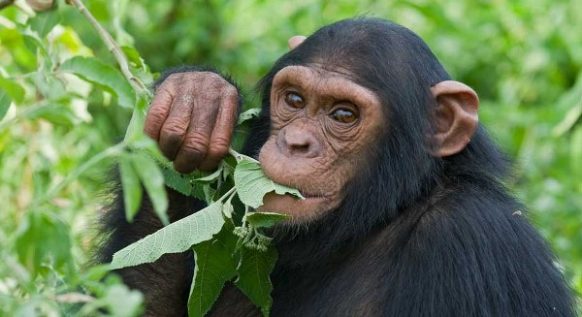
A Kibale and Bwindi combined safari is a single Uganda itinerary that includes both chimpanzee trekking in Kibale Forest and gorilla trekking in Bwindi Impenetrable National Park. The two experiences are fundamentally different — different species, different terrain, different altitudes — but they share the same trekking format: pre-dawn briefing, forest walk, one hour with the animals, walk back. Doing both gives you the widest possible primate experience in Uganda, and it is what most travellers who come for the primates end up booking.
Three things define how the combination works:
- The two parks are far apart. Kibale sits in the centre-west near Fort Portal; Bwindi sits in the far south-west near Kabale. The drive between them is roughly seven to nine hours — a full day’s transfer. This is the single most important structural fact about the route, and it shapes every itinerary decision.
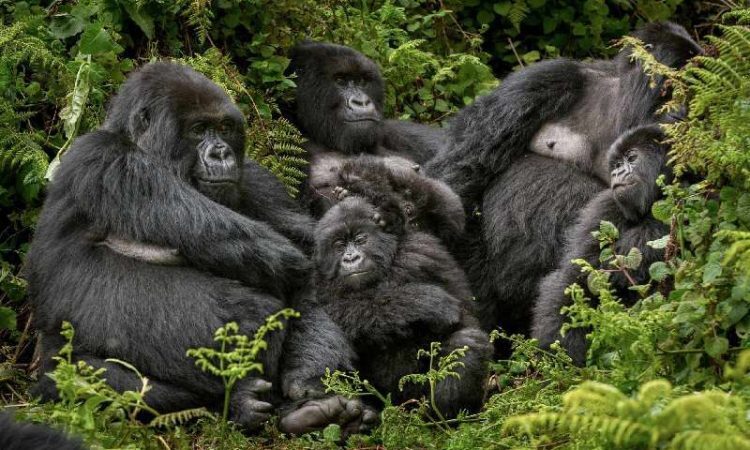
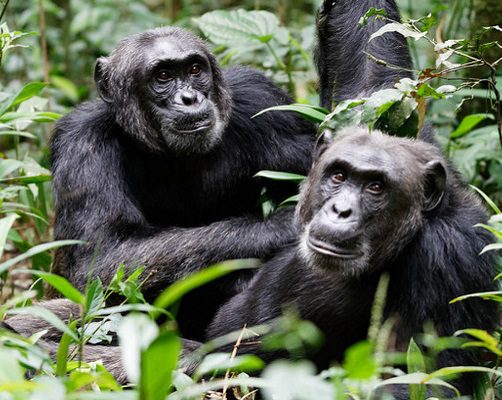
- The experiences are complementary. Kibale is a forest park with thirteen primate species and a well-established chimp trekking programme on gentle terrain. Bwindi is a mountain forest with steep, high-altitude terrain and the world’s most concentrated population of habituated mountain gorilla families. The two parks cover different species, different landscapes and different trekking days.
- Both treks are permit-based. Chimpanzee trekking at Kibale requires a permit booked in advance and paid in full at booking. Gorilla trekking at Bwindi requires a separate permit on a separate allocation. Both are non-refundable and non-transferable once issued. The two permit systems run in parallel and need to be booked together.
The practical consequence is that the combined safari is a permit-driven itinerary. Once both permits are confirmed, the rest of the trip — lodges, transport, additional activities — fits around those two fixed points. The wider primate context across Uganda is covered on the primate tracking experiences page.
Afraeka tip: Book the gorilla permit first. Gorilla permits are the scarcer of the two — Bwindi has a limited number of habituated families and the permits sell out months ahead in peak season. Once the gorilla permit date is confirmed, the chimp trek at Kibale fits around it, and the transfer days can be planned with certainty. The opposite order — booking the chimp permit first and then trying to align the gorilla permit — usually leads to reshuffling the whole itinerary.
What does each park contribute to the itinerary?
The two parks contribute very different things to a Kibale and Bwindi combined safari, which is the main reason the combination is worth doing. Kibale delivers forest primatology on gentle terrain and at moderate altitude. Bwindi delivers a mountain gorilla encounter on steep terrain at higher altitude. Together they cover Uganda’s two headline primate experiences and give the trip two genuinely distinct trekking days.
| Experience | Kibale | Bwindi |
|---|---|---|
| Chimpanzee trekking | Yes — country’s premier site | No |
| Gorilla trekking | No | Yes — four sectors, multiple families |
| Other primates | 12 additional species | A few species (L’Hoest’s, blue monkeys) |
| Terrain | Gentle forest trails; ~1,100–1,600m | Steep mountain forest; ~1,500–2,600m |
| Trekking difficulty | Moderate — easier than Bwindi | High — the harder of the two |
| Community walks | Bigodi Wetland Sanctuary | Buhoma community walk, Batwa experience |
| Forest birding | Excellent — 375+ species | Excellent — Albertine Rift endemics |
| Minimum age | 15 | 15 |
The two parks deliver genuinely different trekking days and complement each other on a single Uganda itinerary.
Two practical points follow from this. First, the two treks are not substitutes — they are complements. Travellers who do both consistently describe the days as being fundamentally different experiences, not two versions of the same thing. Second, the physical demand is asymmetrical: Kibale is the easier day, Bwindi is the harder one. Doing Kibale first builds acclimatisation and confidence for the harder Bwindi trek. Our guide on the gorilla trekking two days in a row format covers the gorilla-only version if you are considering doing two gorilla treks instead of one chimp and one gorilla.
How do you transfer between Kibale and Bwindi?
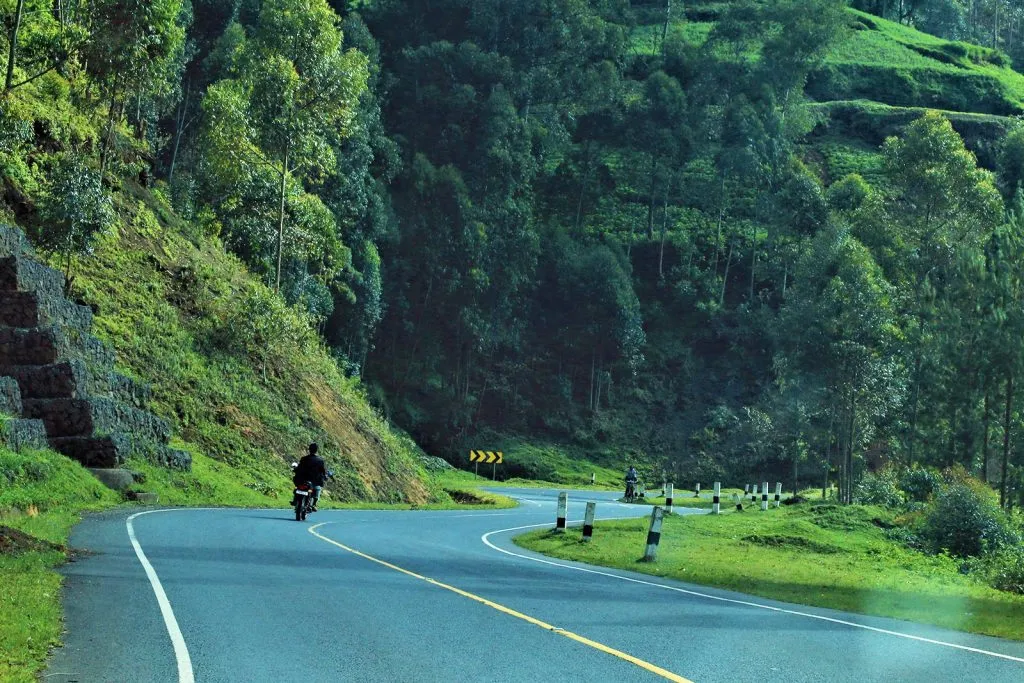
The transfer between Kibale and Bwindi is a full day’s drive — roughly seven to nine hours depending on route and road conditions. There are two main options: the direct route via Kasese and the Queen Elizabeth area, or a broken route that stops for a night at Queen Elizabeth or in the Ishasha sector on the way. The direct route is faster; the broken route adds a night of game viewing in Queen Elizabeth and makes the transfer feel less like a pure travel day.
| Route | Distance | Drive time | Notes |
|---|---|---|---|
| Kibale to Bwindi via Kasese and Rukungiri (direct) | ~380 km | 7–9 hours | Longest single-day option; mostly tarmac with murram sections |
| Kibale to Queen Elizabeth to Bwindi (broken) | ~450 km total | 2 days | Overnight at Queen Elizabeth; includes game viewing |
| Kibale to Ishasha to Buhoma (broken) | ~400 km total | 2 days | Overnight in Ishasha sector; tree-climbing lions en route |
Drive times are approximate. Wet-season murram conditions can add 60–90 minutes to the direct route.
Three practical considerations for the transfer. First, the direct route is genuinely long — seven to nine hours in a vehicle — and most travellers find that breaking it with a night in Queen Elizabeth or Ishasha is worth the extra day. Second, breaking the transfer adds game viewing to the trip, which is the natural bridge between primate parks. Third, if you are booking a short itinerary, the direct route is fine but should not be combined with a morning activity on the same day — the full day is transfer time. Our guide on the Kibale Forest day trip from Fort Portal covers the logistics at the Kibale end in more detail if you are basing yourself in Fort Portal rather than at a forest lodge.
What does a typical route look like?
A typical Kibale and Bwindi combined safari runs eight to ten days, starting and ending at Entebbe or Kampala. The route moves steadily south-west — Kibale, then Bwindi, then back to Entebbe — without backtracking. Adding Queen Elizabeth as the bridge between the two parks extends the route to ten or eleven days.
A 9-day Kibale and Bwindi combined safari, day by day
- Day 1 — Entebbe to Kibale. Drive west from Entebbe (5–6 hours) via Fort Portal. Arrive at your Kibale lodge in the late afternoon.
- Day 2 — Chimpanzee trekking. Morning chimp trek at Kibale. Afternoon Bigodi Wetland Sanctuary walk. Optional night forest walk in the evening.
- Day 3 — Kibale to Queen Elizabeth. Drive south-east via Kasese (3 hours). Afternoon arrival at Queen Elizabeth. Evening at the lodge.
- Day 4 — Queen Elizabeth. Morning game drive in the Kasenyi plains. Afternoon Kazinga Channel boat safari.
- Day 5 — Queen Elizabeth to Bwindi. Drive south through the Ishasha sector (2 hours) for the tree-climbing lions. Continue to Bwindi (another 2 hours). Arrive at Bwindi in the late afternoon.
- Day 6 — Gorilla trekking. Gorilla trekking day at Bwindi. Early morning briefing, forest walk, one hour with the family, walk back.
- Day 7 — Bwindi recovery day. Rest day at the lodge. Optional community walk, waterfall trail or birding.
- Day 8 — Bwindi to Entebbe. Long drive back to Entebbe (7–9 hours) or a flight from Kihihi airstrip to Entebbe (approximately 1 hour).
- Day 9 — Entebbe departure. Buffer day in Entebbe before the international flight.
Two structural notes on this route. First, the Queen Elizabeth stop is optional — a direct Kibale to Bwindi transfer is possible and shortens the trip by two days, but most travellers prefer the broken version for the game viewing and the easier driving. Second, the recovery day at Bwindi is worth keeping. The gorilla trek is the hardest day of the trip, and having a rest day before the long drive back to Entebbe makes the return leg much more manageable.
How many nights at each park?
Kibale needs two nights at a minimum and three if you want to do the chimp trek plus the Bigodi walk plus the night walk. Bwindi needs three nights to allow for the gorilla trek plus one recovery day plus the possibility of a second gorilla trek on a different sector. If you are only doing one gorilla trek, two nights at Bwindi is enough, but it leaves no buffer for a slow trekking day.
| Nights at Kibale | What you can do |
|---|---|
| 2 nights | Chimp trek + Bigodi walk — comfortable |
| 3 nights | Chimp trek + Bigodi walk + night forest walk — full coverage |
| Nights at Bwindi | What you can do |
|---|---|
| 2 nights | Gorilla trek + arrival/departure days — basic |
| 3 nights | Gorilla trek + recovery day + community activities — comfortable |
| 4 nights | Two gorilla treks on different sectors, plus recovery — the deep version |
The most common Kibale and Bwindi combined safari structure is two nights at Kibale, one night at Queen Elizabeth, and three nights at Bwindi — a total of nine to ten days including transfer days at each end. This gives you the chimp trek, the Bigodi walk, a Queen Elizabeth game viewing stop, the gorilla trek and a recovery day, without feeling rushed.
For travellers who want more at Kibale, the night forest walk is a natural third-night addition and delivers the nocturnal primates. Our guide on the other primates in Kibale Forest covers what the different activities deliver, and the Bigodi Wetland Sanctuary walk guide covers the forest-edge species.
How do you book the two permits?
Booking the two permits for a Kibale and Bwindi combined safari follows the same sequence as booking either one on its own. The gorilla permit is the scarce item and should be booked first; the chimp permit at Kibale is generally more available and can be booked second. Both permits require passport details at booking, are paid in full at booking, and are non-refundable and non-transferable once issued. Current permit categories and rates sit on the gorilla permits Uganda page.
What to arrange before your combined safari
- Gorilla permit — Bwindi sector, date, paid in full at booking
- Chimpanzee trekking permit — Kibale date, paid in full at booking
- Queen Elizabeth stop (if breaking the transfer) — lodges and game activities
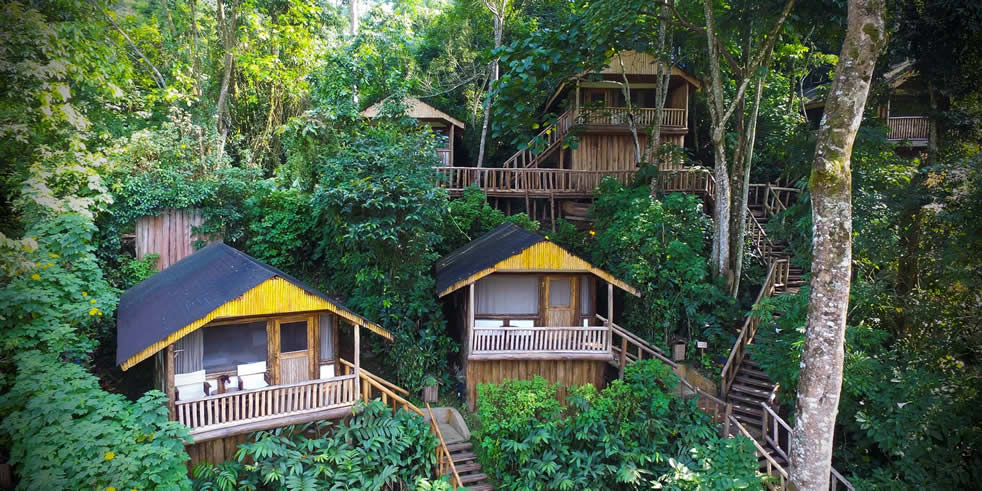
- Kibale lodges for the chimp trek segment
- Bwindi lodges for the gorilla trek segment — matched to the gorilla sector
- Vehicle and driver-guide for the full route
- Porter arrangements for both treks if you want one
- Any mobility or fitness notes shared with the operator in advance
Two practical points on booking. First, the gorilla permit sector choice determines the Bwindi lodge — Buhoma permits need a Buhoma lodge, Rushaga permits need a Rushaga lodge. Book the permit first, then match the lodge. Second, the chimp permit for Kibale can be booked for a standard trek or the full-day habituation, but the standard trek is the right choice for a combined safari — the habituation runs from dawn to dusk and does not fit a route that also includes a transfer to Bwindi. Our guide on the Kibale chimpanzee permit availability covers the seasonal patterns for the chimp side.
When is the best time for a Kibale and Bwindi combined safari?
The best time for a Kibale and Bwindi combined safari is the drier months — December to February and June to September. The trails at both parks are firmer, the roads on the transfer are more predictable, and the game viewing at Queen Elizabeth (if you stop there) is better in the thinner vegetation. The wet months are workable but slower, and the transfer day can stretch significantly if murram sections are muddy.
Three practical points on timing:
- Dry season is easier at both parks. Kibale’s trails are firmer and Bwindi’s descents are less slippery. The combined safari flows more smoothly overall.
- Wet season adds time to the transfer. The Kibale to Bwindi drive can add an hour or more in wet conditions. If you are travelling in the wet months, plan the transfer with extra buffer and consider breaking it overnight.
- Permit availability tightens in peak season. Both chimp and gorilla permits sell out months ahead in June–September and December–February. Book early for peak-season dates, and consider the low season (April, May, November) for better availability and lower demand.
The wider country map is on the Uganda destinations page, and the country-level tourism overview sits with the Uganda Tourism Board. The two-permit structure of the combined safari means that both permits should be booked well ahead of peak-season dates, and the gorilla permit should be confirmed before any other booking is finalised.
Common mistakes with a Kibale and Bwindi combined safari
Most of what goes wrong with this combination comes down to a small set of avoidable mistakes, and all of them can be prevented with one careful planning conversation.
- Booking the chimp permit before the gorilla permit. The gorilla permit is the scarcer of the two. Book it first, then fit the chimp trek around it.
- Underestimating the transfer. The Kibale to Bwindi drive is a full day. Do not schedule a trekking activity on the same day as the transfer.
- Not breaking the transfer. The direct route is possible but long. A night at Queen Elizabeth or Ishasha adds game viewing and makes the trip feel less rushed.
- Only one night at Bwindi. The gorilla trek needs the arrival day, the trekking day and a departure day at minimum. Two nights is the floor; three is more comfortable.
- Skipping the recovery day. The gorilla trek is the hardest day of the trip. A rest day before the long drive back to Entebbe makes the return manageable.
- Choosing the habituation at Kibale by mistake. The full-day habituation does not fit a combined safari. Book the standard chimp trek if you are continuing to Bwindi.
- Booking Bwindi lodges that do not match the permit sector. Bwindi’s four sectors are hours apart. Match the lodge to the permit sector, not the other way around.
- Travelling with children under 15. Both the chimp trek and the gorilla trek have a minimum age of 15. Families with younger children cannot do either trek, though they can do the Bigodi walk, the night walk and the Bwindi community activities.
Can one permit cover two people?
No. One permit covers one person for one trek, and this applies to both the gorilla permit at Bwindi and the chimpanzee permit at Kibale. A family of four doing a Kibale and Bwindi combined safari needs eight permits in total — four for the chimp trek and four for the gorilla trek. Each permit is tied to a named individual, and there is no way to share one or transfer it to another person. Current permit categories and rates sit on the gorilla permits Uganda page.
The two permits are separate documents. Booking a gorilla permit does not reserve a chimp permit, and vice versa. Both must be confirmed individually, and both require passport details, full payment at booking, and non-transferable status once issued. The eight-visitor daily cap per habituated gorilla family — and the equivalent cap per habituated chimp community — applies at each park. A party of eight fills a full day’s allocation at either park, so large groups need to book both permits especially early.
Once both permits are confirmed, the specific family or community you follow is allocated on the morning of each trek. You will know your sector or site in advance because it is on the permit; you will learn your specific family or community at the briefing alongside everyone else. The regulatory framework is set by the Uganda Wildlife Authority.
Afraeka field note: A couple who booked a Kibale and Bwindi combined safari once told us, after the trip, that the two trekking days had felt almost like different trips. At Kibale the forest had been humid and green, the walking gentle, the chimpanzees loud and constantly moving. At Bwindi the forest had been steep and misty, the walking genuinely hard, and the gorilla family still and quiet for the whole hour. Their comment was that booking them together had been the right decision, but that they had not understood beforehand how little the two days would resemble each other. The distance between the parks — a full day’s drive — had turned out to be the structural fact that shaped the whole itinerary, and they had been glad they had broken it with a night in Queen Elizabeth rather than driving straight through. That is the honest pattern with a Kibale and Bwindi combined safari. The treks are the highlight, but the route is what makes the trip work.
A question that comes up regularly on TripAdvisor’s Uganda forum and on r/Uganda is some version of: “Can I do chimps and gorillas in one Uganda trip?” The honest answer is yes, and it is one of the strongest primate itineraries in Africa. The main constraint is the distance between the two parks — the drive is a full day — which means the combined safari needs at least eight days and works best with a stop in Queen Elizabeth in between. Travellers who build the route around the transfer have a smooth, well-paced trip. Travellers who try to compress it usually end up with a rushed itinerary that does not do either park justice.
Frequently asked questions
How far is Kibale from Bwindi?
Roughly seven to nine hours by road — a full day’s drive. The direct route runs via Kasese and Rukungiri. Many itineraries break the transfer with a night in Queen Elizabeth or Ishasha, which adds game viewing and makes the driving more relaxed.
How many days do I need for a Kibale and Bwindi combined safari?
Eight to ten days is the standard. Two to three nights at Kibale for the chimp trek, one night at Queen Elizabeth to break the transfer, and three nights at Bwindi for the gorilla trek and recovery day, plus transfer days at each end.
Should I do Kibale first or Bwindi first?
Most itineraries do Kibale first, then Bwindi, then return to Entebbe. This order moves steadily south-west without backtracking, and doing the easier chimp trek at Kibale first builds acclimatisation and confidence for the harder gorilla trek at Bwindi.
Do I need separate permits for chimp and gorilla trekking?
Yes. The gorilla permit and the chimpanzee permit are separate documents with separate allocations and separate bookings. Both require passport details, full payment at booking, and are non-refundable and non-transferable once issued. Book the gorilla permit first because it is the scarcer of the two.
What is the minimum age for both treks?
15 years for both chimpanzee trekking and gorilla trekking. Families with children under 15 cannot do either trek. They can, however, do the Bigodi walk, the Kibale night forest walk and the Bwindi community activities, which have no minimum age.
Can I add Queen Elizabeth between Kibale and Bwindi?
Yes, and it is the most common way to break the transfer. The route runs Kibale to Queen Elizabeth (3 hours), one or two nights at Queen Elizabeth for game drives and the Kazinga Channel boat safari, then Queen Elizabeth to Bwindi (roughly 4 hours via Ishasha). This turns the transfer into a game-viewing segment.
Can I fly between the two parks?
There are no scheduled flights between Kibale and Bwindi. Domestic charter flights can be arranged, usually via Entebbe or Kajjansi, but the drive is the standard option. Flights are best used for the return from Bwindi to Entebbe at the end of the trip, from Kihihi airstrip.
What is the best time for a Kibale and Bwindi combined safari?
The drier months of December to February and June to September. Trails are firmer at both parks, the transfer roads are more predictable, and game viewing at Queen Elizabeth is easier in the thinner vegetation. The wet months are workable but slower.
How do I book the two permits together?
Book the gorilla permit first — it is the scarcer of the two and its date will anchor the itinerary. Then book the chimp permit at Kibale for a date that fits either side of the gorilla trek date. Passport details are submitted for both permits, and both are paid in full at booking.
Planning a chimp and gorilla combination?
Send us your dates, party size and how many days you have, and we will check permit availability at both parks, recommend the order of the treks, and outline the transfer that connects them — including whether to break it with a stop in Queen Elizabeth. If you are travelling with children under 15, we will show you what the family can do around the treks. No price figures until we know your route, because the permits are only one line of the total.
About the author: Victoria Kayaga is a Ugandan-born safari expert and founder of Afraeka Adventures, with 15+ years in East African tourism. Based in Kampala, she has planned primate-focused itineraries across Kibale, Bwindi, Mgahinga and the wider western circuit for years, and she advises travellers on combining Uganda’s two headline primate experiences into a single coherent route. More about Victoria.
Keep planning
- 7-day Uganda and Rwanda primate safari
- 16-day Rwanda and Uganda gorilla trekking and big five safari
- 18-day Uganda safari
- All Afraeka trips