Last updated: 24 September 2026. Rates and availability are set by UWA and subject to change — confirm before booking.
Short answer: The gorilla trekking tips that matter most for first timers are: book a forgiving sector (Buhoma or Rushaga), get a permit three to six months ahead, hire a porter, break in your boots, arrive a day early to acclimatise, and understand the seven-metre distance and one-hour viewing rules before you go. Fitness matters more than age. The gorilla trekking tips below cover what actually shapes the trekking day, and what first-time trekkers most often get wrong.
Every week, a first-time trekker arrives in Bwindi having read dozens of articles and still unsure about the essentials. The information is out there, but it is scattered — some of it in forums, some in lodge brochures, some in posts that contradict each other. What first-time trekkers actually need is a single, consolidated set of gorilla trekking tips that covers the decisions, the day itself, and the mistakes that most commonly undermine a first trek.
This guide is that consolidation. It is the reference for gorilla trekking tips for first timers — which sector to choose, when to book, what to expect at the briefing, how to handle the viewing hour, and which first-timer errors are worth avoiding. The tips below are the ones we give every first-time client, and they are drawn from years of watching what works and what does not. If you have not yet chosen a park or sector, the Uganda gorilla trekking hub covers the wider picture, and permit requirements are kept current on the gorilla permits Uganda page. The regulatory framework that governs every trek — including the rules first timers most need to know — is published by the Uganda Wildlife Authority.
Gorilla trekking tips for first timers — key facts
- Best sectors for first timers: Buhoma (gentlest terrain) or Rushaga (best permit availability)
- Booking lead time: 3–6 months for peak season; 6–12 months for groups of four or more
- Porter: Strongly recommended for all first timers regardless of fitness
- Boots: Waterproof, with deep tread, broken in before travel
- Arrival: At least one day before the trekking day to acclimatise and rest
- Viewing hour: 1 hour with the family, strictly enforced
- Minimum distance: 7 metres at all times
- Minimum age: 15 years
What are the most important gorilla trekking tips for first timers?
The most important gorilla trekking tips for first timers come down to four decisions made before the trek and two behaviours during it. The decisions are sector, timing, boots and porter. The behaviours are pace and presence — walking at the group’s pace and being fully present during the viewing hour. Everything else is secondary, and no amount of gear compensates for getting these six things wrong.
The six gorilla trekking tips that matter most
- Choose a forgiving sector. Buhoma and Rushaga are the easiest. Nkuringo and Ruhija are the hardest. For a first trek, choose the sector that matches your fitness, not the one that sounds most dramatic.
- Book earlier than you think you need to. Peak-season permits in the most-requested sectors sell out months ahead. Low-season dates are more forgiving, and the tariff structure in those months is more favourable.
- Bring boots, not brand-new boots. Break your boots in for at least a month before travel. Blisters on a trekking day are the most common preventable problem on the trail.
- Hire a porter. This is the most consistently recommended gorilla trekking tip for first timers, and it applies regardless of fitness. A porter carries your daypack and steadies you on the descent.
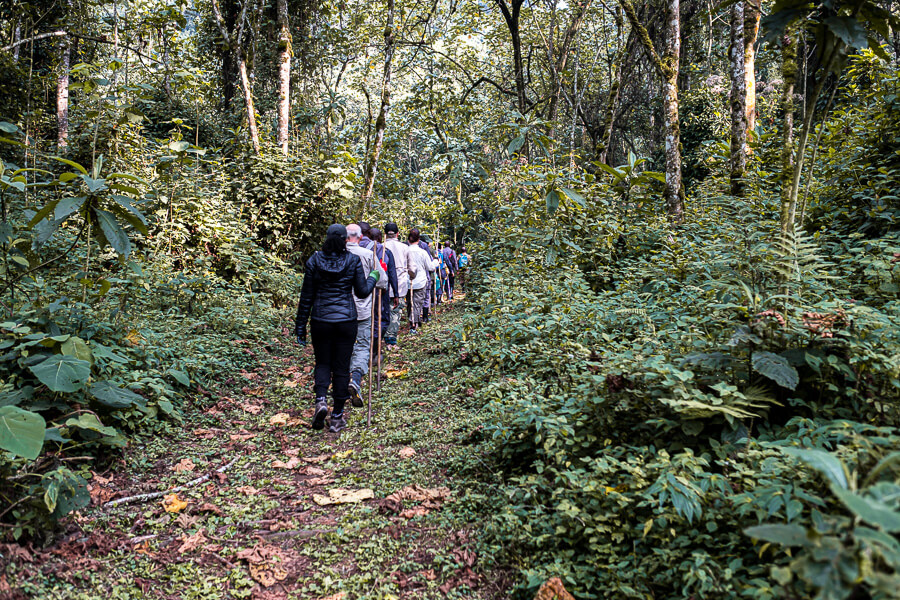
- Walk at the group’s pace. The ranger sets the pace to match the group. Do not try to race ahead or fall far behind — the day is not a race, and the pace is set for a reason.
- Be present during the viewing hour. Sixty minutes sounds long until it is running. First timers who spend the whole hour behind a camera often regret it. Put the camera down for at least ten minutes and just watch.
Three additional gorilla trekking tips are worth noting because they come up in almost every first-timer debrief. First, arrive a day early — jet lag plus altitude plus a pre-dawn start is a poor combination. Second, don’t book the lodge before the permit — the two run on separate systems and mismatches cause problems. Third, understand the rules before the briefing — the seven-metre distance, the one-hour cap, and the no-flash rule are enforced, not advisory.
Which sector is best for a first gorilla trek?
Buhoma is the best sector for most first-time trekkers, because it has the gentlest terrain and the lowest average altitude of Bwindi’s four sectors. Rushaga is the strongest second option and often the better choice if you are booking at short notice, because its larger family count means more daily permits. Both sectors are well-suited to first timers, and both are covered in detail in our sector guides — Buhoma and the wider sector landscape across the blog.
Three points on sector choice for first timers:
- Buhoma is the default for comfort. It has the widest lodge choice, the shortest average transfer to the trailhead, and the gentlest trails. If you are booking three to six months ahead, Buhoma is the natural first choice.
- Rushaga is the default for availability. It has more habituated families than any other sector, which means better odds at short notice and for groups. If Buhoma is full on your dates, Rushaga is the correct alternative.
- Avoid Nkuringo for a first trek unless you are a regular hiker. The ridge-to-valley geography means every trek ends with a sustained climb. It is achievable, but it is not the sector to choose for a first trek if you are unsure about the terrain. Our Nkuringo difficulty guide covers this in depth.
Mgahinga is also an option for first-time trekkers, and it has a quieter, more mountainous character than Bwindi. It has only one habituated family, which makes the trekking day simpler and the sector logistics less complicated. The single-family structure does mean fewer daily permits, so booking earlier matters more for Mgahinga than for Rushaga.
When should first timers book a gorilla trek?
First timers should book three to six months ahead for peak-season dates, and six to twelve months ahead if travelling as a group of four or more. Peak season in Uganda runs June to September and December to February, and those weeks fill first. Low-season dates in April, May and November are more forgiving and carry a reduced tariff, which makes them a good option for flexible travellers.
The single most repeated gorilla trekking tips advice we give to first timers is to book earlier than feels necessary. Permits for the most-requested sectors can sell out six months before the trekking date in peak season, and groups of six or more need six permits in the same sector on the same date — which is a materially harder match than a solo traveller’s single permit. Detailed availability mechanics are covered in our guide on gorilla permit availability.
Two practical points worth remembering for a first booking. First, permits are non-refundable and non-transferable once issued, so book with dates you can commit to. Second, a trip deposit alone does not secure the permit — the full UWA permit fee must be paid at the time of booking. Both rules are confirmed in our terms, and both catch first-time bookers by surprise.
What should first timers know about the trekking day?
First timers should know that the trekking day begins before dawn, involves a walk of anywhere from under an hour to several hours, and ends with the same walk back to the trailhead. The one-hour viewing with the gorillas happens somewhere in the middle. The total day runs four to nine hours, most of it on your feet. What varies most between treks is the length of the walk in, which depends on where the family nested the night before.
Three practical points about the trekking day itself:
- The walk in is not the hard part. Most first timers assume the climb is the challenge. In practice, the descent is harder on knees and hips. Prepare for the walk back, not just the walk in.
- The ranger leads and you follow. The ranger guide is coordinating with trackers and positioning the group. Following their instructions is what keeps the trek on schedule.
- The pace is set for the slowest member. Groups are built to accommodate the pace of the least-fit trekker. Do not worry about being the slowest — the pace is already adjusted for you.
The rest of the day is structured and predictable. The briefing, the registration, the walk in, the viewing hour, the walk back, the certificate and debrief. There are no surprises in the sequence, and the rangers run this every day of the year. What first timers benefit from most is understanding the shape of the day in advance, so nothing about it feels uncertain or improvised. Detailed operational guidance sits on the Uganda gorilla trekking hub, and the terrain specifics for each sector are covered in the sector guides.
What are the most common first-timer mistakes?
The most common first-timer mistakes are booking the wrong sector, leaving the permit too late, skipping the porter, wearing new boots, and spending the entire viewing hour behind a camera. All of them are avoidable, and all of them appear in the debrief conversations we have with clients after their first trek. The gorilla trekking tips in this post are largely built around preventing them.
| Mistake | Consequence | Fix |
|---|---|---|
| Choosing Nkuringo for a first trek | A harder day than expected, especially on the descent | Book Buhoma or Rushaga instead |
| Leaving the permit too late | No availability on preferred dates or sector | Book 3–6 months ahead for peak season |
| Skipping the porter | Fatigue, wet pack, unsteady on descents | Hire a porter — nearly every first timer benefits |
| Wearing new boots | Blisters within the first hour | Break in boots for a month before travel |
| Booking the lodge before the permit | Lodge in a sector you cannot trek | Confirm both together |
| Spending the whole hour behind the camera | Regret afterwards — most common post-trek feedback | Put the camera down for ten minutes and watch |
Two of these mistakes are worth emphasising because they catch almost every first timer. The first is booking the lodge before the permit — lodges and permits run on entirely separate systems, and a mismatch means a lodge you cannot use. The second is spending the entire viewing hour behind the camera. Of everything first timers tell us after their trek, the most consistent regret is not having put the camera down sooner.
What happens at the morning briefing?
At the morning briefing, first timers should expect to register with their passport and permit details, meet their ranger guide, and be assigned to a trekking group. The briefing starts before dawn and lasts roughly thirty minutes. It is also the moment when one of the most useful gorilla trekking tips for first timers becomes actionable — telling the ranger about any fitness or mobility concerns so the group allocation and pace can be planned accordingly.
What to do at the briefing
- Bring your passport and permit details
- Register at the desk and confirm your trekking sector
- Meet your ranger guide and your trekking group
- Tell the ranger about any fitness, knee or mobility concerns
- Confirm your porter arrangement if you have one
- Listen to the briefing on the day’s conditions and family location
- Check your camera settings and disable the flash
- Confirm the meeting point for the walk in
The briefing is also where the day’s operational notes are shared — which family has been located, how far the walk is expected to be, and any special conditions. First timers sometimes treat this as a formality and miss useful information. It is not a formality. It is the point at which the ranger sets the plan for the day, and it is worth paying close attention. Full rules on what the briefing covers are published by the Uganda Wildlife Authority and covered in our gorilla trekking rules and regulations guide.
What should first timers know about the viewing hour?
First timers should know that the viewing hour is one hour with the gorilla family, that the seven-metre distance is strictly enforced, and that flash photography is prohibited. Beyond that, the most important gorilla trekking tips for the viewing hour are practical: settle in, watch more than you photograph, and follow the ranger’s positioning. The hour is short, and the people who enjoy it most are the ones who spend it watching the gorillas rather than managing their equipment.
Three points first timers find useful about the viewing hour:
- The hour starts when contact is made. Not when you arrive at the trailhead, not when you begin the walk. The ranger confirms contact with the family, and the clock starts then.
- The family may move. If the gorillas shift position, the group moves with them. This is normal and it happens on most treks. Do not panic if the ranger asks the group to reposition.
- Silence is expected. During the viewing hour, the group stays quiet enough not to disturb the family. Normal conversation on the walk in is fine; the quiet rule applies to the hour with the gorillas.
Photography during the viewing hour has its own set of gorilla trekking tips, and our gorilla trekking photography guide covers settings, lenses and technique in detail. The short version for first timers: get your camera set up before the walk in, use continuous autofocus, push the ISO high, and remember that flash is prohibited.
Afraeka tip: One of our favourite gorilla trekking tips for first timers is to decide before the trek that you will put the camera down for at least ten minutes during the viewing hour. Trekkers who do this consistently describe the hour as more memorable than those who spend all sixty minutes shooting. The gorillas do not perform — they go about their morning — and the hour feels shorter than anyone expects. Watching without a camera, even briefly, is the part of the day most people remember most clearly.
What should first timers know about fitness and preparation?
First timers should know that fitness matters more than age, and that two months of hill walking before travel makes a measurable difference. The trek is a moderate hike at altitude, and the descent is harder than the climb. Travellers who walk regularly on hills or uneven ground do well; travellers whose exercise is gym-based or flat-ground walking benefit most from a formal training block. Our gorilla trekking fitness level guide covers the demands in detail.
For first timers specifically, four preparation points stand out:
- Walk on hills two to three times a week for at least two months before travel. Gym fitness does not fully transfer to forest terrain.
- Break in your boots thoroughly. Blisters are the most preventable problem on the trek.
- Arrive a day early to acclimatise and rest. Jet lag plus altitude plus a pre-dawn start is a poor combination.
- Be honest about fitness at the briefing. Rangers can match you to a slower group if they know. Hiding fitness concerns makes the day harder for everyone.
Age itself is not a barrier — UWA sets no upper age limit, and travellers over 60 complete the trek every year. What matters is the state of your knees, your cardiovascular fitness, and whether you have prepared. The most consistently useful gorilla trekking tips for first timers about preparation come down to this: two months of training does more for the day than any gear upgrade.
Can one permit cover two people?
No. One permit covers one person for one trek, and this applies to first timers the same as to any other trekker. A party of four needs four permits in the same sector on the same date. Each permit is tied to a named individual, and there is no way to share one or to transfer it to another person. Details on how permits work, including current requirements, are kept current on the gorilla permits Uganda page.
The eight-visitor daily cap per habituated gorilla group applies equally. A group of eight trekkers fills an entire day’s allocation for one gorilla group, and every one of those eight is subject to the same rules — including the seven-metre distance, the one-hour cap, the no-flash rule and the health exclusion. First-time status does not confer any exception, and there is no priority allocation for travellers who have not trekked before.
Once you have your permits, the gorilla group you actually visit is allocated according to the trekking sector, with final group allocation managed by UWA on the morning of the trek. You will know your sector in advance because it is on your permit; you will learn your family at the briefing alongside everyone else. Our sector guides cover the terrain specifics for each option, and the wider landscape is mapped on the Uganda destinations page.
Afraeka field note: A first-time trekker once wrote to us after her trek saying that the most useful gorilla trekking tips she had read in advance had been the ones about the descent — not the climb, the descent. She had trained on hills in the weeks before travel, but she had trained going up. Her legs handled the walk in without difficulty. The walk back, particularly the last forty minutes on wet ground, was where she found the day hardest. Her advice to us, which we now pass on: train for the up, but prepare for the down. A porter makes a bigger difference on the return leg than at any other point in the day. That is the pattern we see over and over — the trekking day is not a climb with a return, it is a round trip, and the return is the part most first timers underweight in their preparation.
A question that comes up regularly on TripAdvisor’s Uganda forum and on r/Uganda is some version of: “I’ve never done anything like this — what should I actually prepare?” The honest answer is that the gorilla trekking tips that matter most for a first timer are not about gear or altitude or gear lists — they are about the four decisions made before the trek and the two behaviours during it. Choose the right sector. Book early enough. Break in your boots. Hire a porter. Walk at the group’s pace. Put the camera down for ten minutes. Get those six things right and the trekking day takes care of itself. Everything else is detail.
Frequently asked questions about gorilla trekking tips for first timers
What are the most important gorilla trekking tips for first timers?
The most important tips are: choose a forgiving sector (Buhoma or Rushaga), book three to six months ahead, hire a porter, break in your boots before travel, arrive a day early to acclimatise, and put the camera down for part of the viewing hour. Fitness matters more than age, and preparation in the two months before travel makes a bigger difference than any gear upgrade.
Which sector is best for a first gorilla trek?
Buhoma is the best sector for most first timers because it has the gentlest terrain and the lowest average altitude. Rushaga is the strongest second option and often the better choice at short notice because its larger family count means more daily permits. Avoid Nkuringo for a first trek unless you are a regular hiker — its ridge-to-valley geography makes the return climb the hardest part of any Bwindi sector.
How far in advance should first timers book a gorilla trek?
Book three to six months ahead for peak-season dates, and six to twelve months ahead if you are a group of four or more. Low-season dates in April, May and November are more forgiving. Permits are non-refundable once issued, and the full UWA permit fee must be paid at the time of booking — a trip deposit alone does not secure the permit.
Do first timers need a porter for gorilla trekking?
Yes — hiring a porter is the most consistently recommended choice for first-time trekkers, and it applies regardless of fitness. A porter carries your daypack and steadies you on the descent, which is where most trekkers feel the accumulated effort. Arrange one through your lodge the evening before the trek, or at the trailhead on the morning of the trek.
What should first timers know about the viewing hour?
The viewing hour is one hour with the gorilla family, strictly enforced. The seven-metre distance is maintained at all times, flash photography is prohibited, and the group stays quiet so as not to disturb the family. The hour starts when the ranger confirms contact with the family. If the family moves, the group moves with them — this is normal.
What are the most common first-timer mistakes?
The most common mistakes are choosing a sector that is too demanding, leaving the permit too late, skipping the porter, wearing new boots that have not been broken in, booking the lodge before the permit, and spending the entire viewing hour behind a camera. All are avoidable with preparation and a careful planning conversation before booking.
Do first timers need to train for a gorilla trek?
If you walk regularly on hills or uneven ground, you probably do not need formal training. If your exercise is gym-based or flat-ground walking, two to three hill walks per week for two months before travel make a significant difference. Walk with the boots and daypack you will actually use, and include descents in your training walks — not just climbs.
What should first timers pack for gorilla trekking?
Waterproof hiking boots broken in before travel, gaiters, long trousers and sleeves, gardening gloves, a light waterproof shell, a warm layer for the morning briefing, a small daypack, plenty of water, and a camera with a strap. Hire a porter to carry the daypack on the trail. Full kit details are covered in our guide on what to pack for gorilla trekking.
Is there an age limit for a first gorilla trek?
Yes — the minimum age is 15 years, set by UWA. There is no upper age limit. Travellers in their 60s, 70s and 80s complete the trek every year, and fitness matters more than age. If you are travelling with a child close to 15, confirm the exact date of birth against the trekking day at the enquiry stage.
Planning a first gorilla trek?
Send us your dates, your party size and an honest sense of your fitness, and we will tell you which sectors suit you best, what to book and when, and what to expect on the day. If you have mobility or medical considerations, we will flag them and suggest the right arrangements — including porters or a sedan chair. No price figures until we know your route, because the permit is only one line of the total.
About the author: Victoria Kayaga is a Ugandan-born safari expert and founder of Afraeka Adventures, with 15+ years in East African tourism. Based in Kampala, she has planned gorilla trekking itineraries across Bwindi’s four sectors and Mgahinga for years, and she briefs every first-time client on the decisions that matter most. More about Victoria.
Keep planning