Last updated: 24 September 2026. Rates and availability are set by UWA and subject to change — confirm before booking.
Short answer: Gorilla trekking sedan chair booking is arranged in advance through your lodge or tour operator, not at the trailhead on the morning of the trek. A sedan chair is a litter carried by a team of local porters that allows trekkers with limited mobility, significant fitness concerns or a relevant medical condition to complete the walking sections of a Bwindi or Mgahinga trek. The viewing hour itself is entirely unaffected — the chair is a transport solution, not a change to the trekking rules. Sedan chair bookings are most commonly made in Bwindi’s four sectors, and they require advance arrangement rather than a same-day request.
Every year, travellers who cannot complete a gorilla trek on foot are told by well-meaning forums that the trek is simply not for them. That is not accurate. The gorilla trekking sedan chair exists precisely so that trekkers with limited mobility, heart or lung conditions, recent injuries, or serious fitness concerns can still spend the one hour with a habituated gorilla family. It is an established part of the Bwindi trekking infrastructure, organised by local community teams, and it has been used successfully for years.
This guide is the reference for gorilla trekking sedan chair booking — what the service actually is, who runs it, how to arrange it, how it fits into the trekking day, and what to expect from the walking sections and the viewing hour. If you have not yet chosen a park or sector, the Uganda gorilla trekking hub covers the wider picture, and permit requirements are kept current on the gorilla permits Uganda page. The regulatory framework for trekking — including the rules that apply to the sedan chair service and the viewing hour — is published by the Uganda Wildlife Authority.
Gorilla trekking sedan chair booking — key facts
- What it is: A litter carried by a team of local porters, used for the walking sections of the trek
- Where available: Bwindi Impenetrable National Park (all four sectors); confirm for Mgahinga
- How to book: In advance through your lodge or tour operator — not on the morning of the trek
- Who it suits: Trekkers with limited mobility, heart or lung conditions, recent injuries, or significant fitness concerns
- Viewing hour: Unaffected — 1 hour with the gorillas, 7-metre distance, no exceptions
- Team size: Usually four or more porters, depending on terrain and distance
- Cost: A community-set fee, paid directly to the sedan chair team
- Minimum age: 15 years (the standard UWA rule, unchanged)
What is the gorilla trekking sedan chair service?
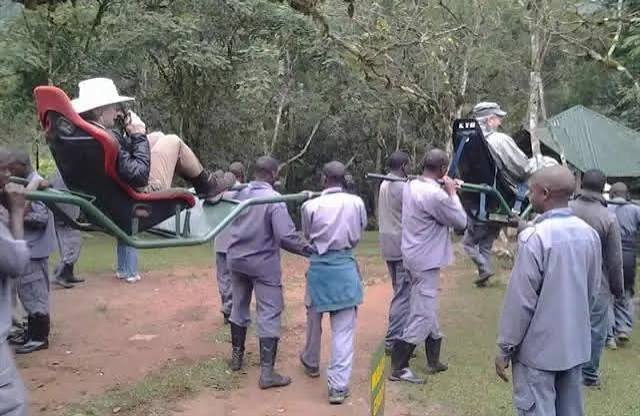
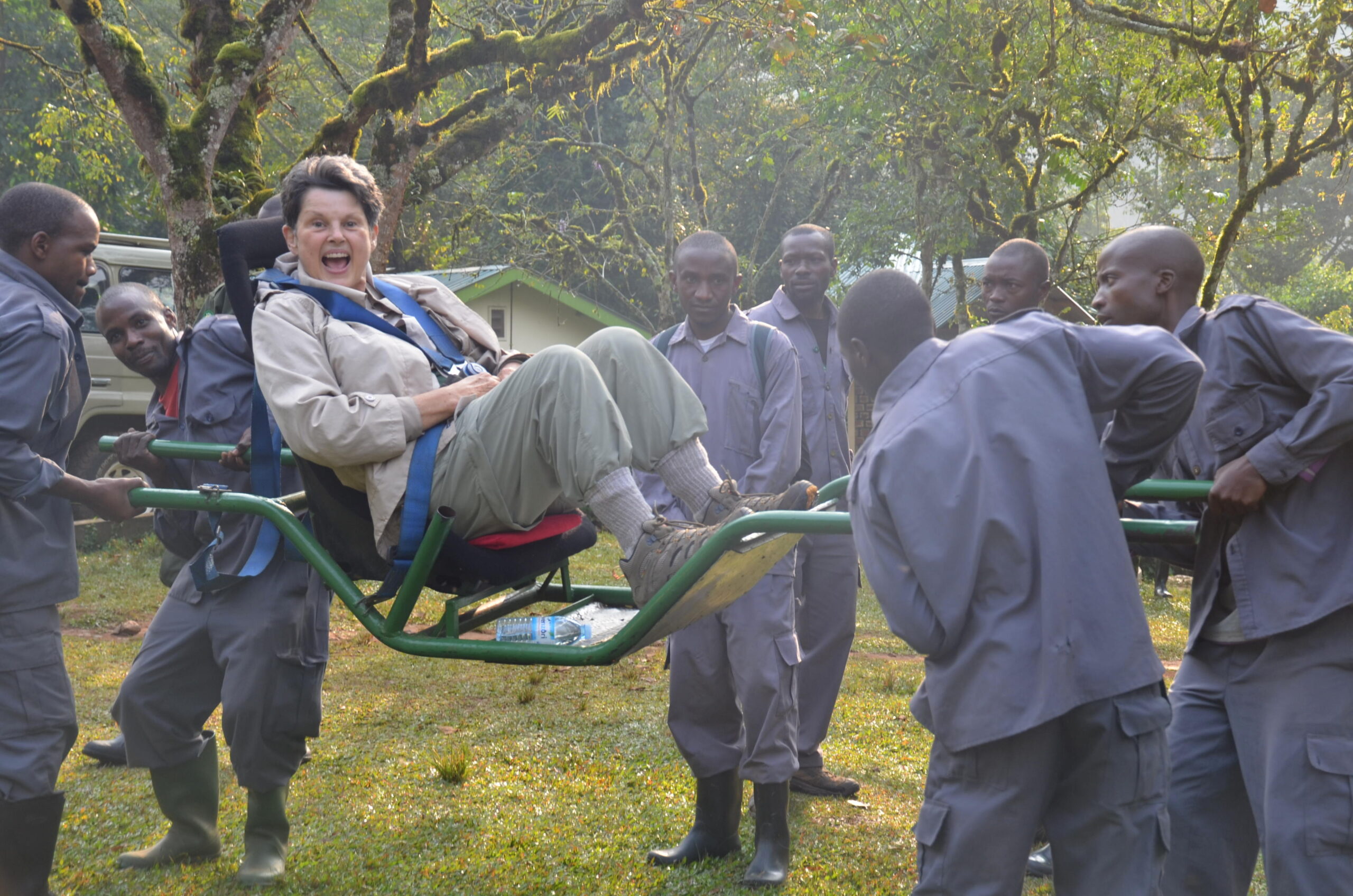
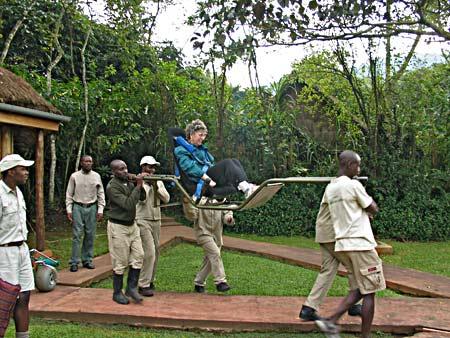
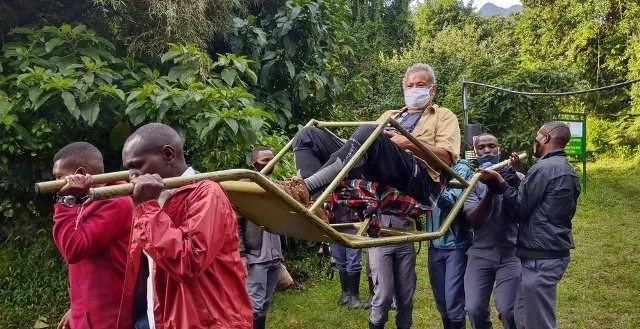
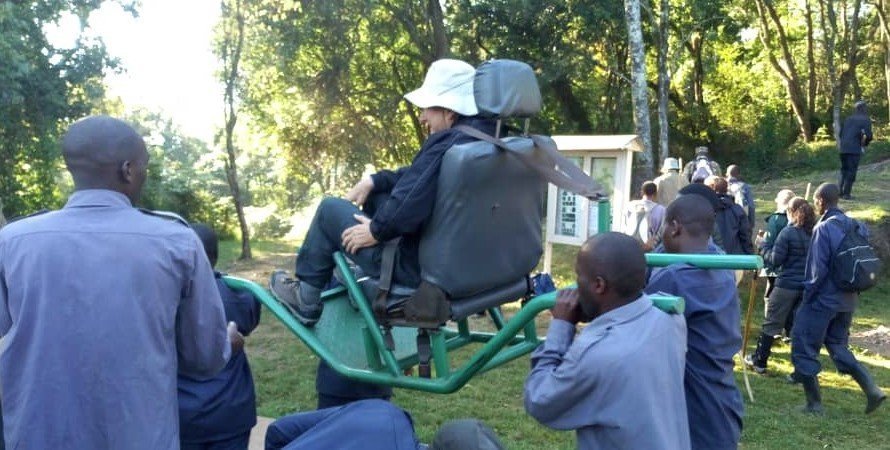
The gorilla trekking sedan chair is a litter — a light frame with a seat — carried by a team of local porters. It is used to transport a trekker along the walking sections of a Bwindi or Mgahinga trekking day: the walk in to the gorilla family and the walk back to the trailhead. It is not a wheelchair, not a stretcher, and not a medical device — it is a practical solution for trekkers who cannot complete the walk on foot, designed specifically for the conditions of the Bwindi forest.
Three things define the gorilla trekking sedan chair service:
- It is carried by porters. The team is made up of local porters from the communities around the park — the same porter associations that provide individual porters to trekkers. Sedan chair teams are usually four or more people, depending on terrain and distance.
- It covers the walking sections only. The trekker is carried for the walk in and the walk out, plus any repositioning during the viewing hour that the ranger requires. The trekker is not carried while the family is being observed, unless there is a specific reason.
- It is a community service. The gorilla trekking sedan chair is not a lodge-run service or an operator add-on — it is organised by the local porter associations that also provide individual porters. The fee goes directly to the team.
The service exists because UWA and the trekking operators recognise that the trail is genuinely demanding, and that travellers with mobility or medical considerations should not be excluded from the gorilla trekking experience by the walk itself. A gorilla trekking sedan chair gives those travellers the same one hour with the same family under the same rules as everyone else on the trail.
Afraeka tip: If you are unsure whether you need a gorilla trekking sedan chair, discuss it with your operator before booking the trek rather than deciding on the morning. The service must be arranged in advance, and the terrain and distance of your specific sector affect how many porters are needed. Our guide on gorilla trekking fitness level covers the trekking demands in more detail and helps you judge whether the chair is the right fit for your trek.
Who is a gorilla trekking sedan chair suitable for?
A gorilla trekking sedan chair is suitable for any trekker who cannot safely complete the walking sections of a Bwindi or Mgahinga trek on foot. That includes travellers with limited mobility, travellers with significant cardiovascular or respiratory conditions, travellers recovering from recent injury, and older travellers whose knees, hips or general fitness make the descent a genuine risk. It is not a service only for trekkers with a diagnosed disability — it is a practical option for anyone whose fitness or health would make the standard trekking day unsafe or unreasonably difficult.
| Trekker profile | Why the sedan chair is appropriate |
|---|---|
| Limited mobility (walking aids or wheelchair at home) | The chair covers the walking sections entirely; the viewing hour is on relatively flat ground at the family location |
| Heart or lung conditions | Avoids sustained cardiovascular and respiratory strain at altitude |
| Recent knee, hip or ankle injury | Avoids the descents that would otherwise be the hardest part of the day |
| Significant fitness concerns | Removes the walking demand; the chair is carried by a team of porters |
| Older travellers with mobility limitations | A practical option when the walk itself is the constraint, not the trekking experience |
The sedan chair is not a substitute for trekking rules. The viewing hour, distance requirements and permit conditions are identical to any other trek.
Three points about who the gorilla trekking sedan chair service is for:
- It is not a lesser experience. Trekkers who use the chair spend the same one hour with the same habituated family under the same rules as any other trekker on the trail. The only difference is how they get there.
- It requires advance arrangement. Because the sedan chair is a team-based service, it cannot be arranged on the morning of the trek. Tell your operator during planning, not on arrival.
- It is booked separately from the permit. The permit is for the trekking slot and the sector. The sedan chair is a separate service arranged through your lodge or operator. Both need to be confirmed in advance.
How does the gorilla trekking sedan chair actually work on the trail?
On the trail, the gorilla trekking sedan chair is carried by a team of porters who walk with the trekking group from the trailhead. The trekker sits in the chair while the team carries it along the forest path, coordinating pace with the ranger guide and the rest of the trekking group. Where the terrain is gentle and the trekker is comfortable, the chair can be set down and the trekker can walk short sections if they wish. Where the trail climbs, descends or crosses difficult ground, the chair is used.
How a sedan chair trekking day runs
- Meet the team at the trailhead. The sedan chair team is assigned at the trailhead, usually alongside the individual porters and the ranger guide. The team coordinates with the ranger on the day’s route.
- Carried on the walk in. The team carries the trekker along the forest path, following the ranger’s route to the family’s location. Pace is set to match the rest of the trekking group.
- Repositioning during the viewing hour. If the gorilla family moves and the ranger needs to reposition the group, the chair may be used for short distances to keep the trekker with the group. Otherwise, the trekker stands or sits near the family.
- The one-hour viewing is standard. The viewing hour is identical to any other trek — one hour with the gorillas, seven-metre distance, no flash, no touching. The chair does not change any of this.
- Carried on the walk out. The team carries the trekker back to the trailhead. This is where the service is most useful for trekkers whose knees, hips or general fitness would struggle on the descent.
- Return to the trailhead and settle the fee. The sedan chair fee is paid directly to the team at the end of the trek. Tipping is customary but optional.
Two things about the gorilla trekking sedan chair that trekkers often ask about. First, the chair does not affect the viewing hour — the trekker still stands or sits near the family, still has the full hour, and is still subject to the same rules. Second, the chair is used at the trekker’s discretion — if you feel able to walk a gentle section, you can, and the team will carry the chair alongside you. There is no requirement to stay in the chair for the full walk.
How do you book a gorilla trekking sedan chair?
You book a gorilla trekking sedan chair through your lodge or tour operator, and you do it in advance — typically when you book the trek itself, or at latest when you confirm your lodge arrangements. It is not a service you can arrange at the trailhead on the morning of the trek, because the team has to be assembled and the appropriate number of porters assigned to match the sector and the distance.
How to arrange a gorilla trekking sedan chair booking
- Tell your tour operator about mobility, fitness or medical needs at the enquiry stage
- Confirm the sedan chair booking when you confirm the trek, not after
- Provide any relevant medical context — this helps the operator plan team size
- Confirm whether the sector you have chosen supports the service (Bwindi sectors do; confirm for Mgahinga)
- Ask for the fee at the time of booking so you can plan cash for the trailhead
- Confirm the meeting point and team size in advance
- Plan for a slightly longer trekking day, since the chair is slower than walking on gentle sections
The gorilla trekking sedan chair booking process is straightforward once you know it exists. The complexity is in the timing — the service must be arranged in advance, and the sector matters. Bwindi’s four sectors (Buhoma, Ruhija, Nkuringo and Rushaga) all support the service. Mgahinga has its own arrangements — confirm directly with your operator whether the sedan chair is available for the date you are trekking, because Mgahinga’s single habituated family and cross-border ranging occasionally affect logistics. Our Nyakagezi gorilla family guide covers the Mgahinga specifics.
If you are already in Uganda and arranging locally, contact a registered operator in Kampala or Kisoro. Sedan chair bookings are handled by the same operators who handle the trekking permits — you do not need to contact UWA directly, and the service is organised at the community level rather than through UWA’s central administration. The International Gorilla Conservation Programme documents how local trekking services, including porter and sedan chair teams, support community livelihoods around the parks.
What does a gorilla trekking sedan chair cost?
The cost of a gorilla trekking sedan chair is set by the local porter associations rather than by UWA or the lodge, and it is paid directly to the team that carries you. The fee is substantially higher than a single porter’s fee — because a sedan chair team is typically four or more people, rather than one — but remains a modest component of the overall trekking cost when compared to the permit itself.
Three points about the gorilla trekking sedan chair fee:
- It is paid directly to the team. The fee does not pass through the lodge, the operator or UWA. It goes to the porters who carried you on the day, and it is one of the main ways the sedan chair service distributes income to the communities around the park.
- Team size affects the total. Sectors with longer approaches or steeper terrain require more porters, and the total cost scales accordingly. Your operator will confirm the fee when arranging the booking.
- Tipping is customary but optional. Many trekkers tip the team at the end of the trek in addition to the standard fee. As with individual porters, tipping is best handled separately and directly.
The practical budgeting point is that the sedan chair is part of the trekking day, not an optional extra to be trimmed. For trekkers whose mobility or medical context makes the chair the difference between trekking and not trekking, it is one of the highest-value components of the trip. Our guide on how to hire a porter for gorilla trekking covers the related service for trekkers who can walk but want assistance with a daypack.
Which sectors support gorilla trekking sedan chair booking?
All four Bwindi sectors support gorilla trekking sedan chair booking: Buhoma, Ruhija, Nkuringo and Rushaga. The service is available in each sector, arranged through the local porter association that operates from that trailhead. Mgahinga also supports the service in principle, but the park’s single habituated family and cross-border dynamics make advance confirmation more important — check with your operator before assuming availability.
Two practical notes on sector choice for sedan chair treks:
- Buhoma and Rushaga are the easiest sectors for the service. Both have gentler terrain and shorter average approaches than Ruhija or Nkuringo, which reduces the walking demand on the team and makes the trekking day smoother.
- Nkuringo is the hardest sector for a sedan chair trek. The ridge-to-valley geography means the return to the ridge is the longest single climb of any Bwindi sector. The sedan chair team can handle it, but the team size will be larger and the day longer. Detailed terrain guidance is in our Nkuringo difficulty guide.
The sector choice for a gorilla trekking sedan chair trek should also consider permit availability. Some sectors fill faster than others, and if you are booking at short notice it may be worth accepting a different sector to secure a permit for your dates. The mechanics of availability are covered in our guide on gorilla permit availability, and the sector-level guides on the blog cover the specific terrains in detail.
What rules apply to a gorilla trekking sedan chair?
The same rules apply to a gorilla trekking sedan chair as to any other gorilla trek. The one-hour viewing cap, the seven-metre distance from the gorillas, the no-flash rule, the no-drones rule, and the health and behaviour rules all apply without exception. The sedan chair is a transport solution for the walking sections; it does not change any of the trekking regulations.
Three points worth understanding about how the rules interact with the sedan chair:
- The viewing hour is not extended. Trekkers using the sedan chair receive exactly the same one hour with the family as any other trekker. There is no extra time for the effort of getting there.
- The seven-metre distance is maintained. The ranger positions the group, and the trekker is positioned with the rest of the group. The sedan chair does not bring the trekker closer to the family.
- The health rules apply fully. Trekkers who are ill on the morning of the trek are refused access regardless of whether they are using the sedan chair. Full details on the rules are in our gorilla trekking rules and regulations guide.
The reason the rules are identical is that the sedan chair is not a special arrangement — it is a transport service that sits underneath the same trekking framework. UWA’s rules exist to protect the gorillas and the trekkers, and the method of getting to the family does not change what happens when you are with them. The Uganda Tourism Board at visituganda.com maintains national context on the parks, and it is a useful resource for travellers planning around the broader Ugandan trekking landscape.
How does a gorilla trekking sedan chair differ from a single porter?
A gorilla trekking sedan chair differs from a single porter in scale and purpose. A single porter is one person who carries your daypack and steadies you on difficult sections — you are still walking the trek yourself. A sedan chair is a team of four or more porters who carry you along the walking sections — you are not walking the trek yourself. The two services serve different trekker profiles and are not interchangeable.
| Feature | Single porter | Sedan chair |
|---|---|---|
| Team size | 1 person | 4 or more people |
| What it covers | Daypack carrying, steadying hand on difficult sections | Complete carrying of the trekker on walking sections |
| Who it suits | Trekkers who can walk the trek but want assistance | Trekkers who cannot safely complete the walking sections |
| Trekker still walks? | Yes — the whole trek | No — the walking sections are carried |
| Relative cost | Modest | Higher — reflects team size |
Some trekkers use both — a sedan chair team for the walking sections and an individual porter or helper for the viewing hour. Others use the sedan chair only on the descent, walking the approach in themselves. The two services are flexible, and your operator can advise which combination best matches your needs. For trekkers whose mobility is genuinely the constraint, the sedan chair is the correct choice. For trekkers whose concern is fitness or pack weight, a single porter is usually sufficient.
Common mistakes with gorilla trekking sedan chair booking
Most of what goes wrong with gorilla trekking sedan chair booking comes down to a small set of avoidable mistakes, and all of them can be prevented with one careful planning conversation.
- Assuming you can book on the morning of the trek. The service requires advance arrangement — the team has to be assembled and sized to the sector. Same-day requests are usually not possible.
- Not telling the operator about mobility needs at the enquiry stage. The operator needs this information early to plan the trekking day, the sector and the team size.
- Assuming the sedan chair changes the viewing hour. It does not. The one-hour cap, the seven-metre distance and the no-flash rule all apply equally.
- Booking a Nkuringo sedan chair trek without understanding the terrain. Nkuringo’s return climb is the longest in Bwindi. The team can handle it, but the day is longer and team size larger than in other sectors.
- Not confirming the fee in advance. The fee is set at the community level, and team size affects the total. Ask for the number when you book.
- Assuming Mgahinga has the same availability as Bwindi. Mgahinga has one habituated family and cross-border dynamics. Confirm sedan chair availability specifically.
- Underestimating the day length. Sedan chair treks are slower on gentle sections because the trekker is often carried rather than walking. Build in extra time.
- Forgetting the minimum age. Trekkers must be 15 or older regardless of trekking format. This is enforced and applies to sedan chair treks.
Can one permit cover two people?
No. One permit covers one person for one trek, and this applies to gorilla trekking sedan chair booking the same as to any other trekking format. A party of four needs four permits in the same sector on the same date. Each permit is tied to a named individual, and there is no way to share one or to transfer it to another person. Details on how permits work, including current requirements, are kept current on the gorilla permits Uganda page.
The eight-visitor daily cap per habituated gorilla group applies equally, and the sedan chair team is not counted against the cap — the porters wait near the group during the viewing hour while the eight permit holders spend their hour with the family. This means the sedan chair booking does not reduce the number of permits available for your party or affect the viewing itself. The sedan chair service and the permit system are entirely separate.
Once you have your permits, the gorilla group you actually visit is allocated according to the trekking sector, with final group allocation managed by UWA on the morning of the trek. You will know your sector in advance because it is on your permit; you will learn your family at the briefing alongside everyone else — and this is the moment to confirm the sedan chair arrangement with the ranger and the team before the walk begins. Details on the wider sector landscape sit on the Uganda destinations page and in the sector guides on the blog.
Afraeka field note: A traveller in her late sixties once wrote to us after a Bwindi trek to say that she had almost cancelled the entire trip because a forum post had told her that “if you can’t walk the trek, don’t bother.” She had a knee replacement three years earlier and did not feel confident on the descents. We arranged a gorilla trekking sedan chair booking through the lodge, explained what the service actually involved, and confirmed the team size for her sector. She trekked. Her message afterwards described the day as one of the best of her life — not because the chair had made things easy, but because it had removed the one thing that stood between her and the gorillas. What she took from the experience, she said, was that the trekking community in Bwindi does not treat the chair as a lesser option. The team carried her, the ranger treated her as a normal trekker, and the viewing hour was exactly the hour everyone else had. That is what the service is for.
A question that comes up regularly on TripAdvisor’s Uganda forum and on r/Uganda is some version of: “I use a walking stick at home — can I still do a gorilla trek?” The honest answer is yes, and the gorilla trekking sedan chair is precisely the service that makes it possible. It is not a medical device or an admission of incapacity — it is a practical service organised by local porter teams, used by trekkers with a wide range of mobility and fitness situations, and it does not change the viewing hour or the trekking rules in any way. What matters is arranging it in advance, confirming the sector, and telling your operator about your needs at the planning stage rather than on arrival.
Frequently asked questions about gorilla trekking sedan chair booking
What is a gorilla trekking sedan chair?
A gorilla trekking sedan chair is a litter carried by a team of local porters, used to transport a trekker along the walking sections of a Bwindi or Mgahinga trek. It covers the walk in to the gorilla family and the walk back to the trailhead. The viewing hour itself is unchanged — one hour with the family, seven-metre distance, no exceptions.
How do I book a gorilla trekking sedan chair?
Book through your lodge or tour operator, in advance — not at the trailhead on the morning of the trek. Tell your operator about your mobility or medical needs at the enquiry stage, so they can plan the trekking day, choose an appropriate sector and arrange the team size. The sedan chair booking is separate from the permit.
How much does a gorilla trekking sedan chair cost?
The fee is set at the community level and paid directly to the sedan chair team. It is substantially higher than a single porter’s fee because the team is typically four or more people. Team size depends on sector terrain and approach distance. Your operator will confirm the fee when arranging the booking. Tipping is customary but optional.
Which Bwindi sectors support sedan chair bookings?
All four Bwindi sectors — Buhoma, Ruhija, Nkuringo and Rushaga — support sedan chair bookings. Buhoma and Rushaga are the easiest sectors for the service because the terrain is gentler. Nkuringo is the hardest because of its ridge-to-valley geography. Mgahinga also supports the service but requires advance confirmation because of its single habituated family and cross-border dynamics.
Does a gorilla trekking sedan chair change the viewing hour?
No. The one-hour cap, the seven-metre distance from the gorillas, the no-flash rule and the no-drones rule all apply equally to sedan chair treks. The chair is a transport solution for the walking sections; it does not change any of the trekking rules or extend the viewing time.
Can I book a sedan chair on the morning of the trek?
No. The service must be arranged in advance because the team has to be assembled and sized to the sector. Same-day requests are usually not possible. Tell your operator when you book the trek, or at the latest when you confirm your lodge arrangements.
Is the sedan chair the same as a porter?
No. A single porter carries your daypack and steadies you on difficult sections — you still walk the trek. A sedan chair is a team of four or more porters who carry you along the walking sections. Some trekkers use both. For trekkers whose mobility is the constraint, the sedan chair is the correct choice; for trekkers concerned about pack weight or fitness, a single porter is usually sufficient.
Who is the gorilla trekking sedan chair suitable for?
It is suitable for any trekker who cannot safely complete the walking sections of a trek on foot — including travellers with limited mobility, cardiovascular or respiratory conditions, recent injuries, and older travellers with knee, hip or general fitness concerns. It is not only for trekkers with a diagnosed disability; it is a practical option for anyone whose health or fitness would make the standard trekking day unsafe or unreasonably difficult.
Do I need a sedan chair if I am reasonably fit?
No. If you can walk the trek safely, a single porter is usually sufficient. The sedan chair is designed for trekkers whose mobility or health makes the walking sections themselves the constraint. If you are unsure which service suits you, discuss it with your operator before booking.
Need a sedan chair arranged for your trek?
Send us your dates, your sector preference and an honest picture of your mobility, and we will arrange the sedan chair booking through the correct porter team, confirm the sector and team size, and explain exactly what the day will involve. If a specific sector is not the right fit, we will tell you. No price figures until we know your route, because the permit is only one line of the total.
About the author: Victoria Kayaga is a Ugandan-born safari expert and founder of Afraeka Adventures, with 15+ years in East African tourism. Based in Kampala, she has planned gorilla trekking itineraries across Bwindi’s four sectors and Mgahinga for years, and she arranges sedan chair bookings for clients with mobility and fitness considerations. More about Victoria.
Keep planning
- 3-day Uganda gorilla safari
- 5-day Bwindi and Lake Mburo safari
- Primate tracking experiences
- All Afraeka trips