Mountain gorilla vs lowland gorilla is a comparison that matters for a practical reason: the two are different animals in different places, and only one of them can be trekked on a conventional safari. Mountain gorillas live in the high forests of Uganda, Rwanda and the Democratic Republic of Congo, and they are the gorillas that visitors trek. Lowland gorillas live in the forests of central and western Africa, and they are not part of a standard East Africa itinerary.
The differences are more than geographic. They show up in size, fur, diet and habitat, and they explain why a mountain gorilla looks the way it does. This article sets out the comparison, the geography, and the reasons the two are not interchangeable — including the conservation status of each.
The Uganda gorilla trekking guide covers the trek itself. This article is about the species.
Mountain Gorilla vs Lowland Gorilla: The Short Answer
Four points summarise the difference.
They are different subspecies. Gorillas are one species divided into two groups — eastern gorillas and western gorillas — and each group contains subspecies. Mountain gorillas are a subspecies of the eastern gorilla. Lowland gorillas comprise both the eastern lowland gorilla (also called Grauer’s gorilla) and the western lowland gorilla.
They live in different places. Mountain gorillas are confined to two small areas: the Virunga volcanoes and Bwindi Impenetrable National Park. Lowland gorillas live across a much wider area of central and western Africa.
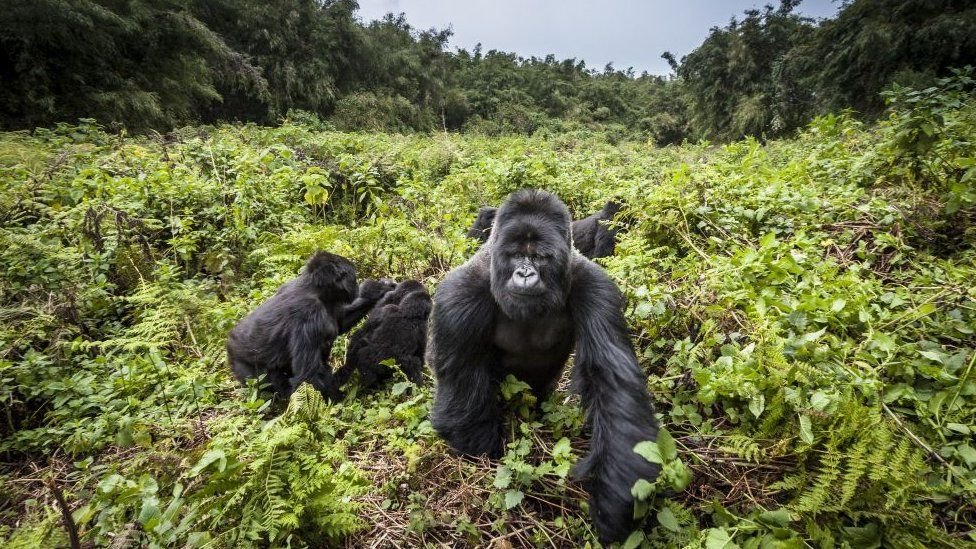
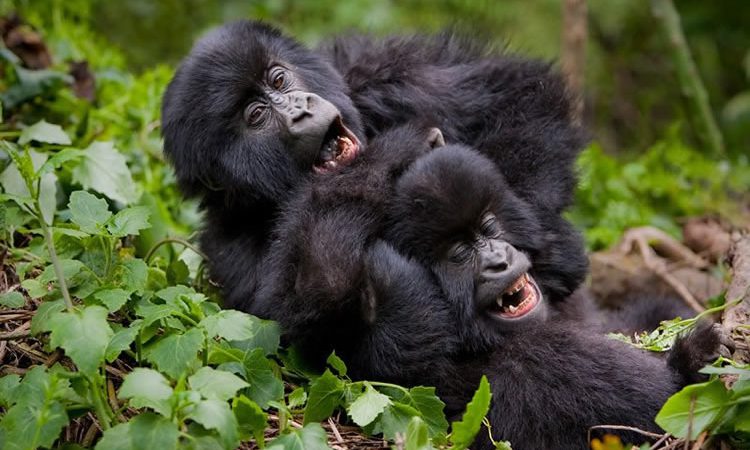
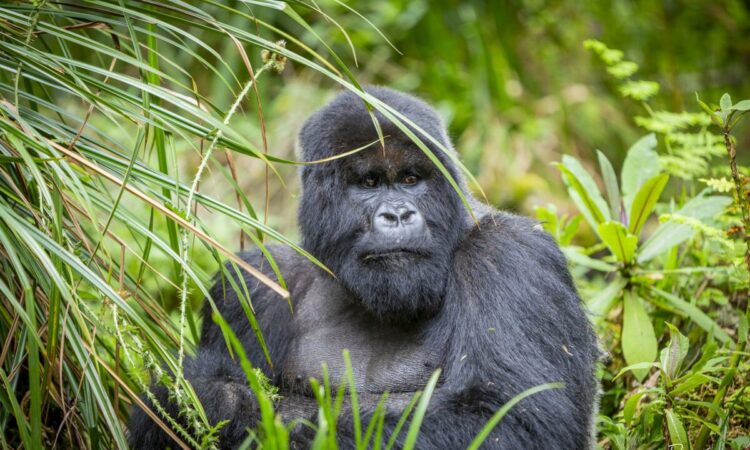
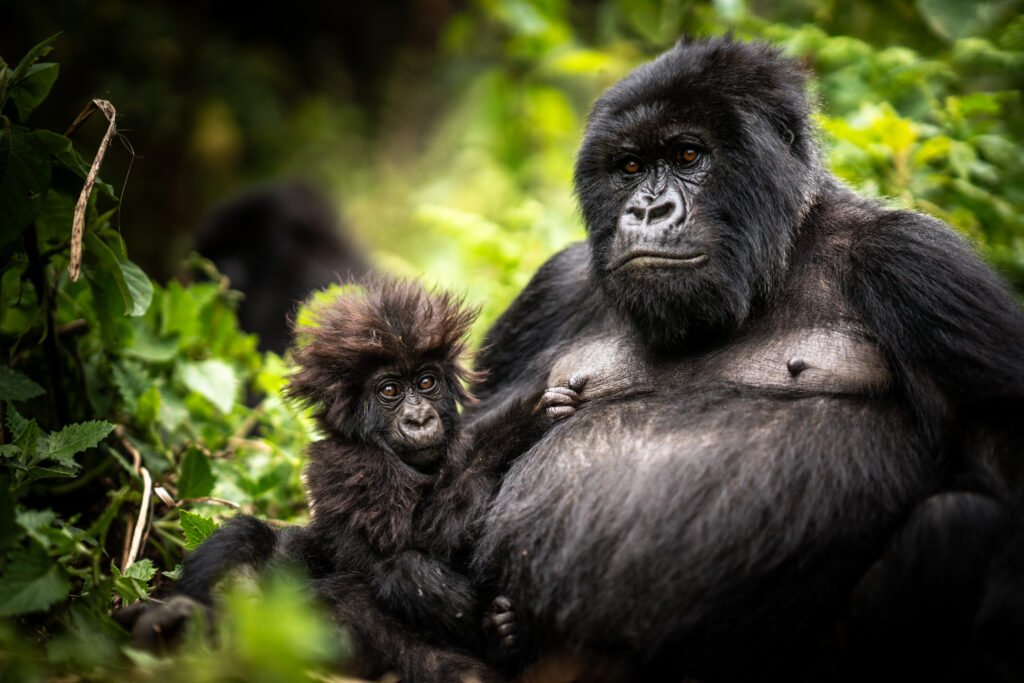
They look slightly different. Mountain gorillas are generally larger and heavier, with longer and thicker fur suited to cold high-altitude forest. Lowland gorillas are generally slightly smaller and leaner, with shorter fur and a more pronounced brow.
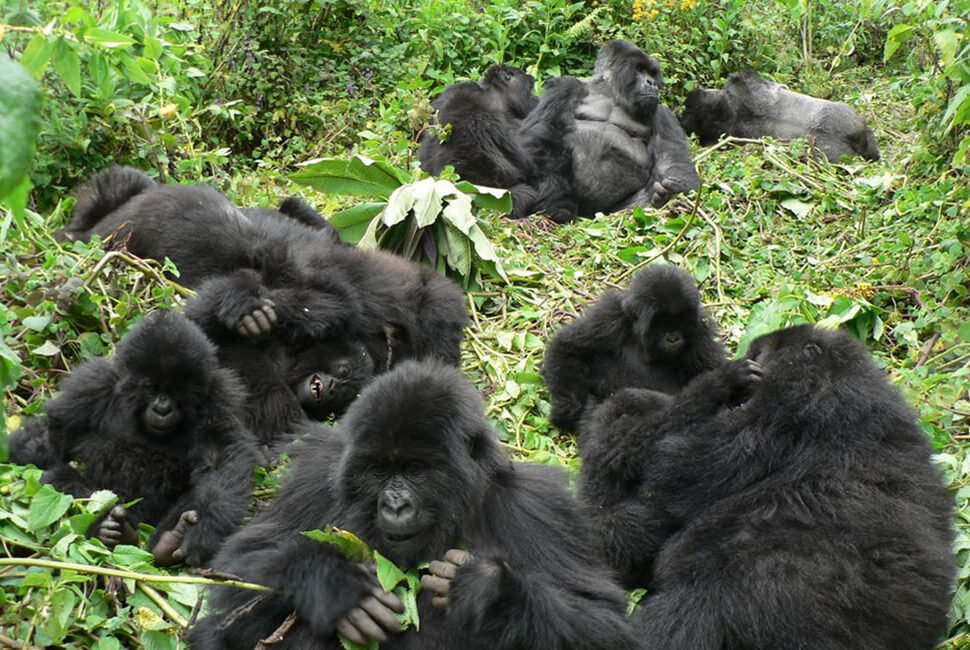
Only mountain gorillas are trekked on a standard safari. The habituated gorilla families that visitors trek in Uganda and Rwanda are mountain gorillas. Lowland gorillas are not part of a typical East Africa trekking itinerary.
What a Mountain Gorilla Is
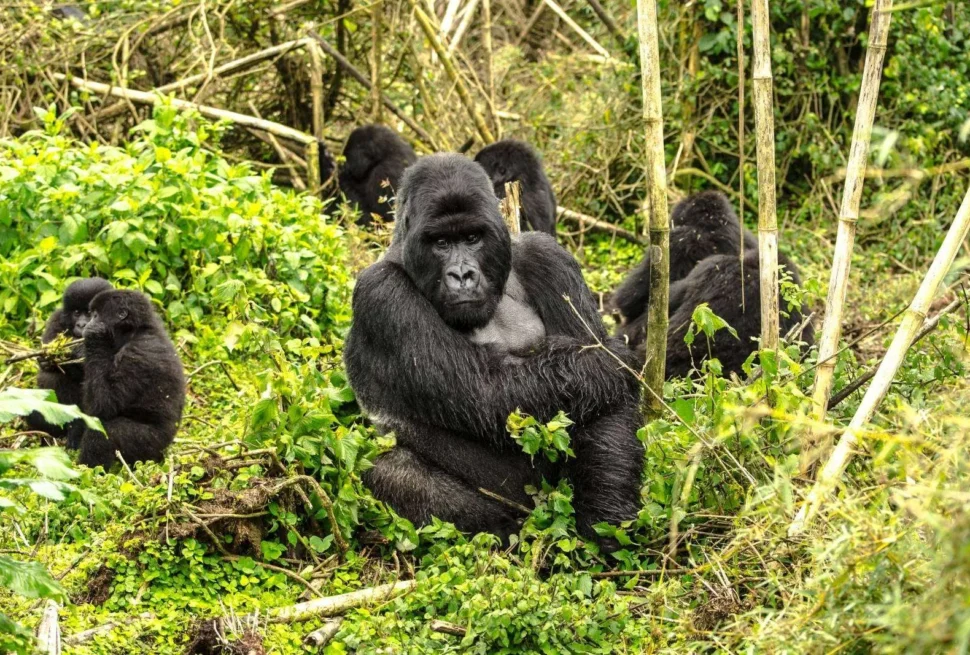
The mountain gorilla is a subspecies of the eastern gorilla, and the global population is around 1,000 individuals. It is confined to two areas.
The Virunga volcanoes. A chain of volcanoes spanning the borders of Rwanda, Uganda and the Democratic Republic of Congo. Volcanoes National Park in Rwanda, Mgahinga Gorilla National Park in Uganda and Virunga National Park in DR Congo all sit within this range.
Bwindi Impenetrable National Park. A separate forest in south-west Uganda, distinct from the Virunga population and home to a substantial share of the world’s mountain gorillas.
Mountain gorillas are not found in Kenya or Tanzania. Any itinerary promising gorilla trekking in either country is wrong on the geography.
Mountain gorillas live at high altitude, in afro-montane forest, and the habitat is cool, wet and often misty. The forest is dense and the ground is steep. This is the environment the trekking articles describe, and it is the environment that shaped the animal’s fur, size and diet.
What a Lowland Gorilla Is
Lowland gorillas are the gorillas of the lowland tropical forests of central and western Africa. The term covers two distinct animals.
The western lowland gorilla
The western lowland gorilla lives in the forests of the Congo Basin and in parts of west-central Africa, across several countries. It is the most numerous gorilla subspecies and the one most commonly seen in zoos — which is why many people’s mental image of a gorilla is actually a western lowland gorilla rather than the mountain gorilla they may later trek to see.
Its habitat is lowland tropical forest, warmer and lower than the mountain gorilla’s afro-montane forest. The diet reflects that: western lowland gorillas eat more fruit than mountain gorillas, because fruit is more available in lowland forest.
The eastern lowland gorilla (Grauer’s gorilla)
The eastern lowland gorilla, also called Grauer’s gorilla, lives in the eastern Democratic Republic of Congo. It is the largest of the gorilla subspecies, and it lives in lowland and transitional forest in a region that has experienced significant instability.
Grauer’s gorilla is not a tourism animal. Access to its range is limited and the security situation in eastern DR Congo is not suitable for conventional gorilla tourism. It is a conservation concern rather than a safari destination.
The Differences Side by Side
| Feature | Mountain gorilla | Lowland gorilla |
|---|---|---|
| Subspecies | Subspecies of the eastern gorilla | Two subspecies: western lowland gorilla and eastern lowland (Grauer’s) gorilla |
| Where it lives | Virunga volcanoes (Rwanda, Uganda, DR Congo) and Bwindi Impenetrable NP (Uganda) | Central and western African lowland forests; eastern DR Congo for Grauer’s |
| Habitat | High-altitude afro-montane forest — cool, wet, often misty | Lowland tropical forest — warmer, lower, more fruit available |
| Size | Generally larger and heavier | Generally slightly smaller and leaner, though Grauer’s is the largest subspecies |
| Fur | Longer and thicker, suited to cold | Shorter, suited to a warmer climate |
| Diet emphasis | Leaves, shoots, stems and bamboo; less fruit | More fruit, particularly the western lowland gorilla |
| Population | Around 1,000 individuals globally | Larger populations, though declining; figures vary by subspecies and survey |
| Trekking | Habituated families trekked in Uganda and Rwanda | Not part of a standard East Africa trekking itinerary |
Why Mountain Gorillas Look the Way They Do
Several of the visible differences come down to climate and altitude.
The fur. Mountain gorillas live in cold, wet, high-altitude forest, and their longer, thicker fur is an adaptation to it. Lowland gorillas live in a warmer climate and have shorter fur.
The size. Mountain gorillas are generally larger and heavier than western lowland gorillas. The relationship is not absolute — Grauer’s gorilla, an eastern lowland subspecies, is the largest of all — which is a reminder that “mountain vs lowland” is not a single size comparison across every subspecies.
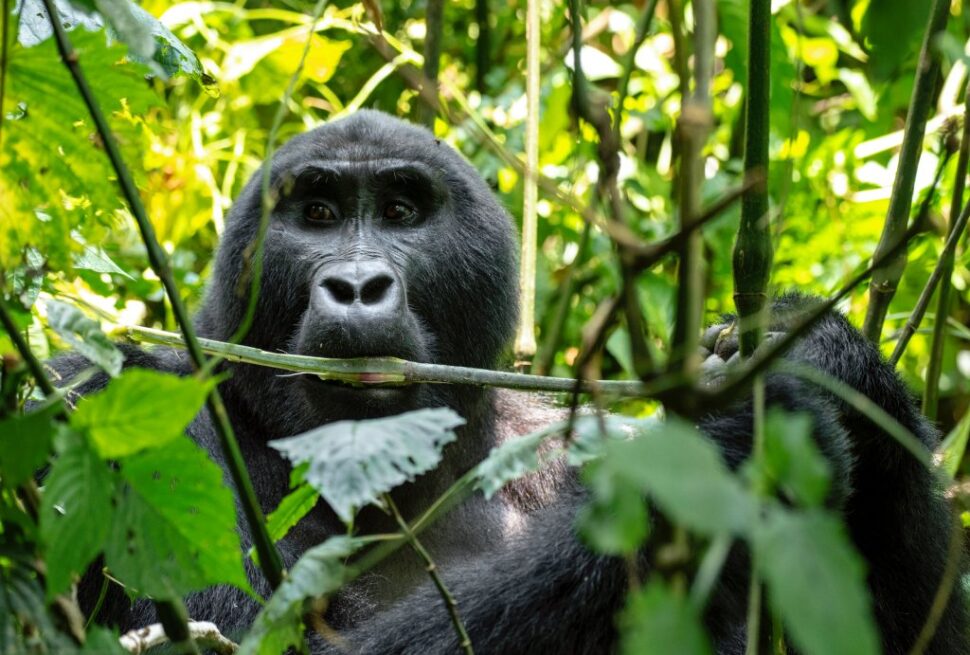
The diet. Mountain gorillas eat a foliage-heavy diet of leaves, shoots, stems and bamboo, with less fruit than their lowland relatives. That is partly a function of what grows at altitude. The mountain gorilla diet is covered in more detail separately.
The overall effect is that a mountain gorilla looks built for cold, wet forest, and a western lowland gorilla looks built for warmer lowland forest. Both are gorillas; neither is a “better” gorilla.
Where Each Can Be Seen
Mountain gorillas
Mountain gorillas can be seen on a trek in three countries: Uganda, Rwanda and the Democratic Republic of Congo. In practice, most international visitors trek in Uganda or Rwanda, because both have established tourism infrastructure, habituated families and permit systems.
In Uganda, trekking takes place in Bwindi Impenetrable National Park and Mgahinga Gorilla National Park. In Rwanda, trekking takes place in Volcanoes National Park. Both are covered in the trekking guides — the Bwindi gorilla trekking page and the Rwanda gorilla trekking guide.
The rule that applies in both countries is the same: a maximum of eight visitors per gorilla family, one hour with the gorillas, and a minimum age of 15. Those are the conditions on which mountain gorilla tourism operates.
Lowland gorillas
Lowland gorillas are not part of a standard East Africa trekking itinerary. Western lowland gorillas live across a wide area of central and western Africa, and seeing them in the wild requires a trip to a different region entirely, with different logistics. Eastern lowland gorillas live in eastern DR Congo, where access is limited and the security situation is not suitable for conventional tourism.
Most people who have seen a lowland gorilla have seen one in a zoo. That is a legitimate way to see the animal, but it is a different experience from a trek — and it is worth being clear which one a photograph shows.
Conservation Status
The two are not in the same position, and the difference is worth stating rather than glossing over.
Mountain gorillas are the conservation success story of the gorilla world, relatively speaking. The population is small — around 1,000 individuals — but it has been stable or growing in recent decades, and the subspecies was reclassified from critically endangered to endangered following the 2018 assessment. That reclassification reflects genuine improvement, and it was achieved through a combination of protected areas, veterinary intervention, tourism revenue and community engagement.
Lowland gorillas are in a more difficult position. The western lowland gorilla is classified as critically endangered, with a large but rapidly declining population affected by hunting, disease and habitat loss. The eastern lowland gorilla (Grauer’s) is also critically endangered and has suffered severe population declines, particularly in areas affected by conflict and mining.
Current IUCN classifications and population estimates are revised periodically, and the figures above should be treated as the position at recent assessments rather than as permanent. Confirm current status through the IUCN Red List if it matters to a specific decision (verify current requirements before travel — rules change).
The practical implication for a traveller is straightforward. Mountain gorilla trekking is a regulated, permit-based activity that contributes to the protection of a small and recovering population. That is part of why the rules exist — eight visitors per family, one hour, no trekking when ill — and part of why the permit costs what it does.
What a Gorilla Trekking Trip Costs
Verified costs are set out below. The permit and visa figures are fixed and confirmed; other elements vary by operator, lodge and itinerary and should be confirmed at the time of booking.
| Element | Where | Price (per person) |
|---|---|---|
| Uganda gorilla permit — standard | Bwindi Impenetrable NP and Mgahinga Gorilla NP | From $800 |
| Uganda gorilla permit — low season | Bwindi and Mgahinga, April, May and November | From $600 |
| Uganda gorilla habituation experience | Rushaga sector, Bwindi only — 4 hours | From $1,500 |
| Rwanda gorilla permit | Volcanoes National Park — no low season discount | $1,500 |
| Uganda e-visa | Applied for at visas.immigration.go.ug before travel | $50 |
| Rwanda e-visa — single entry | Applied for at irembo.gov.rw before travel | $50 |
| East African Tourist Visa | Uganda + Kenya + Rwanda, 90 days multi-entry; does not cover Tanzania | $100 |
| Porter fee | Set locally at the trailhead or park headquarters | Confirm current rate when booking |
| Accommodation near the trailhead | Bwindi, Mgahinga, Kinigi and Musanze | Confirm current rate when booking |
| Chimpanzee trekking permit | Kibale Forest and other forests | Confirm current rate when booking |
Permit and park fees are set by the relevant authorities and revised periodically — the Uganda Wildlife Authority for Uganda and the Rwanda Development Board for Rwanda. Verify current rates before travel.
Frequently Asked Questions
What is the difference between a mountain gorilla and a lowland gorilla?
They are different subspecies living in different habitats. Mountain gorillas live in high-altitude afro-montane forest in Uganda, Rwanda and DR Congo, and are generally larger with longer, thicker fur. Lowland gorillas live in lowland tropical forest across central and western Africa, and are generally slightly smaller with shorter fur and a more fruit-heavy diet.
Are mountain gorillas bigger than lowland gorillas?
Generally yes against the western lowland gorilla, but the comparison is not absolute. The eastern lowland gorilla (Grauer’s) is the largest of all gorilla subspecies. Mountain gorillas are larger and heavier than western lowland gorillas, and their longer fur adds to the impression of size.
Where do lowland gorillas live?
Western lowland gorillas live in the forests of the Congo Basin and parts of west-central Africa, across several countries. Eastern lowland gorillas (Grauer’s) live in eastern DR Congo. Neither is part of a standard East Africa safari itinerary.
Can you trek lowland gorillas?
Not on a standard East Africa itinerary. Mountain gorillas are the subspecies trekked in Uganda and Rwanda, with habituated families and permit systems. Lowland gorillas live in regions with different logistics, and eastern DR Congo is not currently suitable for conventional gorilla tourism.
Why are mountain gorillas called mountain gorillas?
Because of their habitat. They live at high altitude in afro-montane forest in the Virunga volcanoes and Bwindi Impenetrable National Park. The name describes where they live rather than a separate species.
Do lowland gorillas live in zoos?
Western lowland gorillas are the subspecies most commonly seen in zoos, and most people who have seen a gorilla in a zoo have seen a western lowland gorilla. Mountain gorillas are not held in zoos, which is one reason a trek is the only way to see them.
How many mountain gorillas are left?
Around 1,000 individuals globally, confined to the Virunga volcanoes and Bwindi Impenetrable National Park. The population has been stable or growing in recent decades and the subspecies was reclassified from critically endangered to endangered following the 2018 assessment.
Which gorilla species is endangered?
Both groups face serious threats, but the positions differ. Mountain gorillas are classified as endangered following recent improvement. Western lowland gorillas and eastern lowland gorillas (Grauer’s) are both classified as critically endangered, with declining populations. Current classifications should be confirmed through the IUCN Red List.
How to Book
Mountain gorillas are the gorillas that can be trekked, and the permit is the fixed, dated cost that makes the trek possible. Afraeka Adventures is a licensed Ugandan operator based in Entebbe and Kampala, running safaris and primate trekking in Uganda, Rwanda, Kenya and Tanzania since 2018.
Contact Afraeka Adventures at info@afraekaadventures.com or use the enquiry form on our website with your dates, group size and whether you want to trek in Uganda, Rwanda or both. Useful starting points:
- Uganda gorilla trekking — permits, sectors and what the trek involves
- Bwindi gorilla trekking — sectors, trailheads and the forest
- Rwanda gorilla trekking — Volcanoes National Park and the Rwanda permit
- Uganda safari packages — itineraries that include a trek
- Rwanda safaris — itineraries across the country
- Uganda and Rwanda tours — combined itineraries
- East Africa multi-country safaris
- All tour packages
- Enquiry form