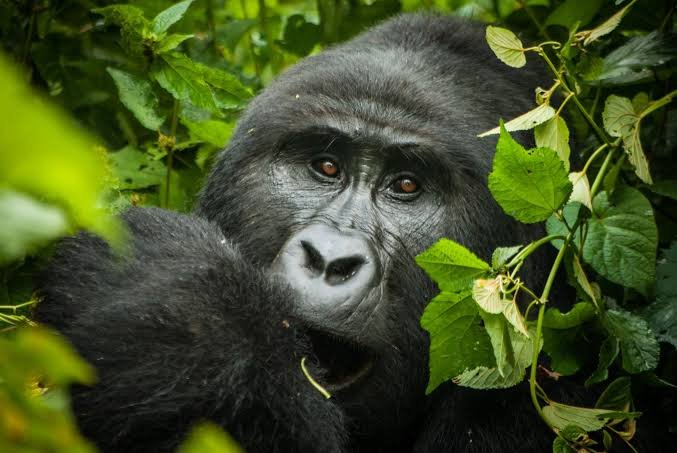
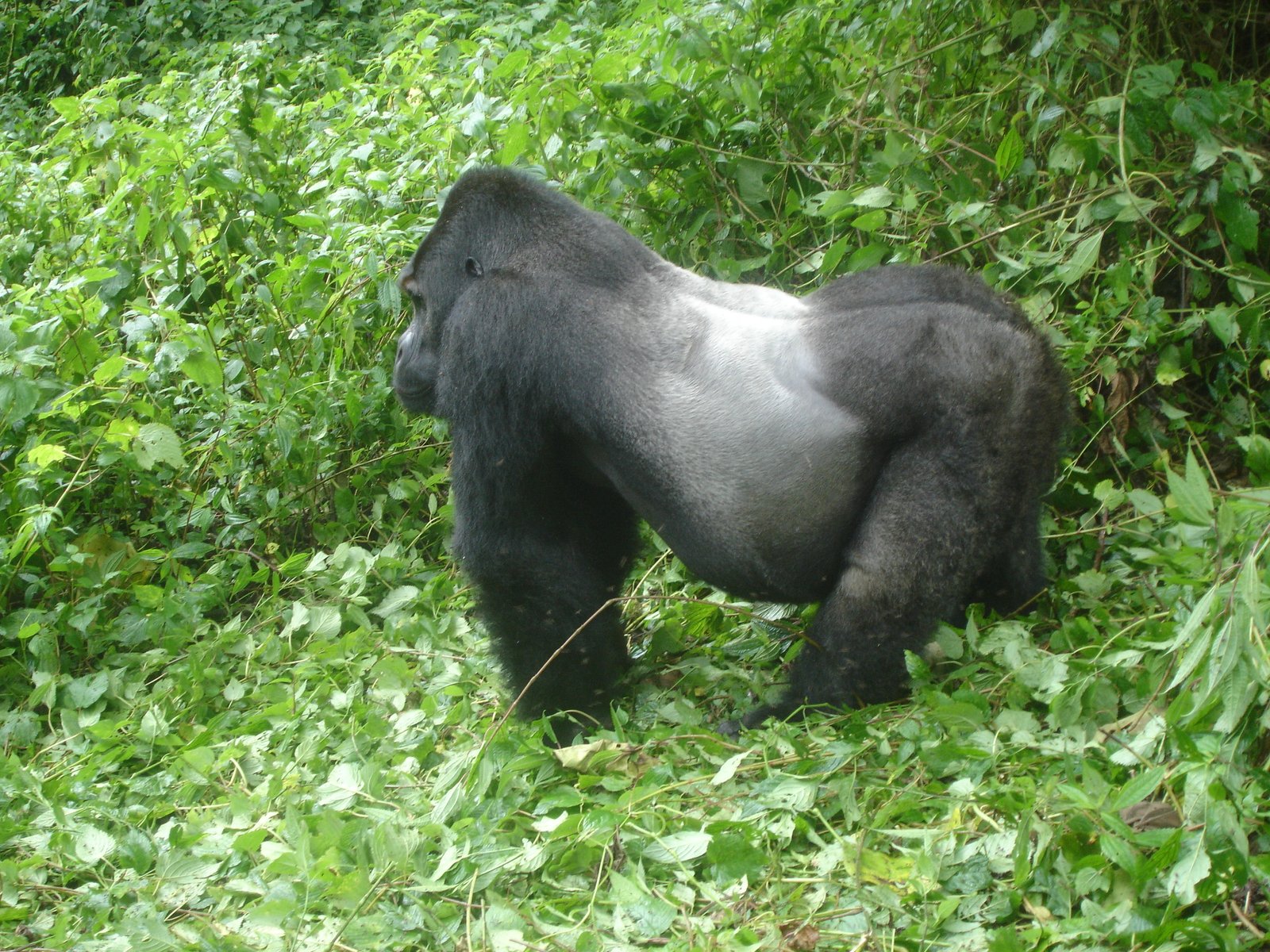
A silverback gorilla is an adult male mountain gorilla who has developed the silver-coloured saddle of hair across his back and taken on the dominant role in a family group. The silver saddle appears in early adulthood rather than at birth, and it marks the transition from a younger male — called a blackback — to a mature male who can lead a group. Most gorilla families that visitors trek have one dominant silverback, and he is the animal the trek rules are largely designed around.
This guide explains what a silverback is, how a male becomes one, what his role in the family involves, and what that means for travellers on a gorilla trek. It does not attempt to answer every question about silverbacks — specific topics like why they beat their chests or exactly how strong they are deserve their own treatment — but it does give enough context to understand the animal you are going to see.
What Is a Silverback Gorilla’s Role in the Family?
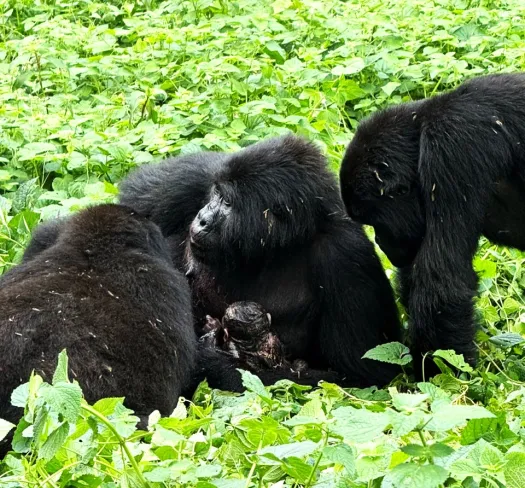
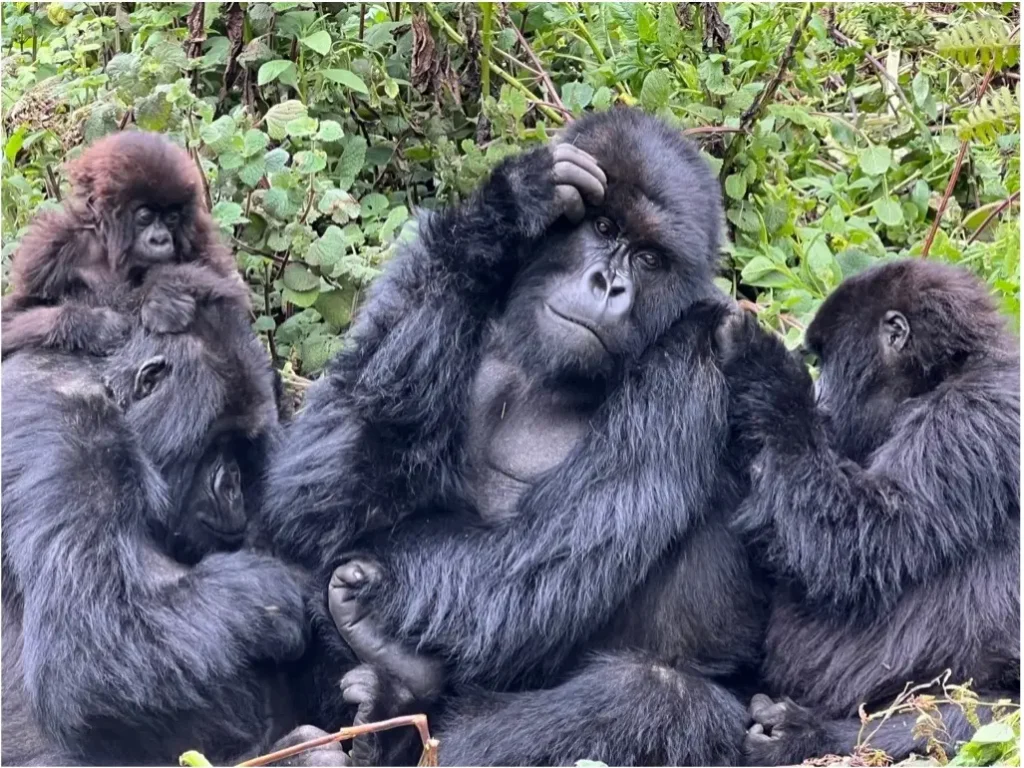
Gorilla families are harems. A dominant silverback leads a group that typically contains several adult females and their offspring, along with younger males who have not yet left to form their own groups. The dominant silverback is the centre of the family, and his role is more than symbolic.
His responsibilities include deciding where the group moves and when it rests, mediating conflict between females, defending the family against threats — including other silverbacks — and mating with the adult females in the group. When visitors spend one hour with a habituated gorilla family, the silverback is often the animal most visible and most consistently present in the encounter, because the rest of the group orient themselves around him.
Many families have one dominant silverback. Some have more than one, in complex arrangements where a younger silverback shares the group with an older one. Family composition changes over time as females transfer between groups, younger males mature and depart, and infants are born. The site’s guide to Rwanda’s gorilla families covers the allocation process and how families differ; this article is about the animal, not the trip.
Silverback vs Blackback: Age and Development
The distinction between a silverback and a blackback is a matter of maturity, not size alone.
A blackback is a younger male who has not yet developed the silver saddle. He may be large and strong, and he may already be capable of challenging for dominance in some circumstances, but he is not yet the mature male who leads a group. The term describes his appearance rather than his age precisely — blackbacks are typically in their late juvenile and sub-adult years.
A silverback has developed the silver saddle, which usually appears in a male’s early teens. The saddle is not a sign of old age — it is a sign of sexual and social maturity. A silverback in his teens is a young dominant male; a silverback in his thirties is an experienced one. Precise age-of-maturity figures vary between populations and sources, and should not be treated as fixed.
The transition is gradual. A male develops the silver saddle over a period of months, and during that transition he may be referred to as a “sub-adult” or “transitioning” male rather than definitively as a blackback or a silverback. The clean binary is useful for explaining the animal to a visitor; the biology is more fluid.
Size, Strength and Behaviour
Adult male mountain gorillas are significantly larger than females — commonly described as roughly twice the weight — and the size difference is part of what makes a silverback the focal animal of a family group. Precise weight and height figures vary between sources and populations and are not worth relying on as specific numbers; what matters for a visitor is the proportionate difference and what it means in practice.
A silverback is a large, powerful animal. The trek rules that govern distance, noise and movement exist because of that — not because gorillas are aggressive, but because a very large wild animal needs a predictable, respectful relationship with the people who come to see him.
Behaviour worth knowing about, without going into detail that belongs in its own article:
- Chest beating is a display behaviour — not a sign of imminent attack, and not exclusively directed at humans. Its precise functions are studied and debated.
- Vocalisations include grunts, roars and a distinctive rumbling sound associated with contentment. The rumbling is one of the most rewarding sounds to hear on a trek because it suggests the family is relaxed.
- Displays can include charging, slapping the ground and vegetation-thrashing. These are almost always bluff charges stopped short, and guides are experienced at reading them.
- Grooming and resting are the most common activities visitors see. The encounter is often quieter than people expect.
Strength, chest-beating mechanics and display behaviour each deserve their own detail. This article deliberately does not try to cover them fully — the focus here is on understanding what a silverback is and how to behave around one.
What to Expect When You See One on a Trek
Visitors on a gorilla trek in Rwanda’s Volcanoes National Park or Uganda’s Bwindi Impenetrable and Mgahinga Gorilla National Parks typically spend one hour with a habituated family. The silverback is usually present, often central, and often the animal visitors are most aware of — both because of his size and because the guides and trackers orient their positioning around him.
Several practical points follow from that.
Distance is set by the guides, not the visitor. The trek rules require a respectful distance from the family, and the guides manage positioning throughout the hour. The distance is often greater than the photographs suggest. It is not a close-encounter experience in the way marketing imagery implies.
Behaviour follows the silverback’s cues. If the silverback is feeding calmly, the family is relaxed. If he becomes alert or begins a display, the guides will signal for the group to hold position or withdraw slightly. Visitors who follow these signals without debate are safe and see more.
No sudden movements, no loud noises, no eating or drinking in the family’s presence. These rules exist primarily to protect the gorillas — human illness can be devastating to a population with no immunity — and secondarily to keep the encounter calm.
Do not trek when unwell. This is the single most important rule and it is treated seriously. It is a conservation measure above all else.
The minimum age is 15, without exception. It is a condition of the permit.
For context on the trekking day itself — the briefing, the walk in, the format of the hour — the Uganda gorilla trekking guide and the Rwanda gorilla trekking guide cover the practicalities.
What It Costs
Permit prices are published and fixed; accommodation, transfers and park fees vary. The table below separates the two.
| Element | Where | Price (per person) |
|---|---|---|
| Gorilla trekking permit — Uganda | Bwindi Impenetrable NP and Mgahinga Gorilla NP | From $800 (From $600 in April, May and November) |
| Gorilla habituation experience — Uganda | Rushaga sector, Bwindi only | From $1,500 |
| Gorilla trekking permit — Rwanda | Volcanoes National Park | From $1,500 (no low-season discount) |
| Uganda e-visa | Applied for at visas.immigration.go.ug | $50 |
| Rwanda e-visa | Applied for at irembo.gov.rw | $50 single entry / $70 multiple entry |
| East African Tourist Visa | Uganda + Kenya + Rwanda | $100 (90 days, multi-entry) |
| Accommodation, transfers, park fees | All parks | Confirm current rates when booking |
Permit prices and visa fees are set by the respective authorities and revised periodically — verify current rates before travel. Official sources are the Uganda Wildlife Authority and the Rwanda Development Board.
One clarification worth repeating because it circulates widely: the Uganda–Russia visa waiver announced in October 2026 covers diplomatic and service passports only. It does not apply to ordinary tourist passports and has not yet entered into force.
Frequently Asked Questions
What is a silverback gorilla?
An adult male mountain gorilla that has developed the silver-coloured saddle of hair across his back and taken on the dominant role in a family group. The saddle usually appears in a male’s early teens, and silverbacks lead groups containing adult females and their offspring.
How does a gorilla become a silverback?
Through maturity, not through a specific event. A male develops the silver saddle in his early teens as he reaches sexual and social maturity. He becomes a dominant silverback by leading a family group, either by attracting females from other groups or by taking over an existing family.
Is a silverback the same as an alpha male?
Effectively yes. A silverback is the dominant male of his group. “Silverback” is a descriptive term based on appearance and maturity; “alpha” is a term borrowed from wolf research. The practical meaning is the same — the leading male — and “silverback” is the correct term for gorillas.
Can there be more than one silverback in a family?
Yes, some families have more than one silverback, typically a dominant older male and a younger one who has not yet left to form his own group. Family composition changes over time as males mature and depart and as females transfer between groups.
How big is a silverback gorilla?
Adult male mountain gorillas are significantly larger than females — commonly described as roughly twice the weight. Precise figures vary between sources and populations and should not be relied on as fixed numbers. What matters for a visitor is the proportionate size difference and the distance rules that follow from it.
Is it safe to be close to a silverback on a trek?
Yes, when the rules are followed. The guides manage distance, movement and the encounter. Silverbacks are wild animals, which is exactly why the rules exist, but habituated silverbacks are used to the controlled presence of small groups of visitors and do not treat them as threats when guidelines are observed.
What should I do if a silverback charges?
Follow the guides’ instructions immediately and without debate. Silverback charges are almost always bluff displays stopped short, and guides are experienced at reading them. Do not run, do not make loud noises, and do not attempt to film unless the guides confirm it is safe to do so.
Do silverbacks protect the family?
Yes. Defence of the group is one of the dominant silverback’s main responsibilities. This is why the distance rules exist: the silverback treats unfamiliar large animals as potential threats, and visitors are managed so that they do not appear threatening.
How to Book
Understanding what a silverback is matters most on the morning of the trek, when the guides explain the rules and why they exist. The booking process itself follows the standard pattern: secure the permit date first, then accommodation, then flights. Permits are date-specific, capped at eight visitors per gorilla family, and availability is not guaranteed at short notice. Afraeka Adventures is a licensed Ugandan operator based in Entebbe and Kampala, running safaris and primate trekking in Uganda, Rwanda, Kenya and Tanzania since 2018.
Contact Afraeka Adventures at info@afraekaadventures.com or use the enquiry form on our website with your dates and group size. Useful starting points:
- Uganda gorilla trekking — the main trekking guide
- Rwanda gorilla trekking — the Rwandan product
- Rwanda gorilla trekking permit booking — securing the permit date
- Rwanda gorilla trekking accommodation — where to base yourself
- Rwanda safaris — the wider picture
- All tour packages
- Enquiry form